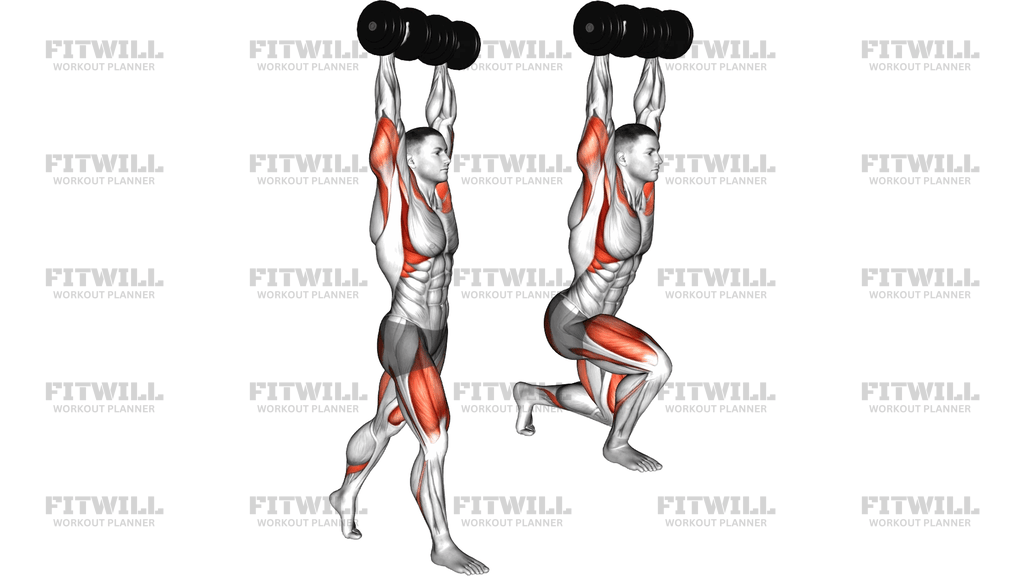
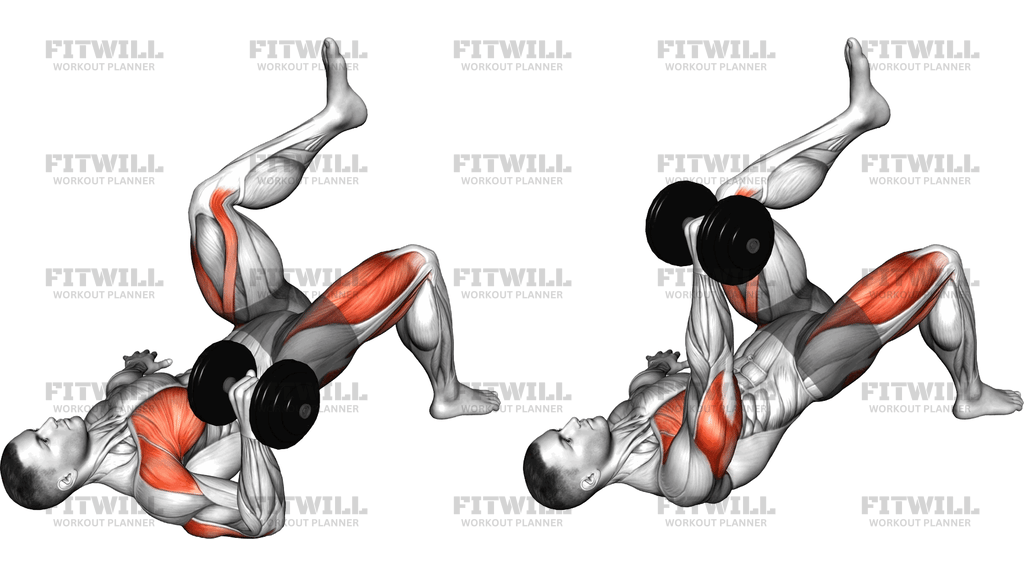
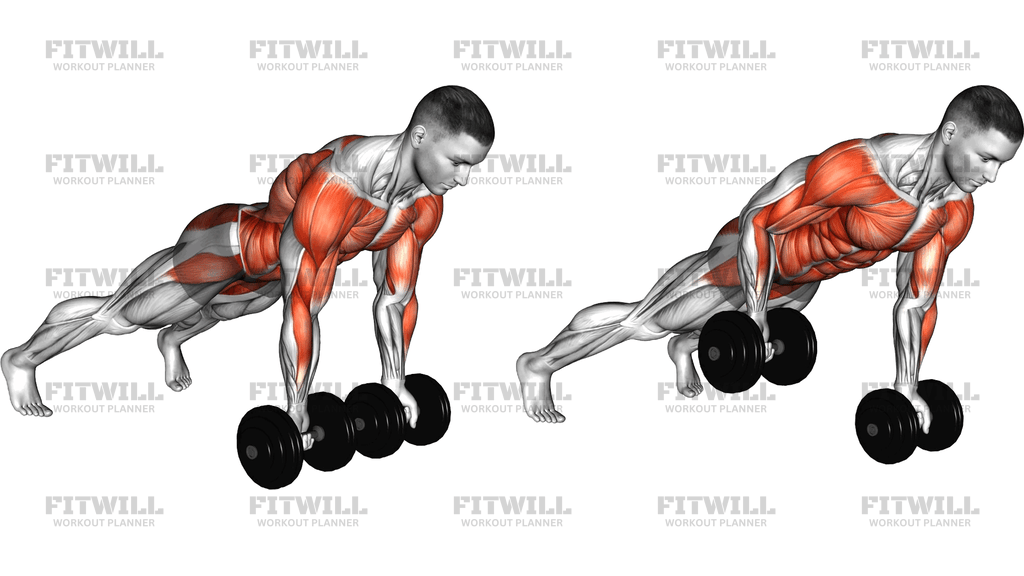
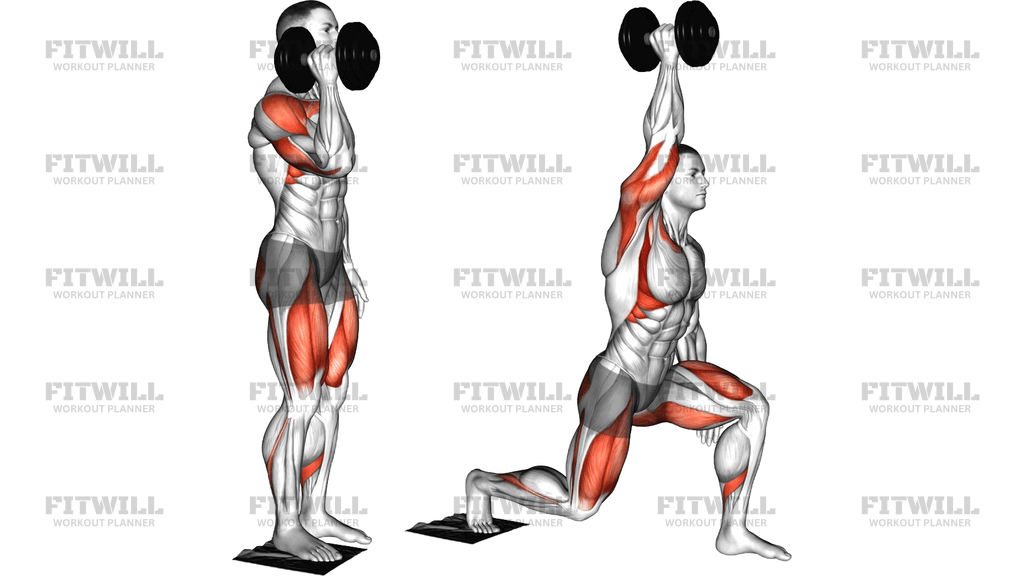
Dumbbell Turkish Get Up (Squat Style)
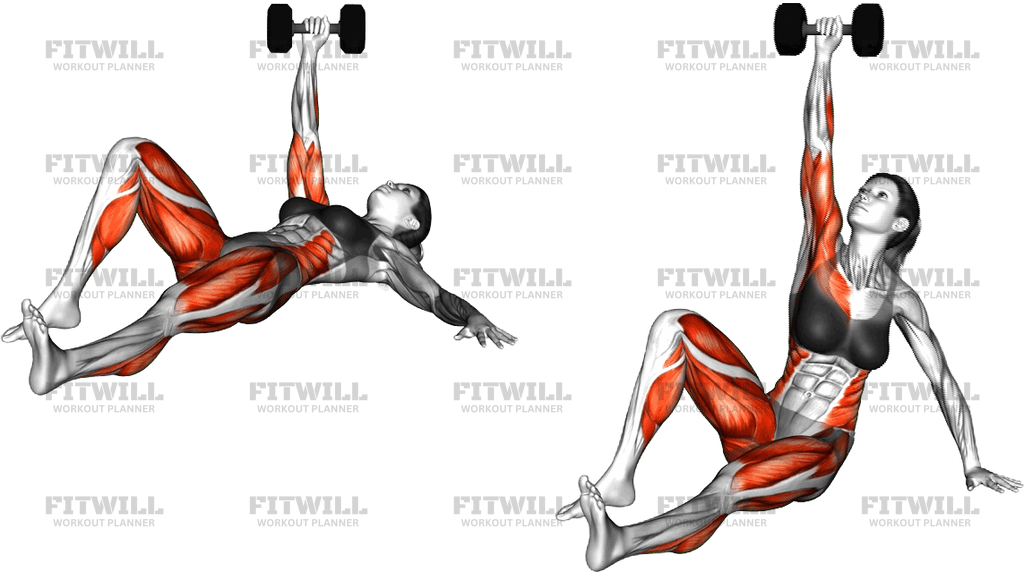
The Dumbbell Turkish Get Up (Squat Style) is a full-body movement that takes you from lying on the floor to standing with a dumbbell held overhead, then reverses the process back down. Unlike the traditional lunge-style get up, this version brings both feet together under your hips at the top half, so you rise through a squat instead of stepping forward into a split stance. The image shows the opening phase clearly: you start on your back with the dumbbell pressed toward the ceiling in one hand, opposite arm reaching out on the floor, and one knee bent to drive the initial roll up.
This exercise trains the whole body as one connected system. Your deep core and obliques work to roll and rotate your torso off the floor, your shoulders and upper traps hold the weight steady overhead, and your glutes, quads, and hamstrings handle the squat stand and the controlled descent. Because the weight stays locked out over your shoulder the entire time, every position also challenges shoulder stability and thoracic control in a way that presses and carries cannot.
The setup matters more here than in most exercises. If the dumbbell is not stacked directly over your shoulder and wrist at the start, or if your bent leg and opposite arm are not placed to support the roll-up, the rest of the movement falls apart and the load starts drifting where it should not go. Take a few seconds before each rep to set your position, and keep your eyes on the dumbbell throughout.
The Dumbbell Turkish Get Up (Squat Style) suits lifters who want stronger shoulders and a more resilient core, grapplers and field athletes who need floor-to-standing strength, and anyone rebuilding confidence after time away from overhead work. It is usually done for low reps, one to three per side, because the quality of each rep matters far more than volume.
Safety comes down to two habits: never let the dumbbell drift behind your shoulder line, and never rush the transition from lying to sitting. If you cannot keep the arm vertical and your torso organized, drop the weight a size. Practice the movement in stages, starting with the roll to the elbow, before stringing the full get up together.
Fitwill
Log Workouts, Track Progress & Build Strength.
Achieve more with Fitwill: explore over 9600 exercises with images and videos, access built-in and custom workouts, perfect for both gym and home sessions, and see real results.
Start your journey. Download today!




Instructions
- Lie on your back on the floor with your legs extended and a dumbbell on the floor beside your right shoulder area.
- Roll slightly toward the dumbbell, grip the handle with your right hand, and press it straight up until your arm is locked out over your chest. Bend your right knee and place that foot flat on the floor close to your hips.
- Reach your left arm out to the side at roughly 45 degrees with the palm down, and turn your left leg so the foot rests on the floor. Brace your core and keep your eyes on the dumbbell.
- Drive through your right foot and push through your left elbow to roll up onto your forearm, then press up to a seated position with the dumbbell still vertical.
- From the seated position, lift your hips off the floor, slide your left leg back under your body, and rise up so both feet are under your hips in a low squat, with the dumbbell locked out overhead.
- Stand all the way up by driving through your heels, keeping the dumbbell stacked over your shoulder and your wrist straight.
- Pause at the top, then reverse every step: squat down, place your left hand on the floor, sit your hips back to the ground, lower to your forearm, and roll back flat with the dumbbell still pressed up.
- Exhale as you come up through the transitions and inhale as you lower; keep breathing steadily rather than holding your breath through the whole rep.
- Lower the dumbbell with both hands to your chest, then set it on the floor beside you before switching sides.
- Complete all reps on one side, then repeat on the other, resetting your setup fully between reps.
Tips & Tricks
- Keep the dumbbell stacked directly over your shoulder joint at every stage. If it starts drifting forward or behind you, stop and reposition rather than muscling the arm back into place.
- Most people fail at the transition from elbow to hand. If you collapse there, exaggerate the push through your posted hand and think about pulling your body around your supporting arm instead of lifting straight up.
- For the squat-style stand, bring your feet close together under your hips before standing. A wide or uneven stance at this point turns the rep into a lunge and defeats the purpose of this variation.
- Keep the heel of your working hand's foot planted through the hip lift. Lifting onto the toes here is the most common reason people lose balance while sliding the leg back.
- Grip the dumbbell handle firmly but keep your wrist neutral. A bent-back wrist with a heavy dumbbell is the fastest route to a shaky lockout.
- Do not look away from the dumbbell until you are fully standing. Your eyes drive your head position, and dropping your gaze early tends to pull the weight off line.
- Start with a light dumbbell, even a 5-10 lb one, until the hip lift and leg-sweep portion feels smooth. The get up punishes ego lifting more than almost any other floor exercise.
- If your shoulder feels unstable at lockout, hold the top position for two to three seconds each rep and skip adding load until the weight feels quiet overhead.
- Do the movement barefoot or in flat shoes. Thick, soft soles make the floor contact and squat stand noticeably harder to balance.
- Slow the descent down more than the ascent. Reversing the get up with control is where much of the core and hip strength is actually built.
Frequently Asked Questions
Which muscles does the Dumbbell Turkish Get Up (Squat Style) work the most?
It targets your deep core and obliques through the rolling and rotating transitions, your glutes, quads, and hamstrings during the squat stand, and your shoulders and upper traps as they stabilize the dumbbell overhead. No single muscle dominates; the value comes from all of them working together.
How is the squat style different from the regular Turkish Get Up?
In the traditional version you stand up by stepping forward into a lunge. In the squat style, you sweep your back leg through so both feet are side by side under your hips, then stand through a squat, which places more demand on your legs and hip mobility.
Can beginners do the Dumbbell Turkish Get Up (Squat Style)?
Yes, but start with no weight or a very light dumbbell and learn the movement in stages: roll to elbow, then to hand, then to the squat stand. Once each piece feels controlled, link them into a full rep.
Why do I keep losing the dumbbell overhead when I sit up from the floor?
This usually means the weight is drifting behind your shoulder line or you are lifting your head and looking away from the dumbbell. Keep your arm vertical over your shoulder and your eyes locked on the handle until you are standing.
How heavy should the dumbbell be?
Choose a weight you could comfortably press overhead several times and hold steady for 30 seconds. Most people progress much faster starting lighter and owning each position than by grinding heavy, sloppy reps.
How many reps should I do?
One to three slow reps per side is typical, either as a warm-up primer or as its own strength finisher. Treat each rep as a sequence of positions rather than a race to standing.
What can I use instead of a dumbbell for the Dumbbell Turkish Get Up (Squat Style)?
A kettlebell works well because the handle keeps the weight centered over your wrist, and a water bottle or shoe makes a good zero-load option while learning. The movement pattern stays identical regardless of the object.
My lower back arches when I lift my hips off the floor. Is that a problem?
Yes, excessive arching means your hips are sagging and your core has switched off. Squeeze your glutes, keep your ribs down, and lift your hips just high enough to sweep the leg through cleanly.
Should I do the Dumbbell Turkish Get Up (Squat Style) before or after my main lifts?
It works well as a warm-up drill with light weight to wake up your shoulders and core, or as a finisher with a moderate load. Avoid doing heavy get ups right before pressing work, since fatigued shoulder stabilizers can affect your pressing control.