Kneeling Pike Push Up (On Bench)
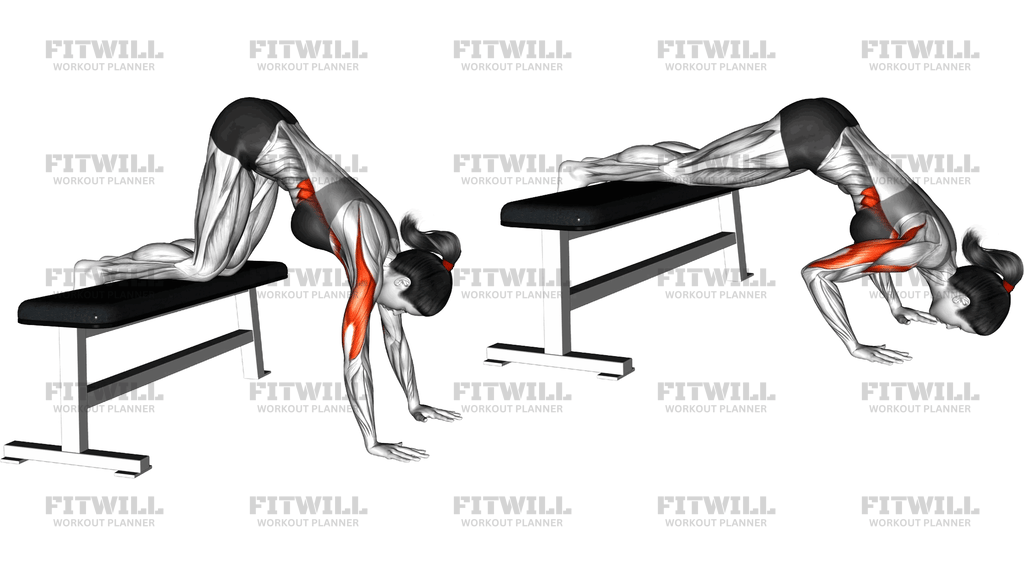
The Kneeling Pike Push Up (On Bench) is a vertical pressing exercise that uses a flat bench to support your knees while your hands stay on the floor. You set up in an inverted V, with hips stacked high over your shoulders, then bend your elbows to lower the crown of your head toward your hands and press back up. Because your knees rest on the bench rather than your feet being on the ground, a large share of your body weight is shifted onto your shoulders and arms while removing the balance and hamstring flexibility demands of a standing pike position.
This movement sits in a useful spot on the difficulty ladder. It is harder than a knee push up on the floor and noticeably harder than a standard pike push up with feet on the ground, because elevating the knees loads more weight through the upper body and steepens the pressing angle. At the same time, the bench under your knees makes the setup far more stable than a wall-facing handstand progression, so you can focus on the pressing pattern itself. It is a common stepping stone for anyone working toward wall handstand push ups, and it also stands on its own as a shoulder-dominant push exercise for calisthenics-style training.
The main work comes from the front and side portions of the shoulders, with the triceps extending the elbows on every rep. The upper traps and the muscles that anchor the shoulder blades work hard to keep your torso from collapsing between your arms, and your core stays engaged to hold the pike line. Compared with a push up, the elbow path is more vertical, which is exactly what makes it carry over to overhead pressing and handstand pushing.
Setup details matter more here than in most floor push up variations. Hand placement on the floor should be slightly wider than shoulder width and far enough in front of the bench that your head can descend between your hands without hitting the bench or your knees swinging forward. A standard flat bench height works well; if your hamstrings limit how high your hips can ride, a lower bench or a step platform gives you a similar angle with less strain.
To perform it well, keep your hips lifted throughout the entire rep rather than letting them drift forward as you descend. Think of moving your head and shoulders down and slightly back in a small arc, elbows traveling at roughly 45 degrees to your torso rather than flaring straight out to the sides. Press until your arms are straight again without locking them hard, and keep your neck relaxed so the top of your head leads the descent instead of your chin.
Because the shoulders are loaded in a flexed position under a meaningful fraction of body weight, progress conservatively. Start with a partial range, add depth as your pressing strength and overhead mobility improve, and stop any set before your shoulder position degrades. If you feel pinching at the front of the shoulder or your lower back starts to sag, reduce the range or drop back to a feet-on-the-floor pike push up until the pattern feels solid.
[ Workout Log & Planner ]
Put your next workout in Fitwill
Keep your plan and training log ready when you are.


Instructions
- Place a flat bench on a non-slip surface and position it so you have clear floor space in front of it for your hands.
- Kneel onto the bench with both shins or knees resting on the pad, then walk your hands forward until they are planted on the floor slightly wider than shoulder width, well ahead of the bench.
- Lift your hips so your body forms an inverted V, with knees on the bench, arms nearly straight, and shoulders stacked close to a vertical line over your wrists.
- Turn your hands out slightly, spread your fingers, and press the floor away so your shoulder blades are not sagging toward each other.
- Brace your core and squeeze your legs lightly to hold the pike position before descending.
- Bend your elbows and lower the top of your head toward the floor between your hands, keeping your hips high and your elbows tracking at about 45 degrees to your torso.
- Descend until your head is close to the floor or your elbows reach roughly 90 degrees, whichever you can control without losing the pike line.
- Press through your palms to straighten your arms and return to the starting inverted V, exhaling as you push up.
- Inhale on the way down and exhale on the press, keeping the rhythm steady from rep to rep.
- Complete your set, then carefully lift your hands one at a time or step off the bench to reset.
Tips & Tricks
- The most common fault is the hips drifting forward over the bench as you lower, which turns the rep into a bent-knee push up. Cue yourself to push the bench away with your knees and keep a straight line from wrists to hips.
- If your head descends past your hands toward the bench frame, your hands are too close to the bench. Walk them a few inches forward so the head lands in clear floor space.
- Flaring the elbows straight out to the sides puts the shoulders in a vulnerable position at the bottom. Keep them angled toward your ribs and let the triceps do more of the lockout.
- Shrugging your shoulders up toward your ears as you fatigue is a sign the traps are taking over. Reset with an active push into the floor between reps.
- If your wrists ache, use push up handles or a slight fist position on the floor to keep them closer to neutral instead of fully extended.
- Cut the set short if your lower back starts to arch or your hips drop; the pike line is the whole point of the exercise, and losing it changes the load to your spine and chest.
- To progress, lower the target depth gradually rather than jumping to full head-to-floor reps, or move to a slightly higher bench once you own the current range.
- Warm up your shoulders with wall slides or arm circles first, since the top position loads the shoulders near end-range flexion.
- Keep your neck long and look at a spot between your hands or slightly behind them; tucking the chin hard rounds the upper back and shortens the pressing path.
Frequently Asked Questions
What muscles does the Kneeling Pike Push Up (On Bench) work?
The front and side shoulders do most of the pressing, with the triceps extending the elbows. The upper traps, shoulder blade stabilizers, and core work to hold the pike position throughout the rep.
Why put the knees on a bench instead of doing a pike push up on the floor?
Elevating the knees shifts more body weight onto the shoulders and arms and steepens the pressing angle, making the exercise harder and closer to a handstand push up. The bench also supports the knees so you do not need standing pike flexibility or balance.
Is the Kneeling Pike Push Up (On Bench) suitable for beginners?
It is an intermediate variation. If you cannot yet do 10-15 solid floor pike push ups, start there first. Beginners can use a lower bench or step platform to reduce the load while learning the pattern.
How far should I lower my head in this exercise?
Lower only as far as you can keep your hips high and elbows at a comfortable angle, ideally until your elbows reach about 90 degrees or your head nears the floor. Depth can increase over time as your strength and overhead mobility improve.
My hips keep dropping toward the bench during reps. How do I fix that?
This usually happens when the shoulders or core fatigue, so end the set earlier. Between reps, actively push the floor away and squeeze your legs to lift the hips back into the inverted V before descending again.
Can the Kneeling Pike Push Up (On Bench) help me get a handstand push up?
Yes, it builds the vertical pressing strength and overhead control the handstand push up requires, while the bench removes balance demands. From here you would typically progress to wall-supported pike push ups with feet elevated higher.
What can I use if I do not have a bench?
A sturdy chair, a step platform, or the edge of a plyo box can substitute, as long as it will not slide and is at a similar height. A lower surface simply makes the exercise slightly easier.
Is it normal to feel this in my wrists?
Some wrist extension load is expected since your palms stay flat on the floor, but sharp pain is not. Try push up handles for a neutral wrist, shift a little more weight toward the heel of your palm, and warm up the wrists before training.
How should I breathe during the Kneeling Pike Push Up (On Bench)?
Inhale as you lower your head toward the floor and exhale as you press back up to the starting position. Keep the breathing smooth so you do not hold your air and lose tension in the pike.
How many reps and sets should I do?
Three to four sets of 5-10 controlled reps is a practical range, stopping before your hip position breaks down. Since the shoulders are loaded near end range, favor clean reps over chasing fatigue.