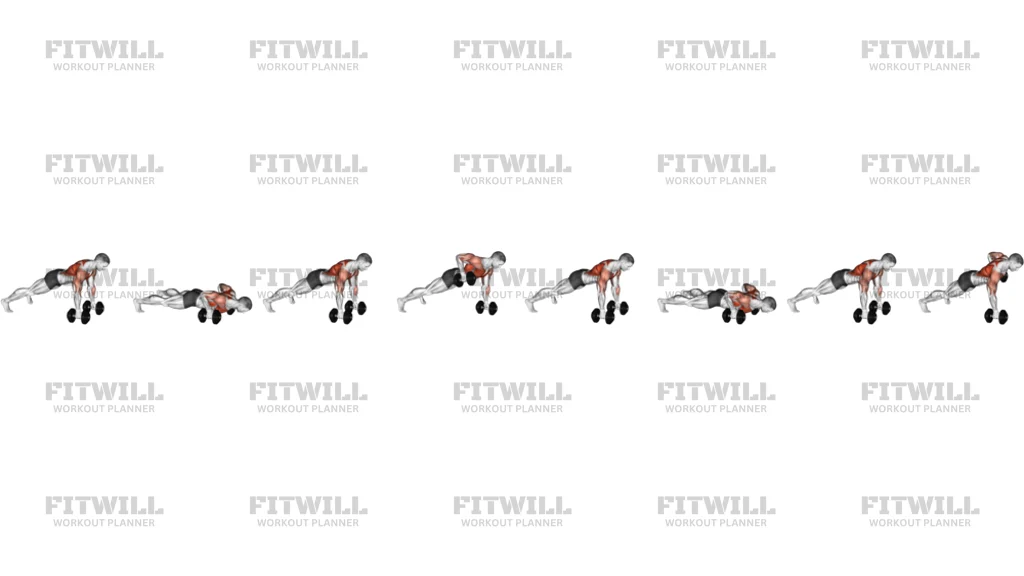
Dumbbell Single Arm Row (Bird Dog Stance On Bench)
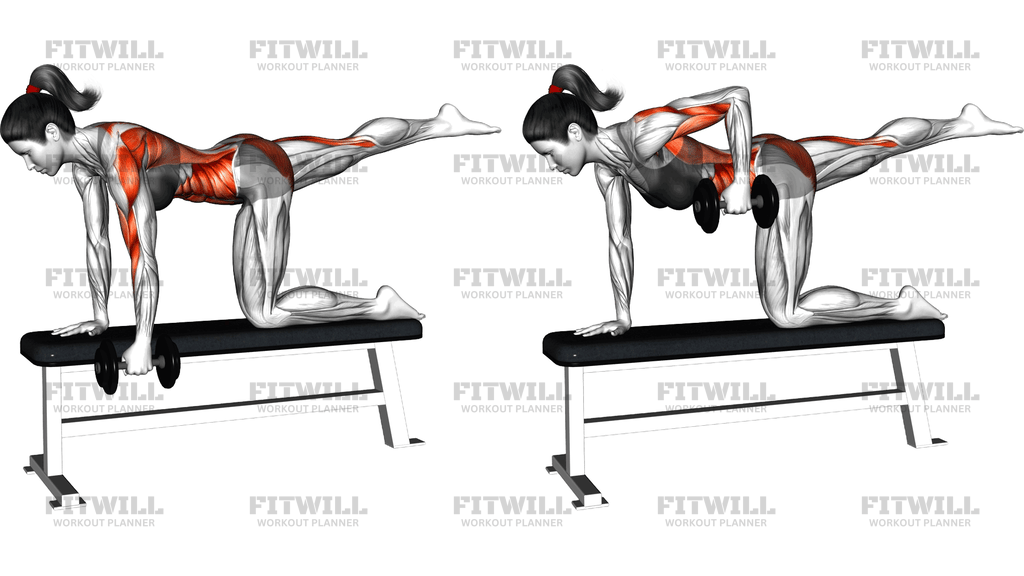
The Dumbbell Single Arm Row (Bird Dog Stance On Bench) is a unilateral row performed from an unstable, three-point support position. Instead of kneeling on the bench with both knees or standing beside it, you place one hand and one knee on the bench while extending your opposite leg straight behind you, holding the bench in a bird dog position. The free hand grips a dumbbell and rows it up toward your hip while your raised leg and braced trunk fight to keep your torso square.
This setup makes the movement far more demanding on stability than a standard single arm row. With only one knee and one hand anchored, your core, glutes, and spinal stabilizers have to work continuously to stop your hips from rotating toward the working side. The row itself targets the lats, rhomboids, and mid-traps, while the biceps and forearm muscles assist through the pull.
The bird dog stance is especially useful for lifters who already own a solid traditional single arm row and want a progression that challenges anti-rotation control. It is also a good fit for people training at home or in a busy gym, since it needs only a bench and one dumbbell. Because the extended leg loads the glutes and hamstrings isometrically, you get a meaningful trunk and hip stability stimulus alongside the upper back work.
Setup details matter here more than in most rows. Your hand should sit directly under your shoulder, the bench height should let your extended leg reach roughly parallel to the floor, and your torso should stay close to horizontal. If the bench is too high or the hand placement drifts too far forward, your spine rounds and the row turns into a shoulder shrug.
To execute it well, think of pulling the dumbbell toward your lower hip with your elbow staying close to your ribs, then lowering it under control until your arm is fully extended. Keep the extended leg active by reaching the heel back rather than letting it sag. Expect to use a lighter dumbbell than you would in a standard single arm row; if your torso twists or your hips wobble, the weight is too heavy for the position.
A practical safety note: because your support base narrows to one knee and one hand, mount and dismount the bench carefully and set the dumbbell down before stepping off. If you feel the movement mostly in your lower back rather than your mid back and lats, reduce the load and re-focus on bracing before pulling.
[ Workout Log & Planner ]
Put your next workout in Fitwill
Keep your plan and training log ready when you are.


Instructions
- Place a flat bench in front of you and set a dumbbell on the floor beside it.
- Mount the bench on all fours: position one hand directly under your shoulder on the bench pad and drop your knee on the same side onto the bench so it rests just behind your hip.
- Pick up the dumbbell with your free hand using a neutral grip (palm facing in), then extend your opposite leg straight back so it is roughly level with your torso and your weight is balanced over the bench.
- Brace your abs, squeeze the glute of the extended leg, and lengthen the back of your neck so your head, spine, and rear leg form one long line.
- Start with your arm fully extended toward the floor, letting the dumbbell hang without locking or slinging the shoulder.
- Pull the dumbbell up toward your lower hip, driving your elbow back and keeping it close to your ribs while your torso stays square to the bench.
- At the top, squeeze your shoulder blade back and down toward your spine without shrugging toward your ear.
- Lower the dumbbell under control until your arm is straight again, resisting the pull of the weight as your torso wants to rotate.
- Exhale as you pull, inhale as you lower, and keep the breathing rhythm steady rather than holding your breath.
- Complete all reps on one side, set the dumbbell on the floor, then switch your hand and knee placement and repeat on the other side.
Tips & Tricks
- Choose a dumbbell noticeably lighter than your usual single arm row load; the narrow bird dog base fails long before the lats do.
- The most common fault is torso rotation toward the working arm. If your chest twists off the bench as you pull, drop the weight and think about pressing the supporting hand down harder.
- Keep the extended leg actively reaching toward the back wall. A sagging or dropped leg is usually the first sign your core has disengaged.
- Do not let the dumbbell drift toward your chest or armpit. Pull toward the lower hip so the elbow tracks back and the lats and mid back do the work.
- Avoid snapping the shoulder forward at the bottom of each rep. Lower until the arm is straight but keep tension by holding the shoulder blade in a stable position.
- If your wrist folds backward under the load, wrap your grip more firmly around the handle rather than letting the dumbbell hang in loose fingers.
- Position the working hand directly under the shoulder, not out toward the far end of the bench. A long hand-to-shoulder reach makes the row feel unstable and strains the shoulder.
- On a narrow bench, align the kneeling leg so the shin rests across the pad, not perched on the edge, before you commit to the pull.
- Slow the lowering phase to a two or three count if you cannot feel your back working; most people rush the eccentric and lose the row entirely.
Frequently Asked Questions
Which muscles does the Dumbbell Single Arm Row (Bird Dog Stance On Bench) work?
The primary muscles are the lats, rhomboids, and mid-traps, with the biceps and forearms assisting on the pull. The bird dog stance also places continuous isometric demand on your core, glutes, and lower back stabilizers.
How is this different from a regular single arm row on a bench?
In a standard single arm row, the same-side knee and hand rest on the bench for a wide, stable base. Here, only one knee and one hand are supported while the opposite leg extends back, which forces your trunk to resist rotation much harder.
Should the extended leg in the Dumbbell Single Arm Row (Bird Dog Stance On Bench) stay lifted the whole set?
Yes, keep it extended and level with your torso for the entire set to get the stability benefit. If your leg drops or your hips start twisting, finish the set with a lighter dumbbell or return to a traditional single arm row.
Is this exercise suitable for beginners?
It can be, but most beginners do better learning a standard single arm row first. Once you can keep your torso square and controlled in that version, start the bird dog stance with a very light dumbbell to practice the balance demand.
Why does the bench height matter for this row?
The bench needs to be low enough that your extended leg can reach back roughly level with your torso. A bench that is too tall pushes your hips up, rounds your spine, and shifts stress away from the mid back.
Why do my hips rotate when I pull the dumbbell?
Rotation usually means the load is too heavy for your current anti-rotation strength or your bracing is loose. Squeeze the glute of the extended leg, press the supporting hand firmly into the bench, and reduce the weight until your torso stays square.
Can I substitute another exercise if I do not have a bench?
You can perform the same bird dog stance row from a quadruped position on the floor with your supporting hand flat on the ground, though the range of motion is shorter. A traditional single arm dumbbell row with both knee and hand supported is another fallback.
How heavy should I go on the Dumbbell Single Arm Row (Bird Dog Stance On Bench)?
Pick a weight you can row for your target reps with zero torso twist and a steady extended leg. Since the narrow base limits how much force you can transfer, most lifters need less load here than in a supported row.
Is it safe for my lower back?
When braced properly, the stance actually trains spinal stability, but rounding or twisting under load is what creates risk. Keep your torso near horizontal, move only at the shoulder and elbow, and stop if you feel strain rather than muscular work in your lower back.