Dumbbell Deep Push-Up And Renegade Row
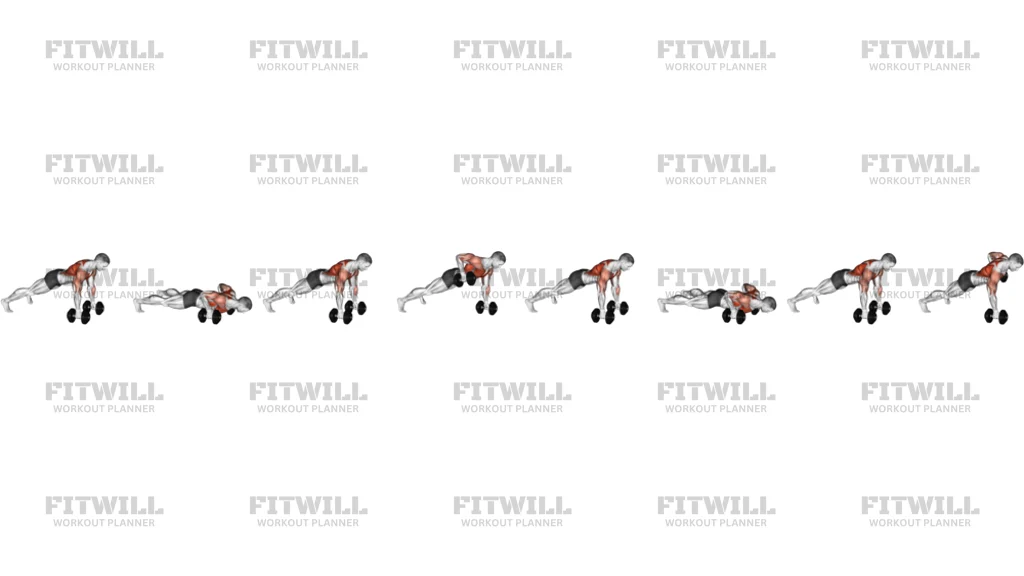
Dumbbell Deep Push-Up and Renegade Row is a compound floor exercise that combines a deep push-up performed on dumbbells with an alternating one-arm row from a plank position. The dumbbells act as handles, which lets the chest travel lower than a standard push-up while keeping the wrists in a neutral position. That extra depth makes the pressing portion more demanding on the chest, triceps, and shoulders, while the row adds an anti-rotation challenge for the lats, upper back, and core.
The exercise works best when the setup is deliberate. Place two stable dumbbells on the floor, take a strong high-plank with your hands on the handles, and set your feet wider than hip width so you can resist twisting when you row. Keep your ribs down, glutes tight, and neck long before the first rep. If the stance is too narrow or the dumbbells are unstable, the row becomes a balance drill instead of a controlled strength exercise.
Each repetition should flow through two clear pieces: a deep push-up, then a row. Lower your chest between the dumbbells with control, press back to plank, then shift only enough weight to one side to pull a dumbbell toward your lower ribs. Keep both hips square to the floor and avoid turning the torso as the row finishes. The free hand should push hard into the floor while the working arm pulls; that opposition is what keeps the body organized.
Breathing matters because this is a fatigue-heavy combination. Inhale on the way down, brace before the press, and exhale through the press or row without letting the torso relax. Most people need lighter dumbbells here than they would use for a standalone renegade row, because the push-up already taxes the shoulders and trunk. If the low back sags, the hips sway, or the shoulders shrug, the set is too heavy or too long.
Use Dumbbell Deep Push-Up and Renegade Row as an accessory strength movement, a challenging upper-body conditioner, or a core-focused full-body drill. It is useful when you want pressing strength, pulling strength, and trunk control in the same pattern. Beginners can regress it by using lighter dumbbells, shortening the range, or separating the push-up and row into two exercises until the plank position stays solid throughout the set.
[ Workout Log & Planner ]
Put your next workout in Fitwill
Keep your plan and training log ready when you are.


Instructions
- Place two stable dumbbells on the floor about shoulder-width apart and take a high plank with one hand on each handle.
- Walk your feet back into a wide stance so your legs can resist rotation, and line your shoulders over your wrists.
- Tighten your glutes, draw your ribs down, and keep your neck neutral before you start the first rep.
- Lower your chest between the dumbbells in a controlled deep push-up until you reach your comfortable bottom position.
- Press the floor away and return to a straight plank without letting your hips sag or twist.
- Shift your weight over one arm and row the opposite dumbbell toward your lower ribs.
- Pause briefly at the top of the row with your shoulders square to the floor.
- Lower the dumbbell back to the floor under control, then alternate sides on the next rep or as programmed.
- Finish the set by stepping your feet in and setting the dumbbells down carefully.
Tips & Tricks
- Use hex dumbbells or another stable handle so the weights do not roll when you transfer body weight to one side.
- A wider foot stance makes the row much easier to control; narrow your feet only after you can keep your hips level.
- Choose lighter dumbbells than you would use for a regular renegade row because the deep push-up adds a lot of fatigue.
- Keep your elbows about 30 to 45 degrees from your torso on the push-up to protect the shoulders and keep the press smooth.
- Row the dumbbell toward your lower ribs or hip line instead of pulling straight up toward your armpit.
- Press the non-working hand into the floor as hard as you pull so the torso stays square.
- If your low back starts to arch, shorten the set or regress to a knee-supported version before form breaks down.
- Lower the dumbbell quietly; slamming it down usually means you lost tension before the next rep.
Frequently Asked Questions
What muscles does Dumbbell Deep Push-Up and Renegade Row work?
It trains the chest, triceps, shoulders, lats, and core, with a big anti-rotation demand from the plank and row.
Why are the hands on dumbbells instead of the floor?
The dumbbells act as handles, which lets you drop your chest lower on the push-up and keeps the wrists in a neutral grip.
Do I row after every push-up rep?
Yes. The usual pattern is one deep push-up followed by one alternating row before you switch sides on the next rep or set.
How wide should my feet be during the row?
Wide enough that your hips stay level when one hand leaves the floor. If the body twists, widen the stance before adding load.
Is this a good beginner exercise?
Only if the load is light and the plank stays solid. Many beginners should learn the push-up and renegade row separately first.
How deep should the push-up go?
Lower until your chest moves below the dumbbells without losing a neutral spine or letting the shoulders collapse forward.
What is the most common mistake with the row?
Twisting the torso to cheat the pull. The hips should stay square while the row comes from the working shoulder and lat.
Can I regress the exercise if the full version is too hard?
Yes. Use lighter dumbbells, shorten the push-up depth, or split the movement into a push-up and a separate one-arm row.