Dumbbell Standing Around Head Rotation
The Dumbbell Standing Around Head Rotation is an overhead circular movement where you hold a single dumbbell with both hands and trace a controlled ring around your head, keeping the plate close to your head and neck throughout the loop. It sits somewhere between strength work and shoulder preparation — light enough that most lifters use a 2.5 to 10 pound dumbbell, deliberate enough that the shoulders and upper back have to stay engaged from start to finish.
This exercise primarily trains the deltoids and the small rotator cuff muscles that steer the upper arm as it circles. Because the weight travels around your head rather than in a straight line, your upper traps, upper back, and trunk must also work to keep your torso from leaning or twisting with the dumbbell. That combination makes it a useful warm-up before pressing days, a recovery drill between heavy sets, and a low-load way to build overhead control.
The standing setup is what separates this from seated halo variations. With your feet planted roughly hip-width apart, there is no bench or backrest to hide against, so your core has to brace and your ribs have to stay stacked over your pelvis. If you let the weight pull you off center, the circle becomes sloppy and the joints in your neck and lower back absorb stress that should belong to the shoulders. Treat the setup as part of the exercise, not a formality.
Execution is simple to learn but easy to rush. Press the dumbbell overhead, bend your elbows slightly, and guide the weight in a smooth ring so it passes in front of your face, beside one ear, behind your head, and beside the other ear before returning to the front. Keep the plates close to your head the whole way — the movement is a halo, not a wide swing. Halfway through your set, reverse the direction so both sides of the circle get the same work.
Most people use this exercise in one of three ways: as the first shoulder drill of a pressing warm-up, as part of a shoulder health circuit alongside band rotations and face pulls, or as a light activation block on upper body days. Because the load stays modest, it is also a practical choice for beginners learning to hold weight overhead, and for older lifters who want supervised-feeling shoulder work without heavy pressing.
A few safety points matter here. Start lighter than you think you need, because the leverage changes as the dumbbell passes behind your head and momentum can drag your arms out of position. Move at a pace you could stop instantly, and skip the exercise entirely if circling overhead produces pinching or pain at the shoulder — a smaller circle or a lighter implement is the sensible adjustment.
[ Workout Log & Planner ]
Put your next workout in Fitwill
Keep your plan and training log ready when you are.


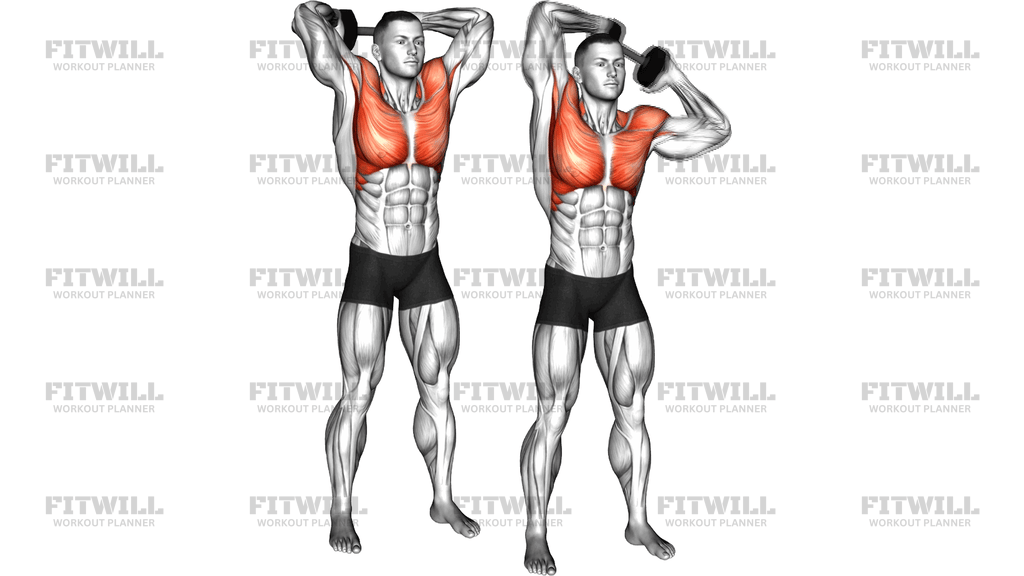
Instructions
- Stand with your feet about hip-width apart, holding one dumbbell horizontally by one end with both hands cupped around it.
- Press the dumbbell straight overhead until your arms are fully extended and the weight sits directly over the crown of your head.
- Draw your shoulder blades down, brace your abdominal muscles, and tuck your ribs so your lower back is not arching under the weight.
- Bend your elbows slightly and begin guiding the dumbbell forward and down in front of your face, keeping the plates a few inches from your head.
- Continue the circle: past one ear, behind the back of your head, then past the other ear, tracing a smooth ring with your elbows and shoulders following the path.
- Complete the loop back to the overhead starting point and keep going for the desired number of repetitions in that direction.
- Reverse direction halfway through the set so you rotate the dumbbell around your head an equal number of times each way.
- Exhale steadily as the weight travels around, and avoid holding your breath during the circle.
- When finished, lower the dumbbell under control back to chest height before dropping your arms, and shake out your shoulders before the next set.
Tips & Tricks
- Choose a dumbbell light enough that you could pause it at any point in the circle — most people need far less weight here than for any press.
- The most common mistake is widening the circle to make it easier. If the plates drift away from your head, your shoulders stop steering and momentum takes over.
- Watch for your head chasing the weight. Keep your gaze forward and let the dumbbell move around you, not the other way around.
- If your lower back arches when the dumbbell passes behind your head, squeeze your glutes slightly and re-brace before continuing the circle.
- Keep the bend in your elbows consistent on both sides. Straightening one arm mid-circle makes the dumbbell travel unevenly and loads one shoulder more than the other.
- Slow the tempo behind the head, where you cannot see the weight and the leverage against your shoulders is greatest.
- If overhead circling causes shoulder pinching, shrink the radius of the circle or replace the dumbbell with a light plate until your range improves.
- Alternate which direction you start with each session so the first, freshest reps are not always rotating the same way.
- Pair this with a heavier pressing movement rather than stacking it after exhausting your shoulders — it works best when the rotator cuff is still fresh.
Frequently Asked Questions
What muscles does the Dumbbell Standing Around Head Rotation work?
The shoulders are the primary muscle group, especially the deltoids, with the rotator cuff muscles controlling the circular path. Your upper traps, upper back, and core work isometrically to keep your torso still while the weight moves around your head.
How heavy should the dumbbell be for Around The Head Rotations?
Stay light — usually 2.5 to 10 pounds, even for strong lifters. The exercise targets control and endurance in the shoulder stabilizers, and a heavier dumbbell tends to turn the circle into a swinging motion.
Should I keep my elbows straight or bent during the rotation?
A slight, consistent elbow bend works best. Fully straight arms force the weight into a wider arc, while bending and straightening repeatedly changes the path and makes one side of the circle uneven.
Why does the dumbbell need to stay close to my head?
Keeping the plates a few inches from your head keeps the load close to your centerline, so your shoulders steer the weight instead of your lower back and neck compensating. A wide circle multiplies the leverage dramatically.
Which direction should I rotate the dumbbell around my head?
Both. Perform half your repetitions clockwise and half counterclockwise, or alternate directions each session, so the shoulder muscles around the joint get balanced work.
Is the Dumbbell Standing Around Head Rotation good for beginners?
Yes, as long as the weight stays light and the circle stays tight. It teaches overhead positioning and shoulder control before a beginner progresses to overhead pressing, and it can be scaled down to body-weight arm circles if needed.
Can I do this exercise before bench press or overhead press?
It works well as a warm-up drill before both, because it raises the temperature of the shoulder stabilizers without fatiguing them. Keep it to one or two light sets so you save your strength for the main lift.
My lower back arches when the dumbbell goes behind my head. How do I fix it?
Re-brace your abs, squeeze your glutes, and slow the movement as the weight passes behind you. If the arch persists, the dumbbell is likely too heavy or your circle is too wide — reduce both before continuing.
What can I substitute if I don't have a dumbbell?
A small weight plate, a kettlebell held by the horns, or a light medicine ball all work with the same around-the-head path. With no equipment at all, body-weight arm halos still train the movement pattern.
Is it safe to rotate a weight around my neck and head?
It is safe for most people when the load is light, the plates stay close to the head, and the tempo is controlled. If you have a history of shoulder impingement or neck problems, start with a very small circle and stop if you feel pinching or pain.