Resistance Band Assisted Wide Grip Pull Up
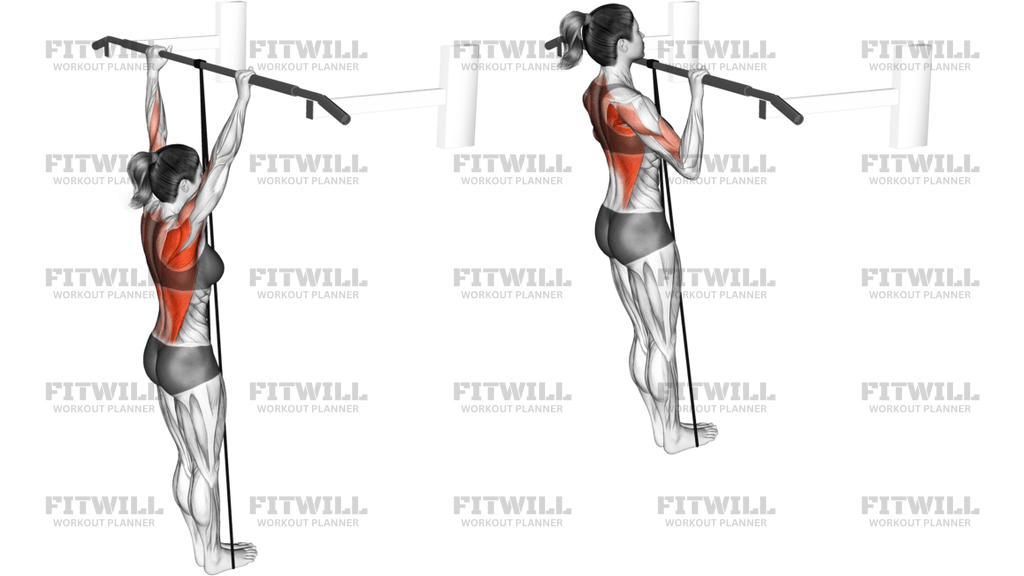
The Resistance Band Assisted Wide Grip Pull Up is a bodyweight pulling exercise performed on a pull-up station with a wide, overhand grip on the angled outer handles. A resistance band is looped over the top of the bar and tucked under one knee, so the band stretches as you descend and helps lift you back up through the hardest part of the movement. This assistance makes the wide-grip pull up accessible while you build the strength to eventually perform it unassisted.
This variation is ideal if you are working toward your first strict pull up, returning after a layoff, or want extra volume on pulling days without grinding out single reps. The wide grip shifts the emphasis toward the lats and upper back compared with a closer, shoulder-width grip, and the band support lets you accumulate more total reps at a manageable effort level.
The primary muscles worked are the lats, with strong contributions from the rhomboids, mid traps, and rear shoulders as the shoulder blades pull down and together at the top. The biceps and forearms handle much of the elbow flexion and grip demand, while the core works to keep your body from swinging as you travel up and down. Because the band provides the most help at the bottom, you still have to work hard near the top of each rep.
Setup matters more than most people expect. The band must be securely anchored over the center of the bar and positioned under the knee before your feet leave the ground, and the wide handles should sit just outside shoulder width so your elbows can drive down comfortably. A band that is too light leaves you stalling halfway up; one that is too thick turns the set into a band squat rather than a pull up, so choose the lightest band that lets you complete your target reps with control.
Execute each rep by pulling your elbows down toward your ribs until your chin clears the bar, keeping your chest tall and your knees stacked under the band anchor rather than drifting backward. Lower yourself slowly until your arms are fully extended, letting the band stretch under control instead of dropping into the bottom. This controlled return is where much of the strength adaptation happens, especially for beginners.
A common mistake is kipping or swinging to finish reps, which usually means the band is too light or the set is too long. Another isshrugging the shoulders up to the ears at the bottom instead of starting each rep from a depressed shoulder position. Keep the range honest, reset your grip and shoulder position between reps, and progress by using thinner bands or adding reps over time rather than rushing to remove assistance entirely.
Fitwill
Log Workouts, Track Progress & Build Strength.
Achieve more with Fitwill: explore over 9600 exercises with images and videos, access built-in and custom workouts, perfect for both gym and home sessions, and see real results.
Start your journey. Download today!




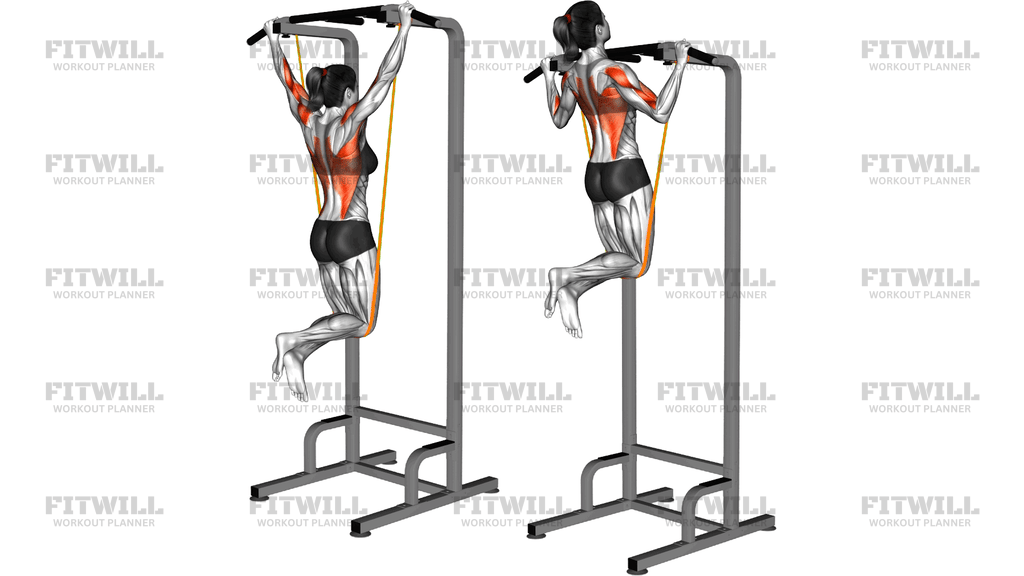
Instructions
- Loop a resistance band over the center of the pull-up bar and pull one side down through the other so it locks securely in place.
- Stand or kneel on the station, place one knee into the hanging band, and grip the wide outer handles with an overhand grip slightly wider than shoulder width.
- Let your body hang with arms fully extended, then squeeze your shoulder blades down and together so your shoulders sit away from your ears.
- Brace your core and keep your legs together with the knee pressing into the band, feet tucked behind you.
- Pull by driving your elbows down and slightly back toward your ribs, keeping your chest lifted toward the bar.
- Continue pulling until your chin clears the bar and your upper chest is close to your hands.
- Pause briefly at the top, then lower yourself slowly and evenly until your arms are straight and the band is fully stretched.
- Exhale as you pull up and inhale as you lower down, keeping the breathing steady throughout the set.
- Finish the set by stepping your knee out of the band while still gripping the bar, then lower your feet carefully to the floor before releasing your grip.
Tips & Tricks
- Choose a band that lets you complete all reps with your chin clearly over the bar; if you stall at mid-range, the band is too light.
- Keep your knee stacked directly under the band anchor point. If your body drifts forward or backward, the band angle changes and the assistance becomes inconsistent.
- Avoid pulling with straight, flared elbows out to the sides. Think of driving your elbows down toward your torso so the lats do the work instead of the shoulder joints taking the strain.
- Do not drop into the bottom position. The band will rebound you back up if you fall fast, which robs you of the lowering portion where strength is built.
- If your grip gives out before your back does, chalk your hands or use a full wrap rather than shortening the range of motion.
- Start each rep from a dead hang with shoulders depressed. Yanking from a shrugged, slack position is the most common cause of shoulder discomfort on wide-grip variations.
- Keep your head neutral by looking slightly up at the bar rather than craning your chin over it at the end of the rep.
- Progress by adding reps with the same band first, then move to a thinner band before attempting an unassisted wide-grip pull up.
- Check the band for wear before each session and make sure it is centered on the bar so it cannot slide sideways mid-set.
Frequently Asked Questions
What muscles does the Resistance Band Assisted Wide Grip Pull Up work?
The lats are the primary mover, supported by the rhomboids, mid traps, and rear shoulders as the shoulder blades retract. The biceps and forearms handle elbow flexion and grip, and the core stabilizes your body throughout the hang.
How does the wide grip change the exercise compared to a normal pull up?
The wider hand position reduces biceps leverage and places greater demand on the lats and upper back to pull the elbows down. It also shortens the comfortable range slightly, so aim for your upper chest toward the bar rather than forcing your chin excessively high.
Should I put the band under one knee or both knees?
One knee under the band, as shown in the standard setup, keeps your hips and torso aligned and makes the assistance more consistent. Both knees can work but tends to pull your body into a slight forward arch and makes it harder to keep a neutral position.
How do I know which resistance band to use?
Pick the lightest band that lets you complete your target reps with your chin clearing the bar and a controlled lowering phase. Most beginners start with a thick band and progress to thinner ones as the set feels easier.
Can beginners do the Resistance Band Assisted Wide Grip Pull Up?
Yes, it is one of the best ways for beginners to train the wide-grip pull up pattern, because the band gives the most help at the bottom where the movement is hardest. Focus on full range and slow lowering rather than rep quantity.
Why do I keep swinging during the movement?
Swinging usually comes from pulling too explosively, dropping fast into the bottom, or letting the knee slip off the band's center. Slow the lowering phase to two or three seconds, keep the knee stacked under the anchor, and reset to a still hang before each rep.
What can I substitute if I do not have a band?
An assisted pull-up machine, a partner holding your feet or waist, or negative-only wide-grip pull ups where you jump to the top and lower slowly all work. The band is often preferred because it scales smoothly and mimics the natural strength curve.
Is it safe if the band slips off the bar?
A properly looped band anchored over the center of the bar will not slip, so always thread it securely and center it before starting. Inspect the band for cracks or thin spots before each session and never use a damaged band.
How do I progress away from band assistance?
First increase your reps with the current band, then switch to a thinner band and rebuild your rep count. Once you can perform around eight to ten solid reps with a light band, test occasional unassisted single reps at the start of a workout.
How close should my hands be on the wide handles?
Grip slightly wider than shoulder width, roughly where your forearms stay vertical at the top of the pull. Going excessively wide strains the shoulders and shortens the range without adding meaningful back involvement.