Resistance Band Sumo Deadlift
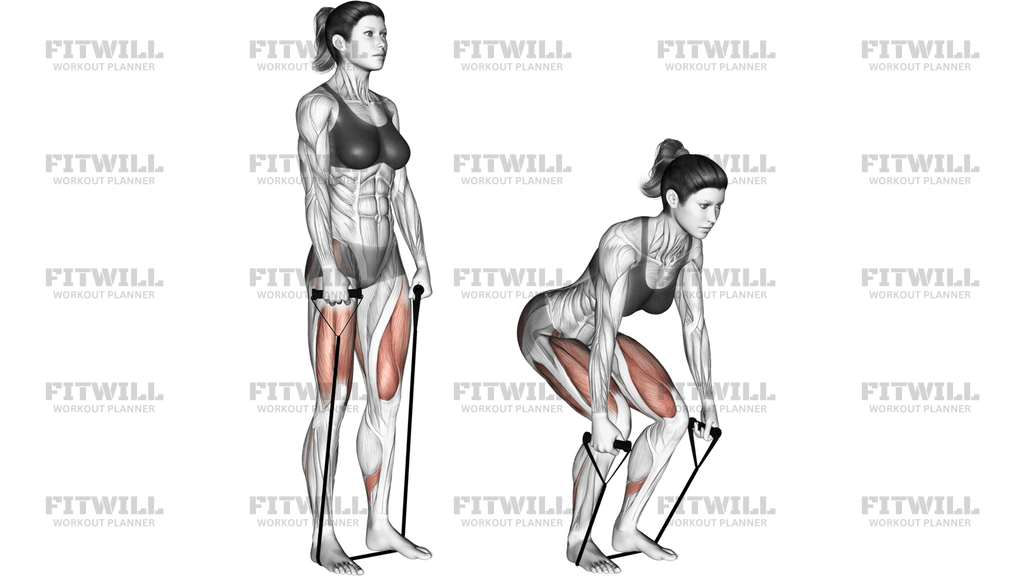
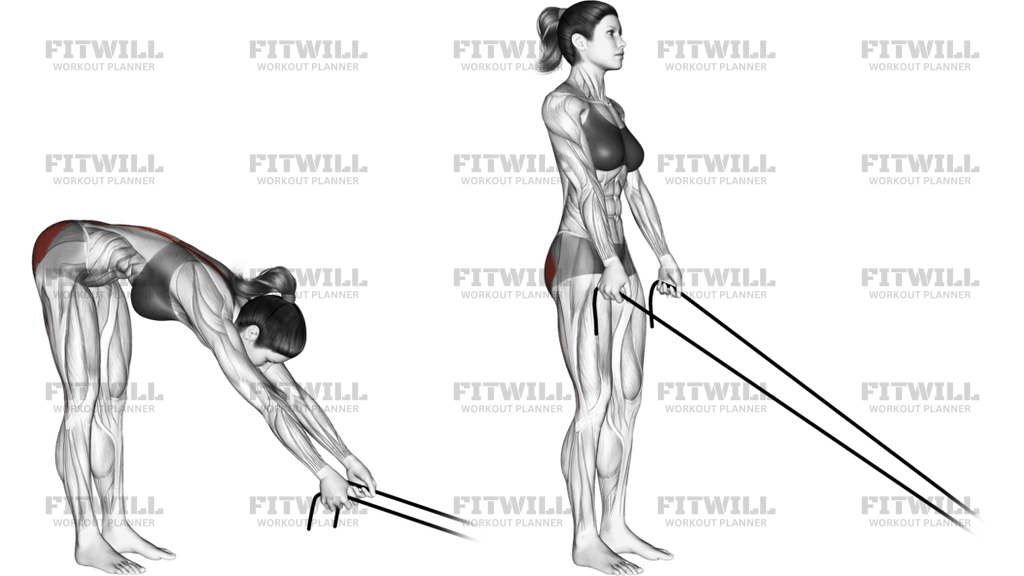
The Resistance Band Sumo Deadlift is a hip-dominant hinge performed with a long resistance band anchored under both feet and held in a wide sumo stance. Because the band passes under the outside of each foot and crosses in your hands, the pulling tension rises steeply as you stand, so the top of the lift is where your glutes and hips work hardest. The wide foot position, with toes turned slightly out, changes the emphasis compared to a conventional deadlift: your inner thighs and glutes take on much more of the load, while your back stays in a shorter, more upright position.
This variation suits lifters who train at home or travel, since a single band replaces a barbell and plates entirely. It is also useful as a teaching tool for the sumo hinge pattern itself, because the band gives smooth feedback and the lighter starting tension lets you set your hips and spine properly before resistance builds. More experienced lifters often use it as a high-rep finisher after barbell work or as a warm-up to wake up the glutes before heavier pulls.
The main muscles at work are the glutes, hamstrings, and adductors of the inner thigh, with the quads contributing as you extend out of the bottom. Your erector spinae muscles brace the spine isometrically, and your grip and forearms work to hold the band securely through the whole range. Because the band's tension peaks at lockout, the movement specifically trains that strong finishing squeeze of the glutes that carries over well to other hip extension exercises.
Setup quality matters more here than in most band drills. The band must sit flat under the middle of each foot, and the stance has to be wide enough that your knees track over your toes rather than collapsing inward. If your feet are too close together, the band will pull your knees in and your lower back will round to compensate at the bottom. Take a moment to set the stance and wedge your hips down before you ever pull.
To execute well, think of the lift as a push through the floor rather than a pull with the arms. Your arms are simply hooks holding the band; the force comes from driving your hips forward and your feet apart into the ground. Stand tall at the top with a deliberate glute squeeze, then lower under control by pushing your hips back and letting your knees bend in line with your toes.
Keep the band tension even between both hands throughout each rep, and stop the set if you feel your lower back taking over or your knees caving in. Like any deadlift variation, the safest approach is a moderate range with a flat back rather than chasing depth at the cost of spine position.
[ Workout Log & Planner ]
Put your next workout in Fitwill
Keep your plan and training log ready when you are.


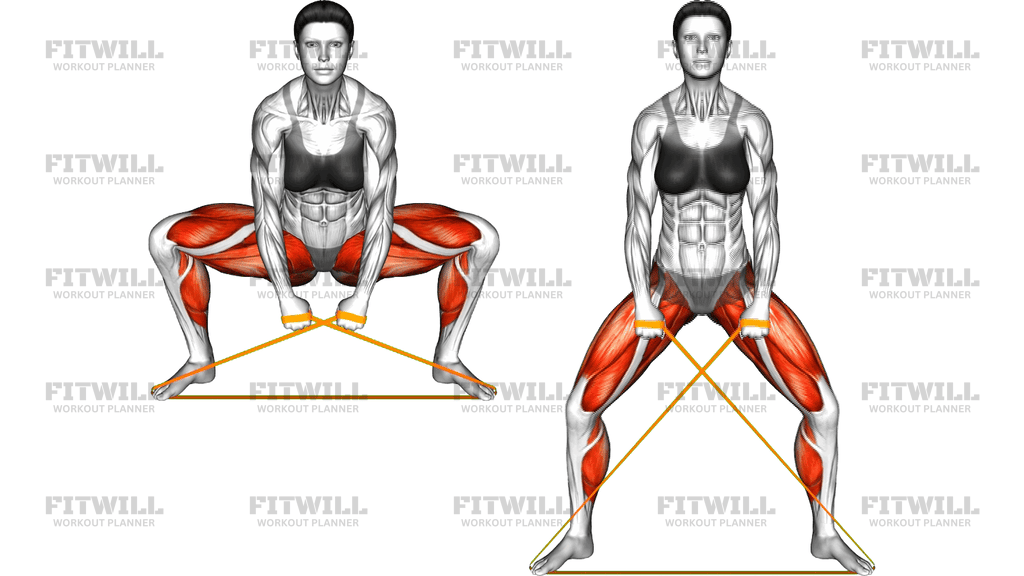
Instructions
- Place a long resistance band flat on the floor and set both feet on top of it, shoulder-width apart so the band runs under the middle of each foot.
- Step your feet out to a wide sumo stance, roughly one and a half shoulder widths, and turn your toes out about 30 to 45 degrees.
- Grab the band with both hands at the center, letting the band cross in front of your legs so each hand holds the opposite side, and keep your arms straight with shoulders pulled slightly back.
- Push your hips back and bend your knees to lower into a deep squat, letting your knees travel out over your toes while keeping your chest up and back flat.
- Take a breath and brace your core as if preparing for a light punch to the stomach before you initiate the pull.
- Drive your feet down and apart into the floor to stand up, pushing your hips forward as the band's tension increases toward the top.
- Finish standing fully upright with your legs straight and your glutes squeezed, keeping your shoulders back rather than shrugging.
- Lower slowly by pushing your hips back first, then bending your knees, guiding the band back to the floor in the same path it came up.
- Exhale at the top as you stand and inhale at the bottom before each rep, resetting your brace every repetition.
- Complete your set, then step one foot off the band carefully to release the tension before standing up fully out of the stance.
Tips & Tricks
- Choose a band tension that challenges you at the top without forcing your back to round at the bottom, since the difficulty rises as you stand and the bottom position is where form breaks first.
- If your knees cave inward during the pull, deliberately think about spreading the floor with your feet, or shorten the band under your feet slightly to reduce inward pull.
- Keep the band centered over the middle of your feet, not the toes, or it can slip forward mid-lift and change the pulling angle.
- Do not hyperextend or lean back at the top; standing tall with a glute squeeze is enough, and overextending wastes the lockout position and stresses the lower back.
- Keep your arms relaxed and straight the entire time. If you find yourself rowing the band with your elbows, the weight is too heavy or your hips are shooting up too fast.
- If your hips rise before your shoulders, reduce the depth slightly or use a lighter band so you can keep chest and hips moving up together.
- Wear flat shoes or go barefoot so your feet grip the band and you can feel pressure spread evenly across the whole foot.
- Turn your toes out only as far as you can keep your knees tracking over them; excessive external rotation with a narrow stance is a common cause of knee discomfort in sumo stances.
- Rest the band fully on the floor between sets rather than stepping off under tension, which is the most common way people get snapped by a stretched band.
Frequently Asked Questions
What muscles does the Resistance Band Sumo Deadlift work?
It primarily targets the glutes and hamstrings, with strong involvement from the inner thigh adductors because of the wide stance. The quads, lower back, and grip muscles work to support and stabilize the movement.
How is the Resistance Band Sumo Deadlift different from a conventional deadlift?
The wide stance and turned-out toes shift more work to the glutes and inner thighs and allow a more upright torso. The band also makes the lift easiest at the bottom and hardest at the top, the opposite of how a barbell load feels.
Why is the band crossed in the hands?
Crossing the band lets each side pull evenly from both feet and keeps the tension centered between your legs. It also prevents the band from sliding off the outer edge of either foot during the lift.
Is the Resistance Band Sumo Deadlift good for beginners?
Yes, it is one of the more beginner-friendly hip hinge options because the low starting tension lets you set your stance and spine position comfortably. Start with a light band and focus on keeping your back flat and knees tracking over your toes.
How wide should my sumo stance be?
A practical starting point is about one and a half shoulder widths with toes turned out 30 to 45 degrees, adjusted so your knees travel in line with your toes. If your knees collapse inward, widen slightly or use less band tension.
What is the most common mistake with this exercise?
Letting the knees cave inward as the band tension increases, usually because the stance is too narrow or the band is too strong. Rounding the lower back at the bottom is the next most common issue, so cut depth before you lose a flat back.
Can I use the Resistance Band Sumo Deadlift instead of barbell deadlifts?
It works well when you have no barbell access or want a lower-spine-load hinge with high reps, but the resistance profile and loading ceiling are different. Treat it as a complement or substitute for hypertrophy and patterning rather than maximal strength work.
How many reps should I do?
Because band tension peaks at lockout, sets of 12 to 20 reps tend to work best for this variation. Go to within a couple of reps of losing form rather than training to a hard failure point.
Is it safe for my lower back?
When performed with a braced, neutral spine and a manageable band tension, it is generally a joint-friendly hinge option. Keep your torso position controlled, avoid jerking the band off the floor, and stop if you feel strain in your lower back rather than your hips and thighs.
What can I do if my grip fatigues before my hips do?
Choke up on the band by gripping closer to your feet, which shortens the band and reduces the tension your hands must hold. You can also use a thicker or shorter band so the same tension requires less stretch through your fingers.