Resistance Band Sumo Deadlift
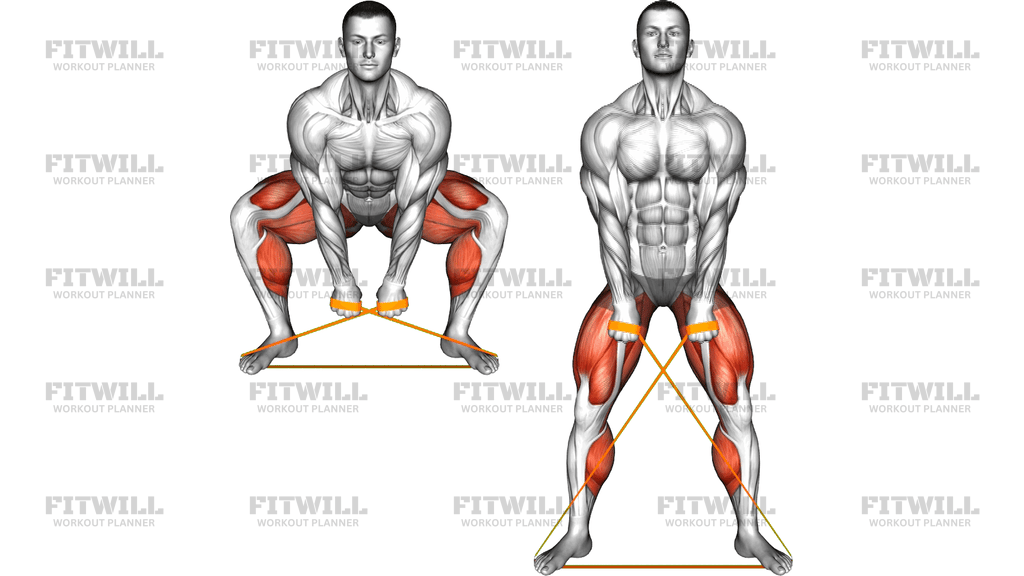
The Resistance Band Sumo Deadlift is a wide-stance hip hinge performed with a long resistance band looped under both feet. Because the band is crossed in an X between your feet and hands, the tension pulls diagonally inward, which means your hips, inner thighs, and upper back all have to work to control the path. At the bottom you sit into a deep wide squat position with a flat back, and at the top you finish tall with your glutes squeezed and the band stretched across your hips.
This setup matters more than it looks. The X configuration keeps the band from sliding along your legs and creates a line of resistance that increases as you stand up, so the hardest part of the rep is the lockout rather than the floor. That profile suits people who find barbell deadlifts heavy off the ground but want to strengthen the finishing drive of the hips. It also lets you train the sumo pattern at home or while traveling with a single piece of equipment.
The movement primarily trains the glutes and the adductors along the inner thigh, with strong contributions from the quads, hamstrings, and the muscles of the lower back that hold your spine in position. Your grip and upper back work isometrically the whole time to keep the band anchored and your chest up. Compared with a conventional deadlift, the wide stance puts your torso more upright and shifts more demand toward the hips and inner thighs.
To execute it well, think of it as a push with your legs rather than a pull with your arms. Set your knees over your toes, keep your weight spread across the whole foot, and drive the floor away while your hips and shoulders rise at the same rate. Resist the band's inward pull by actively pressing your knees out as you stand. At the top, stand fully upright without leaning back, then lower with control until the band touches down lightly before the next rep.
The Resistance Band Sumo Deadlift works well as a main lower-body lift in home programs, as a warm-up or groove-setter before heavier barbell work, and as a high-rep finisher for glutes and adductors. Choose a band tension you can control for clean reps with a neutral spine, and progress by moving to a thicker band or doubling up bands rather than by rushing range of motion.
[ Workout Log & Planner ]
Put your next workout in Fitwill
Keep your plan and training log ready when you are.


Instructions
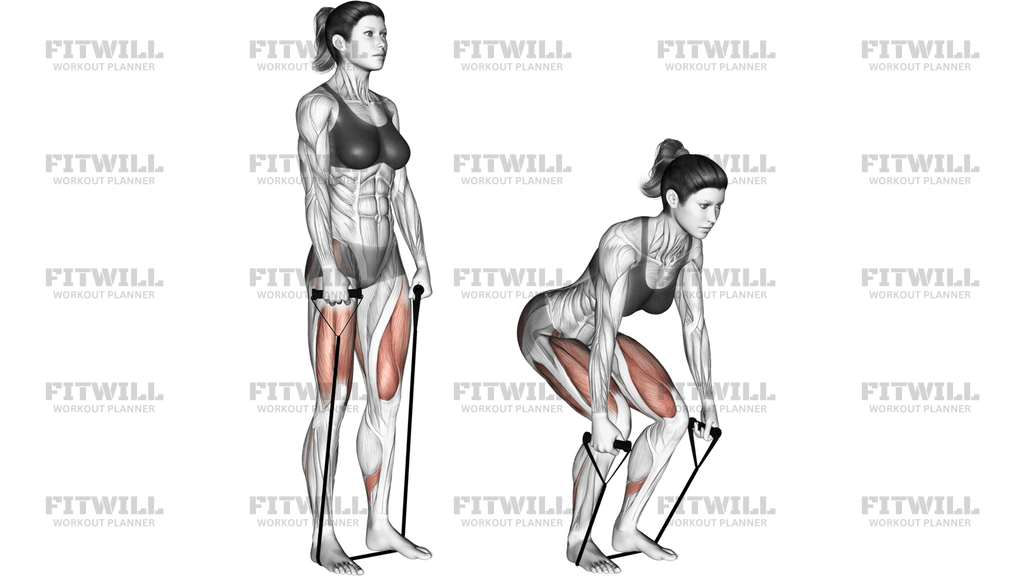
- Place a long resistance band flat on the floor and step both feet onto it, set wider than shoulder width with your toes turned out at roughly 30 to 45 degrees.
- Cross the band into an X between your legs and grip one end in each hand outside your knees, adjusting the slack so there is light tension while you are standing tall.
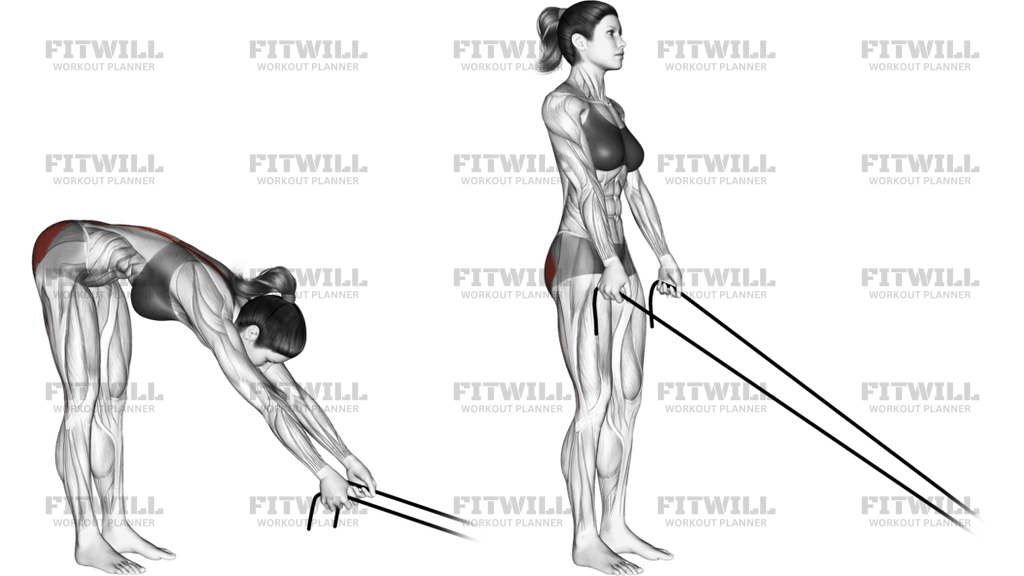
- Push your hips back and bend your knees until your hands hang between your legs and the band touches down near the floor, keeping your chest lifted and your back flat.
- Wedge your knees out so they track over your toes, then take a breath into your belly and brace your torso before each rep.
- Drive your feet into the floor and stand up, letting your hips and shoulders rise together while pressing your knees outward against the band's inward pull.
- Finish standing fully upright with your glutes squeezed, knees straight but not locked back, and the band stretched taut across the front of your hips.
- Reverse the rep by pushing your hips back first, letting the band travel down the inside of your legs until it returns to the floor.
- Exhale at the top as you stand, and inhale again at the bottom before starting the next repetition.
- Keep your arms relaxed and straight throughout; the band should be anchored by your legs and torso, not lifted by your hands.
- After your final rep, release the tension gradually, step off the band one foot at a time, and check the band for wear before reracking it.
Tips & Tricks
- If the band slides up your calves on the way down, widen your stance slightly or re-center the band under your mid-foot so it stays pinned during the hinge.
- A rounded back at the bottom usually means the band is too heavy or you are reaching with your arms instead of sitting your hips back; drop to a lighter band and own the hinge first.
- Knees caving inward is the most common fault in this stance because the band pulls your hands, and therefore your legs, toward the midline; cue yourself to spread the floor with your feet on every rep.
- Keep your shoulders slightly ahead of the band at the bottom. If your chest pops up before your hips move, the rep turns into a stiff-legged pull and your lower back takes the load.
- Do not lean backward at the top. The band's resistance peaks standing tall, so squeeze your glutes to finish the lockout instead of hyperextending to feel it more.
- Grip the band under the arch of your foot on the same side so both ends in one hand stay secure; losing one end mid-rep can snap the band back at your shins.
- Inspect the band for small tears before each session. A band under this much stretch stores a lot of energy, and a failure at the top of a heavy pull is dangerous.
- If you feel this mostly in your lower back, shorten the range: stop the descent when your back starts to round and rebuild the bottom position gradually.
- Chalk or a towel in your hands helps if the band slips when your palms sweat, especially on higher-rep sets.
Frequently Asked Questions
What muscles does the Resistance Band Sumo Deadlift work?
It primarily targets the glutes and the adductors of the inner thigh, which is why the wide stance and crossed band matter. Your quads, hamstrings, and lower back support the movement, and your grip works hard to hold the band.
Why is the band crossed in an X under the feet instead of held straight?
The crossed setup anchors each end under the opposite foot and stops the band from sliding up your legs during the hinge. It also makes the resistance pull inward and upward, which forces your knees to stay pressed out through the whole rep.
Is the Resistance Band Sumo Deadlift good for beginners?
Yes, as long as you start with a light band and keep the range to where your back stays flat. The band's resistance increases as you stand, so the bottom position stays manageable while you learn the hip hinge.
How is this different from a barbell sumo deadlift?
The band is hardest at the top where a barbell is relatively easy, and it is joint-friendly because there is no compressive load on the spine. The trade-off is less absolute load, so it suits higher reps, warm-ups, and home training rather than maximal strength work.
How do I know which band strength to use?
Pick a band that lets you complete all reps standing fully upright with squeezed glutes and a flat back at the bottom. If you cannot lock out without leaning back, go lighter; if the band feels slack at the top, move to a thicker one.
Should my shins stay vertical during the Resistance Band Sumo Deadlift?
Not necessarily. With the wide, toes-out stance your knees will travel forward and out over your toes, especially at the bottom. What matters is that your knees track in line with your toes and your weight stays spread across your whole foot.
My knees cave in on every rep. How do I fix it?
The crossed band actively pulls your legs toward the midline, so this fault is very common. Slow the reps down, consciously drive your knees outward, and consider adding band hip abductions or lateral band walks to strengthen the outer hips.
Can I do this exercise if I don't have a long loop band?
You can tie two shorter bands together or double a long band, but avoid flimsy or damaged bands since they stretch far and snap hard. The band must be long enough to reach from the floor under both feet to your hands while you stand upright.
How many reps should I do?
Because the resistance peaks at lockout, this movement responds well to sets of 8 to 15 reps with a controlled tempo. For a warm-up before barbell deadlifts, 2 to 3 sets of 10 light reps works well to activate the glutes and adductors.
Is it safe to do Resistance Band Sumo Deadlifts every day?
Light-band sets are low fatigue and can be done often, but treat heavier or high-rep sessions like any hard lower-body training and allow a day of recovery between them. Stop and reassess your setup if you feel pinching at the hips or persistent lower-back soreness.