Bodyweight Rope Inverted Row
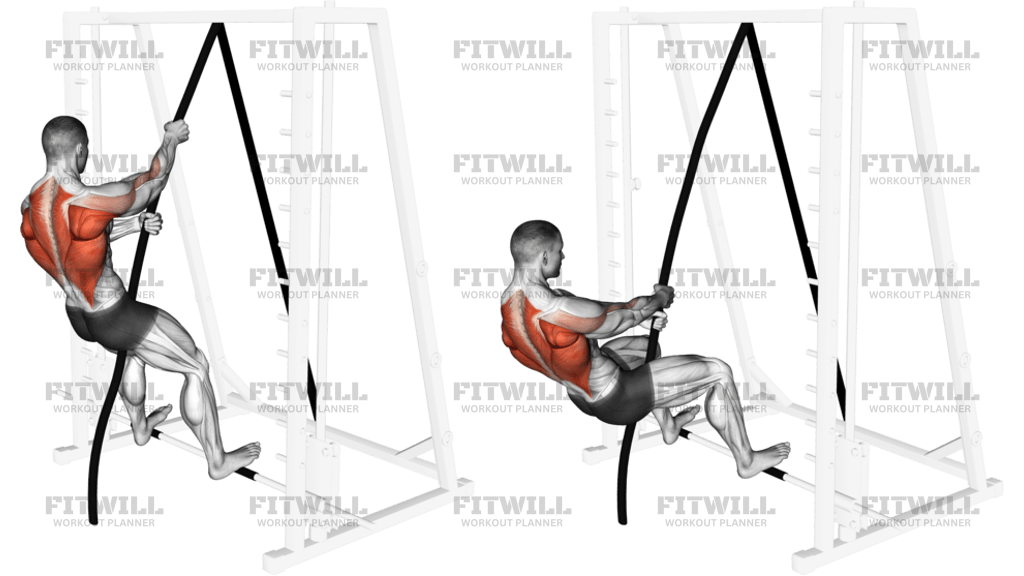
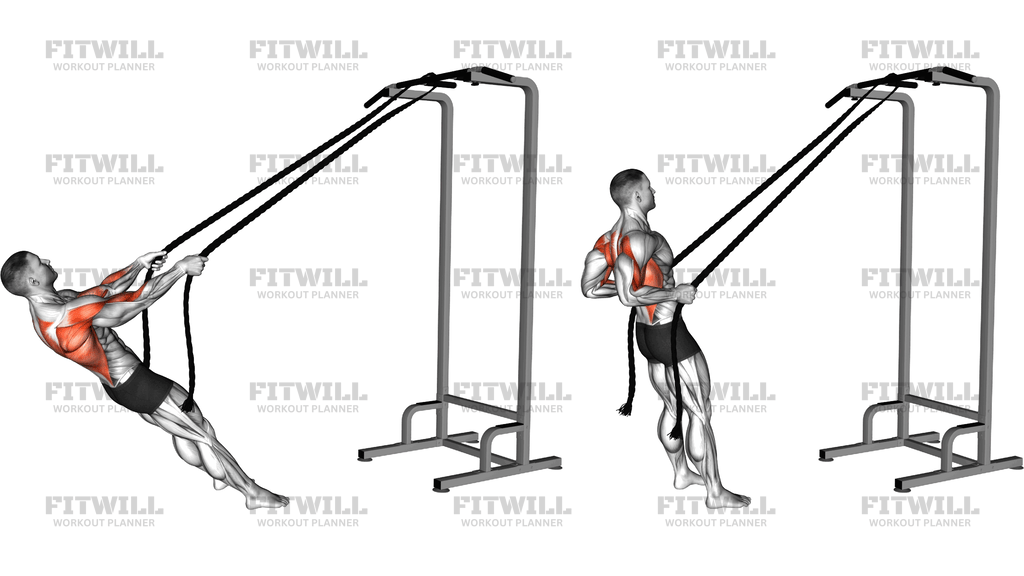
The Bodyweight Rope Inverted Row is a horizontal pull performed with two training ropes draped over a high anchor such as a pull-up station. You grip the ropes, lean your body back to a challenging angle, and pull your torso up toward your hands by driving your elbows down and back. Because the resistance comes entirely from your own bodyweight, the difficulty is governed almost completely by how far you lean back and how much of your weight you load onto the ropes.
This exercise is a strong choice for anyone who wants a rowing pattern without a barbell or machine. It suits beginners who need an accessible entry point to pulling, lifters who want higher-volume back work without spinal loading, and anyone training at a station where ropes are available. It also works well as a stepping stone toward pull-ups, since it builds the same lats and upper back muscles through a shoulder-extension and retraction pattern.
The main muscles working are the lats, rhomboids, and middle traps, which draw the shoulder blades back and pull the upper arms toward the torso. The biceps and forearms handle the gripping and elbow flexion, the rear deltoids assist the pull, and the core and legs stay engaged to keep your body in a straight line from head to heels throughout the set.
Setup is what makes or breaks this movement. The anchor point needs to be secure and the ropes need to be the same length on both sides, because an uneven rope will twist your torso and shift the work to one side. Your body angle determines the load: a steep, upright angle makes the row easier, while leaning back until your body approaches a forty-five degree angle or lower makes it considerably harder.
To execute it well, walk your feet forward until your body is at the desired incline, squeeze your glutes and brace your midsection, and start each rep from fully extended arms. Pull by pulling the ropes toward your chest and driving your elbows past your ribs, not by yanking with the hands. Pause briefly at the top with your chest tall, then lower yourself back down under control until your arms are straight again.
Common use cases include home or garage training where minimal equipment is available, warm-up activation before heavier pulling, and finisher work at the end of a back session. If your grip gives out before your back does, choke up slightly on the rope or reduce the body angle rather than shortening the range of motion.
[ Workout Log & Planner ]
Put your next workout in Fitwill
Keep your plan and training log ready when you are.


Instructions
- Drape two training ropes over a high, secure anchor such as a pull-up station, and adjust them so both sides hang at equal length.
- Grip one rope in each hand at the same height, then walk your feet forward and lean back until your body forms a straight line from head to heels at your chosen angle.
- Plant your feet shoulder-width apart with heels down, squeeze your glutes, and brace your abs so your hips do not sag or pike.
- Let your arms extend fully and allow your shoulder blades to protract slightly forward to set the starting position.
- Exhale and pull the ropes toward your lower chest by driving your elbows down and back, keeping them close to your body rather than flaring them wide.
- Pull until your hands are beside your ribs and your chest is tall, squeezing your shoulder blades together at the top for a brief pause.
- Inhale and lower yourself back to the starting position under control, letting your arms straighten fully before the next rep.
- Complete all reps at one body angle, then stand up, release the ropes one hand at a time, and reset the ropes if they have shifted on the anchor.
Tips & Tricks
- If the ropes slip on the anchor during a set, stop and re-secure them before continuing; a shifting rope changes your grip height mid-rep and throws off your pull.
- If your hips drop toward the floor, the angle is too aggressive or your core has fatigued. Step your feet back toward the anchor to shorten the lever before your form breaks.
- Keep your neck in line with your spine by looking at a fixed point on the floor a short distance ahead of your hands, not up at the anchor.
- Do not let your shoulders shrug up toward your ears as you pull; think about pulling your shoulder blades down into your back pockets to keep the tension on the lats and mid-back.
- If your forearms burn out before your back, re-grip higher up the rope so more rope hangs below your hands and your wrists stay closer to neutral.
- Use a two-second lowering phase instead of dropping back to the start; the eccentric portion is where much of the rowing strength is built.
- Progress by walking your feet forward slightly each week, or elevate your heels on a low step to increase the load while keeping the same body line.
- Chalk or a towel over the rope can help if sweaty hands make the grip slippery on higher-rep sets.
Frequently Asked Questions
Which muscles does the Bodyweight Rope Inverted Row work the most?
The lats, rhomboids, and middle traps do most of the pulling, with the biceps, forearms, and rear deltoids assisting. Your core and legs work isometrically to hold the inclined body position.
How do I adjust the difficulty of the Bodyweight Rope Inverted Row?
Walk your feet toward the anchor to make the row easier, or forward to lean back further and load more bodyweight onto the ropes. Raising your heels on a step adds load without changing your grip.
Is the Bodyweight Rope Inverted Row suitable for beginners?
Yes, and it is one of the more beginner-friendly rowing variations because the angle lets you scale the load precisely. Start with a fairly upright body position and progress gradually as your pulling strength improves.
Why should both ropes be the same length before starting?
Uneven ropes cause one side of your torso to rotate or rise higher than the other, shifting the work to your stronger arm. Equal lengths keep the pull symmetrical and let both sides of your back work evenly.
How is the Bodyweight Rope Inverted Row different from a barbell row?
The rope row uses your own bodyweight as resistance and places your body at an incline, so there is no spinal compression from a barbell. It is generally easier to recover from and easier to scale for higher reps.
What should I do if I cannot complete a full pull on the ropes?
Step your feet back toward the anchor to reduce the load, or shorten the range slightly and build toward a full pull. Partial reps with a straight body are better than full reps with sagging hips.
Can the Bodyweight Rope Inverted Row help me get better at pull-ups?
It trains the lats, upper back, and grip through a pulling pattern that complements vertical pulling, and it lets you accumulate volume safely. Pairing it with assisted or band-assisted pull-up work is a common progression route.
How do I keep my core from fatiguing before my back during this exercise?
Set a firm brace before your first rep, squeeze your glutes to lock in the hip position, and choose a body angle where holding the plank-like line feels easy. If your hips sag anyway, reduce the angle for the remaining reps.
Is it safe to do the Bodyweight Rope Inverted Row every training day?
Because the load is self-regulated and there is no external weight, many people tolerate it several times per week. Still, treat your grip and elbows like any other trained tissue and leave a day of recovery between demanding pulling sessions.
What can I use instead of ropes for an inverted row?
A straight bar set in a power rack, a sturdy table edge, rings, or a suspension trainer all work for the same pattern. The rope's advantage is a softer, more grip-friendly handle and slightly more freedom in wrist position.