Band Squat To Overhead Press
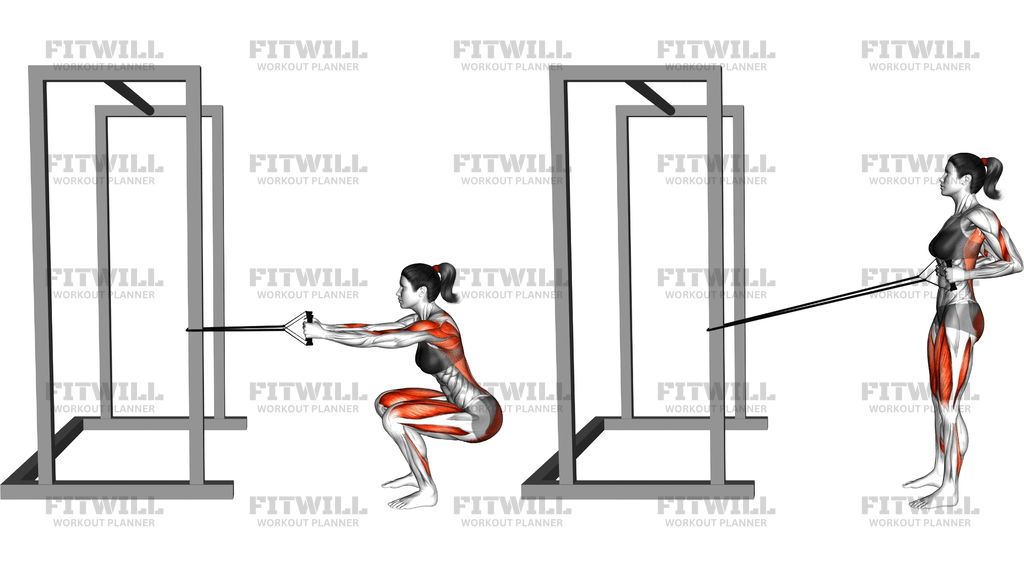
The Band Squat To Overhead Press is a full-body compound movement that combines a bodyweight squat with an overhead press in one continuous motion. You stand on the middle of a resistance band with both feet, hold the handles at shoulder height, squat down, and then drive up through your legs while pressing both handles straight overhead. Because the band stretches further as you stand and press, the resistance builds naturally through the hardest part of the movement, which is exactly where a barbell or dumbbell thruster tends to feel easiest.
This exercise earns its place in almost any training program. The squat portion targets the quads, glutes, and hamstrings, while the press demands work from the shoulders and triceps. Tying the two together forces your core to transfer force from the ground up, so your abs and lower back stay busy stabilizing your torso from start to finish. It is a practical choice for anyone training at home with minimal equipment, for beginners learning the timing of a thruster pattern before adding load, and for more experienced lifters who want a high-rep conditioning finisher without a barbell.
Setup matters more here than with most band exercises. If your stance is too narrow or your grip too low, the band will slacken at the bottom of the squat and go loose, robbing you of tension. Position your feet roughly shoulder-width apart with the band secured flat under both heels, and set your hands so the band is already taut when the handles sit just outside your shoulders. That pre-tension is what keeps the movement honest from the first rep to the last.
Execution should feel like one flowing sequence, not two separate exercises stitched together. Sink into a squat with your chest tall and knees tracking over your toes, then explode upward and let that momentum carry the handles overhead in a single press. Lock out with the band stretched over your head and your biceps beside your ears, then lower the handles back to your shoulders as you descend into the next squat. The more smoothly you link the descent and the press, the more you get out of every rep.
A few practical points will keep this movement safe and effective. Choose a band you can press overhead for your target reps with a couple left in the tank, because pressing into a band that is too strong will pull you forward or backward as you fatigue. Keep your ribs stacked over your hips at the top rather than leaning back to finish the press, and never let your knees cave inward on the way down. If you feel the band slipping under your feet, pause, reset your stance, and continue rather than pushing through a compromised setup.
[ Workout Log & Planner ]
Put your next workout in Fitwill
Keep your plan and training log ready when you are.


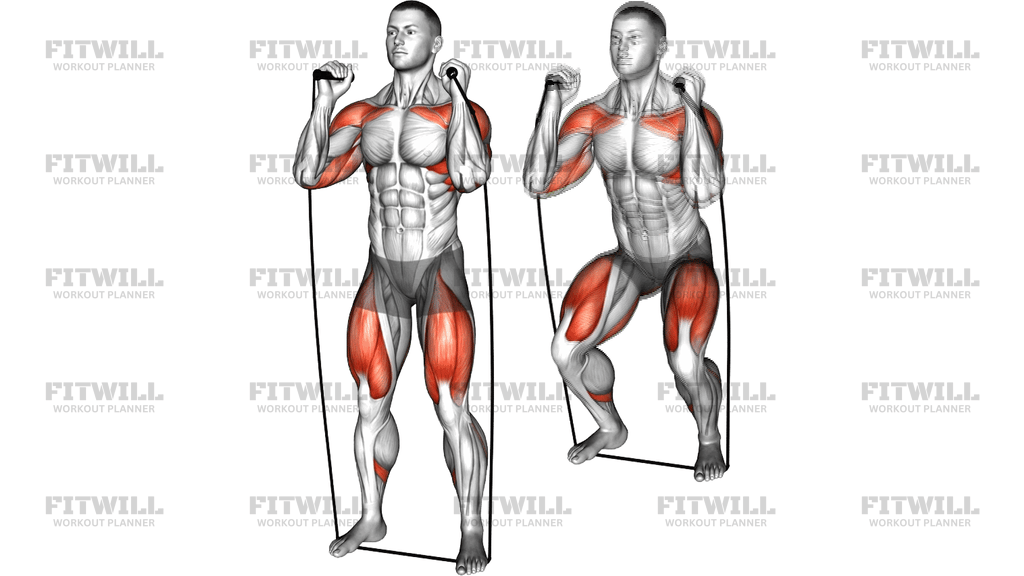
Instructions
- Place a resistance band flat under both feet and stand with your feet about shoulder-width apart, toes turned out slightly.
- Grip a handle in each hand and bring them up to shoulder height, palms facing forward, with the band already taut against the sides of your arms.
- Keep the band running behind your arms or under your arms consistently, and make sure it is not twisted before you begin.
- Brace your core and pull your ribs down so your torso stays stacked over your hips.
- Push your hips back and bend your knees to lower into a squat until your thighs are at or just below parallel, keeping the handles at your shoulders.
- Drive through your whole foot to stand up forcefully, and as your hips extend, press both handles straight overhead until your arms are fully locked out.
- Pause briefly at the top with the band stretched and your biceps close to your ears.
- Lower the handles back to shoulder height under control as you sink directly into your next squat.
- Exhale as you stand and press, and inhale as you lower into the squat.
- After your final rep, release the handles down to your sides, then step one foot off the band to release the tension safely.
Tips & Tricks
- If the band goes slack at the bottom of the squat, shorten your grip by choking up on the band or use a shorter band so tension stays constant throughout.
- Wider or heavier feet placement increases band tension; narrow your stance slightly if the press is too hard to lock out.
- Watch for the ribcage flaring and lower back arching as you press; squeeze your glutes at the top to keep your torso vertical.
- If your heels lift in the squat, shift your weight back into your midfoot and sit into your hips rather than dropping straight down onto your toes.
- Do not let the band pull your hands behind your shoulders at the top; if your arms drift backward, the band is too strong or your grip is too low.
- Move the press in a straight vertical line slightly behind your head rather than arcing forward around your face, which strains the shoulders.
- Keep your knees tracking in line with your toes; the band will not stop them from caving, so actively push your knees out as you descend.
- For conditioning, keep the transitions continuous; for strength, pause one second at the top of each press and control the descent.
- If the band slips off your heel mid-set, stop and re-seat it flat under your foot rather than adjusting your stance to compensate.
Frequently Asked Questions
What muscles does the Band Squat To Overhead Press work?
It primarily trains the quads and glutes through the squat, then the shoulders and triceps through the press. Your core works the entire time to transfer force from your legs to your arms.
Is the Band Squat To Overhead Press good for beginners?
Yes, it is one of the friendliest ways to learn the squat-to-press pattern because the band provides light, forgiving resistance. Start with a thin band and master the timing before progressing to a heavier one.
Why does the band feel loose at the bottom of my squat?
Your grip is probably set too low or your stance is too wide for the band length, so the band slackens when you descend. Choke up on the band or shorten it so tension stays on your shoulders even in the bottom position.
How do I set up my feet on the band correctly?
Stand with the band flat under the middle of both feet, about shoulder-width apart, so it cannot roll or slide off your heels. Keeping it under the arch or heel rather than the toes gives you a stable base.
Should I press as I stand or wait until I am fully upright?
Begin the press as your hips extend so the leg drive feeds into the overhead lockout, which is how a thruster is meant to flow. Pressing only after you fully stand turns it into two separate movements and wastes the momentum from your legs.
Can I use the Band Squat To Overhead Press for conditioning?
Absolutely. Performing continuous reps with moderate band tension for 30 to 60 seconds raises your heart rate quickly and works the whole body, making it a great finisher or circuit station.
What should I do if the band pulls me backward at the top of the press?
The band tension is too heavy for your current pressing strength, so switch to a lighter band. You can also step one foot slightly narrower to reduce overall tension, as long as the band stays secure under both feet.
Is it safe for my lower back and knees?
When performed with an upright torso, braced core, and knees tracking over your toes, it is a controlled, low-load movement. Avoid leaning back to finish the press and stop if you feel the band forcing you out of position.
What can I substitute if I do not have a resistance band?
A dumbbell or kettlebell thruster follows the same movement pattern. Without equipment, a plain bodyweight squat to overhead press still trains the coordination, just with less resistance.