Resistance Band Sumo Deadlift High Pull
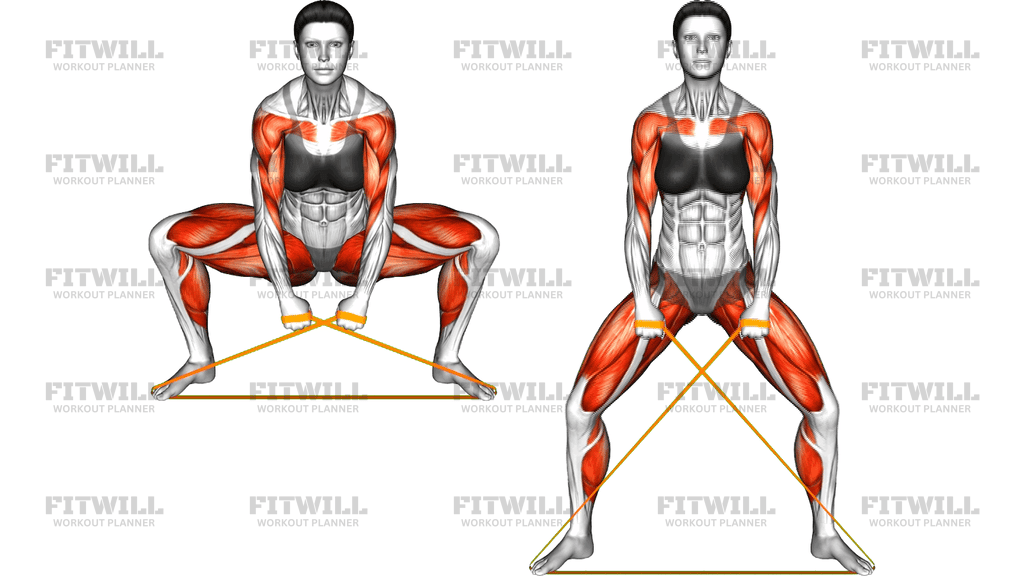
The Resistance Band Sumo Deadlift High Pull is a full-body compound lift that combines a wide-stance deadlift with an upright row, all driven by the elastic tension of a band anchored under your feet. You start in a deep sumo squat with the band crossed under both feet, then drive through the floor to stand tall while pulling the handles up toward your chest. One movement, two distinct phases: a powerful leg and hip drive followed by an upper-back pull.
This exercise is useful for anyone who wants the coordination and timing of an Olympic-style pull without a barbell or plates. Because the band's resistance increases as it stretches, the lift gets harder exactly where you extend upward and pull, which trains explosive intent through the whole range. It fits well into home workouts, warm-up sequences for barbell lifting days, and conditioning circuits where you want a lot of muscle working at once.
The lower body does the heavy lifting here. The wide stance shifts emphasis toward the quads, inner thighs, and glutes, while the hamstrings and lower back stabilize the hinge on the way down. As you rise and pull, the traps, shoulders, and upper back take over, and your forearms and grip work continuously against the band's tension.
Setup matters more with this variation than with most band exercises. The band must sit securely under the full width of both feet, and the crossing of the band between your legs changes the pulling angle, so an uneven anchor will pull you off balance. Take a moment to even out the length on each side before your first rep, and keep your knees tracking over your toes in the sumo position rather than caving inward.
To execute it well, think of the movement as one fluid wave: push the floor away with your legs, let the hips finish extending, then let that momentum carry your elbows up and out as the hands rise to chest height. Lower the handles back down under control, reset your brace, and repeat. Avoid turning it into an arms-only row, because the power should come from the legs and hips first.
Practically, this lift works well for higher-rep strength work, explosive conditioning, and as a low-equipment substitute for sumo deadlift high pulls or clean pulls. Start with a lighter band to learn the timing, and stop the set when you can no longer keep your chest up and knees aligned, since form tends to break down before strength does.
[ Workout Log & Planner ]
Put your next workout in Fitwill
Keep your plan and training log ready when you are.


Instructions
- Place a resistance band flat on the floor and step both feet onto it with a wide sumo stance, toes turned out at roughly 30 to 45 degrees, so the band runs under the middle of each foot.
- Cross the band in front of your legs and grip one end in each hand, then even out the length on both sides so the tension is balanced.
- Push your hips back and bend your knees to lower into a deep sumo squat, letting your hands hang down between and slightly behind your knees with a straight back and a proud chest.
- Brace your core and pull your shoulder blades down and together before initiating the lift.
- Drive through your heels and the outer edges of your feet to extend your knees and hips, keeping the band taut the entire way up.
- As you reach full standing extension, pull the handles upward toward your chest, leading with your elbows so they finish high and wide above your hands.
- End the rep standing tall with the band drawn up near chest or collarbone height, elbows above the wrists.
- Reverse the path in a controlled manner: lower the handles first, then sit your hips back into the sumo squat until the hands return to the starting position between your legs.
- Exhale forcefully as you drive up and pull, and inhale as you lower back into the squat.
- Complete the set, then step one foot off the band carefully to release the tension before standing up out of the stance.
Tips & Tricks
- If the band slips off your heels during the pull, widen your feet slightly or position the band closer to the arch of each foot so it stays anchored under load.
- Knees collapsing inward is the most common fault in this stance; consciously push your knees out over your pinky toes, especially in the bottom position where the band pulls you forward and down.
- Keep your chest lifted in the deep squat. If your back rounds, shorten the range by squatting less deep until your hips and lower back can hold the position.
- Do not let the pull become an arm row. If your elbows stay low and your shoulders shrug early, the legs finished too slowly — accelerate the stand-up first, then pull.
- A band that is too heavy will drag you into the squat on the way down. Choose a lighter resistance and move with control rather than letting the band yank you into the bottom.
- Check that both sides of the band are equal in length before each set; an uneven cross makes one arm and one hip work harder than the other.
- Keep your weight balanced across the whole foot rather than rocking onto your toes, which usually happens when the hips shoot up before the shoulders.
- For a more explosive, athletic version, add a small rise onto the balls of your feet at the top of the pull, but only after you can control the standard tempo.
- If your wrists ache at the top, relax your grip slightly and let the band rest more across the palms rather than cocking the wrists back hard.
Frequently Asked Questions
What muscles does the Resistance Band Sumo Deadlift High Pull work?
It primarily targets the quads, glutes, and inner thighs during the wide-stance squat and drive, then challenges the traps and shoulders in the high pull phase. Your grip, forearms, and lower back work throughout to control the band.
Why is the band crossed between my feet instead of just looped under both feet?
The crossed setup changes the pulling angle so the band pulls diagonally across your body, mimicking the path of a barbell high pull and keeping even tension on each arm. It also makes the anchor more secure under a wide sumo stance.
Is the Resistance Band Sumo Deadlift High Pull suitable for beginners?
Yes, provided you start with a light band and practice the two phases separately first. Learn the sumo squat pattern with the band simply hanging, then add the high pull once the leg drive feels natural.
How high should I pull the band at the top of the movement?
Pull to around chest or collarbone height with your elbows leading, high and out to the sides. Pulling higher usually just adds shrugging and wrist strain without extra benefit.
What is the most common mistake in this exercise?
Letting the knees cave inward during the squat, or turning the lift into an arms-only row by pulling before the hips finish extending. Both reduce the training effect and put unnecessary stress on the joints.
Can I substitute a dumbbell or kettlebell for the band?
You can perform a sumo deadlift high pull with a kettlebell or dumbbell held in one or both hands, but you lose the increasing tension at the top and the crossed pulling angle. The band version is often easier on the grip and joints for higher reps.
How many reps and sets should I do of the Resistance Band Sumo Deadlift High Pull?
For strength and power, work in sets of 6 to 10 explosive reps; for conditioning, 12 to 20 continuous reps with a moderate band works well. Rest enough between sets that your squat depth and knee position stay clean.
My lower back feels taxed during this movement — is that normal?
Some lower back involvement is expected since it stabilizes your spine, but sharp strain means your chest is dropping or the band is pulling you into a rounded posture. Reduce the band tension, squat less deep, and re-brace before each rep.
How do I get out of the exercise safely once the set is finished?
Lower the handles fully while staying in the sumo stance, then step one foot off the band while holding the other side firmly so the tension releases slowly. Never stand up with the band still anchored under your feet with slack, as it can snap upward.