Band Squat To Overhead Press
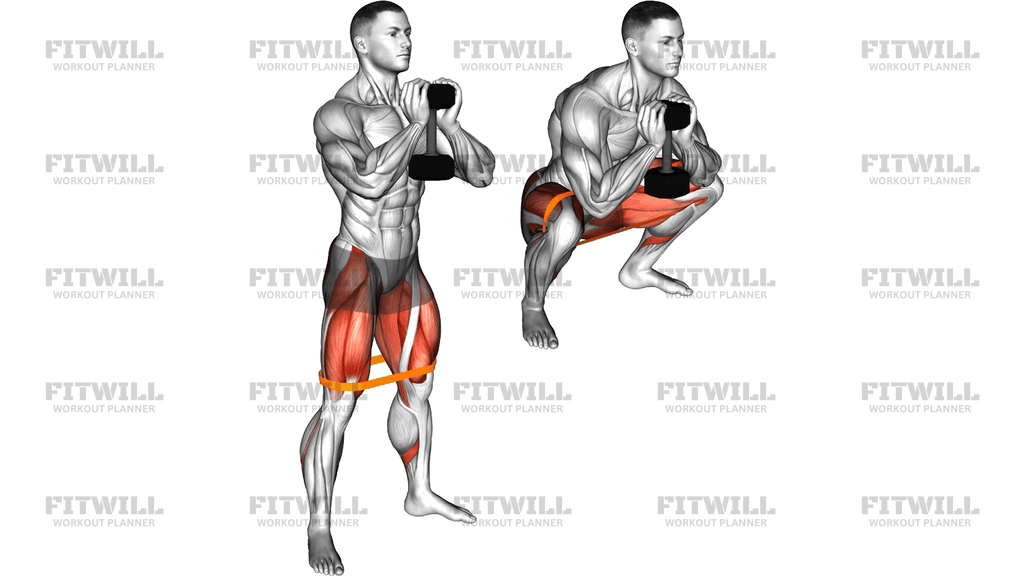
The Band Squat To Overhead Press is a full-body compound lift that combines two foundational patterns into one continuous movement: a bodyweight squat against resistance band tension, followed immediately by an overhead press. You stand on the middle of a resistance band with your feet about hip-width apart, hold the handles at shoulder height, squat down, then drive through your heels to stand while pressing both handles straight overhead in one fluid motion. Because the band is anchored under your feet, the tension is highest at the top of the press and lightest in the bottom of the squat, which makes the movement feel smooth and joint-friendly.
This exercise is a great fit for people who want the training effect of a barbell thruster or dumbbell push press without heavy loads or a fully equipped gym. It trains the quads, glutes, and hamstrings through the squat portion, then challenges the shoulders and triceps as you press, with your core working the entire time to keep your ribcage stacked over your pelvis. The band setup also adds a subtle stability demand, since you have to stay balanced on the band while controlling the handles.
Setup matters more than most people expect. If your feet are too narrow, the band will slip off during the squat; if the band is doubled or twisted, the tension will be uneven between your left and right sides. Take a moment to place both feet squarely on the band's center, check that the lengths from floor to each handle are equal, and stand tall before your first rep.
Execution should feel like one coordinated wave rather than two separate exercises. Lower into a squat with your chest up and knees tracking over your toes, then as you stand, transfer that momentum into the press so your arms finish overhead as your hips reach full extension. Keep your wrists neutral and avoid letting the band pull your arms backward at the top.
Because resistance bands scale easily by using lighter or heavier tubing, this movement works well for beginners learning the squat-to-press pattern, for warm-ups before heavier lifting, and for home workouts or travel sessions where space and equipment are limited. Higher-rep sets also raise your heart rate quickly, making it a useful conditioning tool when programmed with short rest periods.
The main safety points are simple: never let your lower back arch as the band stretches overhead, keep the band fully under your mid-foot so it cannot snap up toward your face, and choose a band tension that lets you press fully overhead without shrugging or leaning sideways. If you cannot keep your heels down in the squat, elevate them slightly or reduce the depth before adding more tension.
[ Workout Log & Planner ]
Put your next workout in Fitwill
Keep your plan and training log ready when you are.


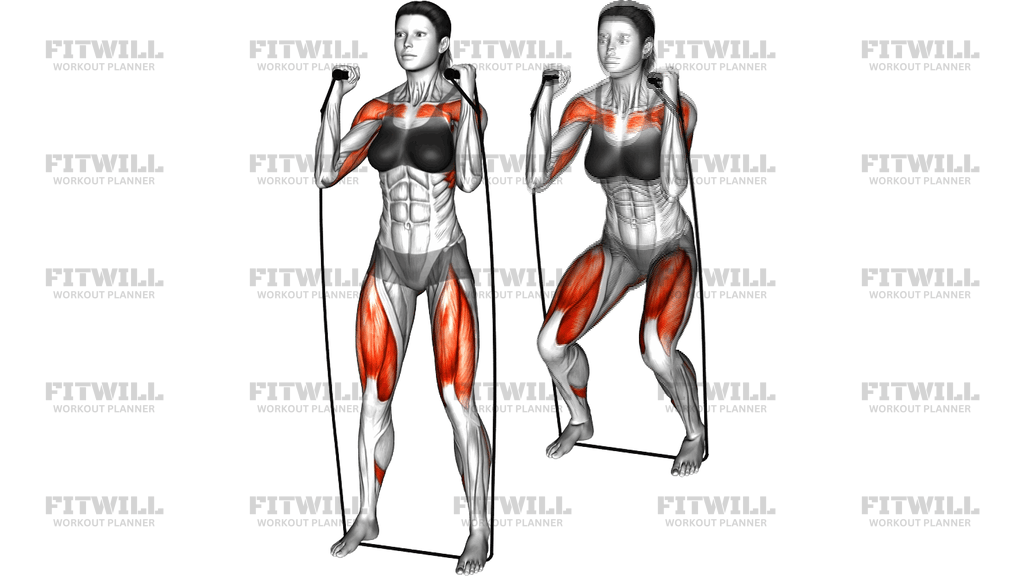
Instructions
- Place the middle of a resistance band flat on the floor and step onto it with both feet at hip-width, positioning the band under your mid-foot so it cannot slip toward your toes.
- Grip a handle in each hand and bring them up to shoulder height with your palms facing forward and elbows tucked slightly in front of your torso, adjusting your grip so both sides of the band have equal tension.
- Stand tall with your chest up, shoulders back, and brace your abdominal muscles as if preparing for a light nudge to the stomach.
- Push your hips back and bend your knees to lower into a squat, keeping your weight distributed through your whole foot and your knees tracking in line with your toes.
- Descend until your thighs are at or near parallel to the floor, or as deep as you can go while keeping your heels down and your back neutral.
- Drive through your heels to stand, and as your hips extend, press both handles straight up overhead until your arms are fully extended and your biceps are near your ears.
- Pause briefly at the top with your core tight, making sure your lower back is not arching under the band's pull.
- Lower the handles back to shoulder height under control, then hinge at the hips and knees to begin the next squat without pausing at the top.
- Exhale as you stand and press, and inhale as you lower into the squat.
- After your final rep, release the handles to your sides first, then step off the band one foot at a time so the anchor stays secure.
Tips & Tricks
- If the band slackens at the bottom of the squat, switch to a shorter band or choke up on the handles slightly, so tension stays present through the whole range instead of only at the top.
- A common mistake is pressing too early and turning the rep into a standing calf raise with arms; make sure your hips finish extending before the handles lock out overhead.
- If the band rolls off your heels during deep squats, shift your feet slightly wider so the band sits under the arch of each foot rather than at the heel edge.
- Watch for uneven handle heights at the top of the press, which usually means you are standing closer to one end of the band; re-center your stance between sets.
- Keep your wrists straight and stacked over your forearms rather than bending them back, since the band's pull at lockout can drag extended wrists into discomfort.
- If your heels lift in the bottom position, your band tension is likely too heavy for your squat depth; use a lighter band and own the depth before progressing.
- Avoid bouncing out of the squat using momentum you cannot control, especially when the band is longest at the bottom where the load is lightest and easiest to cheat.
- Ribs should stay down over your pelvis at lockout; if you feel the band pulling you into a lean-back, tighten your glutes and exhale as you finish the press.
- For conditioning sets, standardize your depth by touching a consistent point each rep, since band squats give you no external weight to gauge depth.
Frequently Asked Questions
What muscles does the Band Squat To Overhead Press work?
The squat portion mainly targets the quads, glutes, and hamstrings, while the press works the shoulders and triceps. Your core stays engaged throughout to keep your torso upright against the band's pull.
Is the Band Squat To Overhead Press suitable for beginners?
Yes, and it is actually a smart way to learn the squat-to-press pattern because the band's tension is lightest at the bottom of the squat where you need mobility most. Start with a light band and a partial squat depth, then progress as your control improves.
Where exactly should I place the band under my feet?
Place it under your mid-foot, roughly under the arch, not your heels or toes. This keeps the band from sliding off during the squat and gives you even tension on both sides.
How do I choose the right band tension for this exercise?
Pick a band that lets you reach full depth in the squat with your heels down and still press fully overhead without your lower back arching. If the last few reps force you to lean back or shorten your squat, drop to a lighter band.
Why do my lower back and shoulders ache at the top of the press?
This usually means the band is pulling you into an overextended position at lockout. Tighten your glutes, brace your abs, and finish the press with your ribs down instead of letting the band stretch you backward.
Can I do the squat and press as two separate movements instead of one motion?
Yes, standing fully before pressing is a valid and slightly easier variation, and it is a good stepping stone if the combined rhythm feels uncoordinated. Work toward linking them once you can keep your torso stable through both parts.
What can I substitute if I do not have a resistance band?
A barbell thruster, two light dumbbells held at shoulder height, or a single kettlebell pressed after each squat all train the same pattern. The band version is simply the most portable and easiest on the joints.
How many reps and sets should I do of the Band Squat To Overhead Press?
For strength and technique, 3 to 4 sets of 8 to 12 reps with a heavier band works well. For conditioning, use a lighter band and 15 to 20 reps with short rests, keeping your squat depth consistent as you fatigue.
Is it safe if the band slips while I am squatting?
A slipping band usually means it is positioned too far back on your heels or your stance is too narrow. Stop the set, re-center the band under your mid-foot, and reset your stance rather than trying to finish the rep off-balance.