Barbell Lateral Lunge
Barbell Lateral Lunge is a side-to-side lower-body strength exercise performed with a barbell across the upper back. Instead of stepping forward or backward, you shift your body into one leg and sit the hips back toward that side, which makes the movement especially useful for frontal-plane strength, hip control, and athletic change-of-direction work.
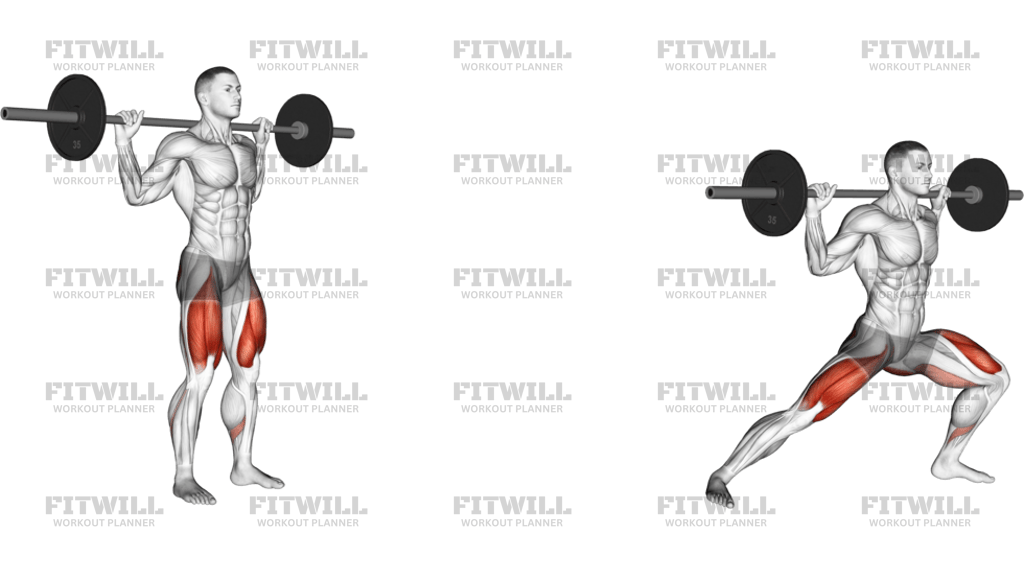
The image shows a back-rack position with the bar resting across the shoulders, a tall torso, and one leg taking a wide step out while the other stays long and straight. That setup matters because it lets the working hip load through the glute and inner thigh while the trunk stays organized. The exercise trains glutes primarily, with hamstrings, core, and lower-back muscles helping you keep the pelvis level and the chest stacked over the hips.
A clean rep starts before the descent. Set the bar firmly on the upper traps, take a stance wider than shoulder width, and turn the toes only slightly out so the knees can track naturally. Once you brace, shift into the stepping leg and sit down and back rather than collapsing straight down. The planted foot should stay flat, the opposite leg should stay extended, and the torso should lean just enough to keep balance without folding over the bar.
At the bottom, the bent knee should track in line with the toes and the loaded hip should feel strong, not pinched. Drive the floor away through the heel and midfoot of the working leg to return to center, then reset before the next rep. Breathing should stay deliberate: inhale as you lower, exhale as you stand, and keep the ribcage from flaring under the bar. If the bar shifts, the knee caves inward, or the pelvis twists, shorten the step and reduce the load.
This is a good accessory lift for squats, deadlifts, field sports, and any program that needs stronger hips in the side-to-side plane. It also works well when you want unilateral leg loading without the balance demands of a split squat. Keep the movement controlled, use only pain-free depth, and stop the set if the adductors, knees, or lower back lose alignment before the legs do.
[ Workout Log & Planner ]
Put your next workout in Fitwill
Keep your plan and training log ready when you are.


Instructions
- Set the barbell across your upper traps, hold the bar just outside shoulder width, and stand tall with your feet a little wider than shoulder width.
- Brace your core, keep your chest lifted, and point your toes only slightly outward so your knees can move in the same line.
- Shift your weight into one leg and take a controlled step out to the side with the other foot.
- Sit your hips back and down over the stepping leg while keeping the opposite leg long and the planted heel flat.
- Lower until the bent knee tracks over the toes and the working hip reaches a strong, controlled depth.
- Drive through the heel and midfoot of the bent leg to push yourself back to the starting stance.
- Bring your feet back under the bar, reset your posture, and repeat on the same side or alternate sides as programmed.
- Inhale on the descent, exhale as you stand, and re-rack the bar only after you finish the set.
Tips & Tricks
- Keep the bar pinned to the upper back; if it rolls or shifts, the side step usually turns into a torso twist.
- Take a wide enough step that the hip loads up, but not so wide that the planted foot collapses to the inside edge.
- Let the non-working leg stay long and quiet instead of squatting down on both sides.
- Keep the chest proud and the ribs stacked so the bar does not pull you into a rounded forward lean.
- Track the knee in the same direction as the toes to protect the hip and keep the glute doing the work.
- Use a slower lowering phase if you tend to bounce out of the bottom or lose control in the groin.
- Choose a load that lets you return to center without driving off the toes or shifting the pelvis.
- Stop the set if the knee caves in, the heel pops up, or the lower back starts taking over.
Frequently Asked Questions
What muscle does Barbell Lateral Lunge target most?
The glutes are the main target, with strong help from the adductors, quads, hamstrings, and core.
Where should the bar sit during the movement?
The bar should rest across the upper traps, the same as a back squat, not on the neck.
How wide should my step be?
Wide enough to load the hip of the bent leg, but not so wide that you lose balance or roll onto the inside of the foot.
Should the other leg bend too?
The trailing leg can bend a little for balance, but the working side should do most of the loading.
Is this more about the glutes or the inner thighs?
Both matter, but the glute on the loaded side and the adductors are the biggest drivers of the side lunge.
Can beginners use a barbell for lateral lunges?
Yes, but only after mastering the bodyweight version and keeping the side step, knee path, and trunk position under control.
What if I feel it in my groin?
A strong stretch is normal, but sharp groin pain means the step is too wide, the depth is too deep, or the load is too heavy.
How do I progress the exercise?
Progress by adding load only after you can keep the bar steady, the knee tracked, and the return to center smooth.