Smith Seated Wrist Curl
Smith Seated Wrist Curl is a seated forearm isolation exercise that uses the fixed bar path of a Smith machine to keep the repetition strict and easy to control. With your forearms braced on your thighs and your palms facing up, the bar sits in the fingers and rolls toward the palms as you flex the wrists. That setup makes it a very direct way to train the wrist flexors without needing to balance a free bar.
This exercise primarily targets the forearms, especially the wrist flexors, while the brachioradialis, biceps, and wrist extensors help stabilize the arm and guide the bar. In practical terms, you should feel the lower forearm do most of the work while the upper arm stays quiet. The Smith machine does not make the movement easier so much as more precise, which is useful when you want to keep the motion honest and avoid shrugging, swaying, or cheating the curl with the elbows.
The setup matters a lot. Sit squarely on the bench, plant both feet, and place the forearms across the tops of the thighs so the wrists can move freely past the knees. Let the bar rest in the fingers at the bottom, then curl it by closing the hands and flexing the wrists upward. The forearms stay pinned in place the entire time; if the elbows drift or the torso rocks, the load shifts away from the wrists and the set stops being a true forearm movement.
Use a controlled range and a slow lowering phase. The top of the rep is a short, strong squeeze, not a violent yank, and the bottom should be reached only as far as your wrists can extend comfortably. Breathing should stay simple: exhale as you curl the bar up and inhale as you lower it back down. A smooth cadence is more valuable here than heavy loading, because the target muscles respond best when tension stays constant and the wrists do not lose alignment.
Smith Seated Wrist Curl is often used as accessory work after bigger pulling or pressing exercises, or as focused forearm training when grip endurance and wrist strength matter. It fits well in bodybuilding, strength, and arm-focused sessions, but it also makes sense for beginners who want a stable way to learn wrist flexion with light resistance. Keep the reps strict, stop before the wrists start to bounce, and treat the movement like a precision drill rather than a lift to be muscled through.
[ Workout Log & Planner ]
Put your next workout in Fitwill
Keep your plan and training log ready when you are.


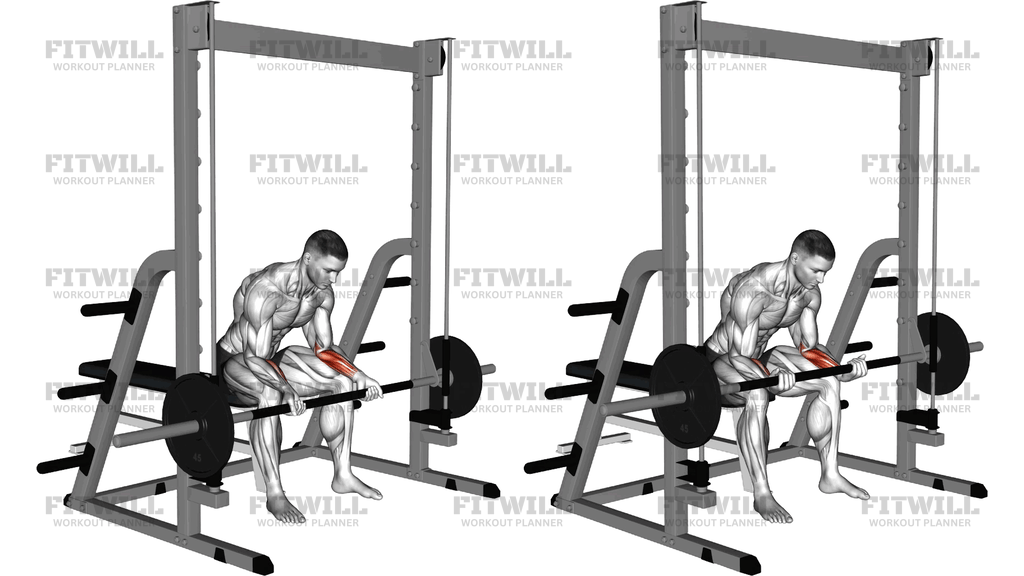
Instructions
- Sit on a bench in front of the Smith machine and place your forearms across your thighs with your palms facing up.
- Position the bar low in your fingers so your wrists can extend at the bottom of the rep.
- Keep your feet flat and your torso still so the forearms stay pinned to your legs.
- Start with the wrists extended and the bar hanging just past the knees.
- Curl the bar by flexing your wrists and rolling it from the fingers toward the palms.
- Pause briefly at the top when the forearms are fully contracted.
- Lower the bar slowly until the wrists extend again without letting the bar drop.
- Keep your elbows, shoulders, and torso quiet for every repetition.
- Exhale as you curl up and inhale as you lower under control.
Tips & Tricks
- Let the bar sit in the fingers at the bottom so you get a full wrist flexion range instead of a shortened half rep.
- Keep the forearms glued to the thighs; if the elbows slide forward, the movement turns into a body English exercise.
- Use a lighter load than you would expect, because wrist flexion responds better to strict reps than to heavy cheating.
- Lower the bar slowly and deliberately so the wrist extensors do not get a free fall on every rep.
- Avoid squeezing the bar with a crushing grip from the start; the hands should close as the wrists curl up.
- Keep the shoulders relaxed and down so you do not turn the set into a trap shrug.
- Stop the set if the wrists start bouncing off the bottom, since that usually means the load is too heavy.
- If the bar digs into the palms, reset it lower in the fingers and shorten the thumb tension slightly.
Frequently Asked Questions
What muscles does Smith Seated Wrist Curl train most?
It mainly trains the wrist flexors in the forearms, with the brachioradialis and biceps helping stabilize the arm.
Can beginners perform this exercise?
Yes. The Smith machine makes it easier to learn the wrist curl pattern, especially if you keep the load light and the motion strict.
Where should my forearms be during the set?
Rest them across the tops of your thighs so the wrists can move freely while the upper arms stay still.
Should the bar stay in my palms the whole time?
No. At the bottom it should sit deeper in the fingers, then roll toward the palms as you curl the wrists up.
How heavy should I load the Smith machine?
Use a weight that lets you keep the forearms fixed on the thighs and control the lowering phase without bouncing.
What is the most common mistake with this movement?
Most people let the elbows drift or use the shoulders to help, which turns the exercise into a partial arm swing instead of a wrist curl.
How many reps work best?
Moderate to higher reps usually work well because the forearm muscles respond well to controlled, repeated tension.
Can I use it for grip training too?
Yes, but the focus should stay on wrist flexion; the grip will still work, just as a supporting part of the lift.