Band Decline Sit-Up
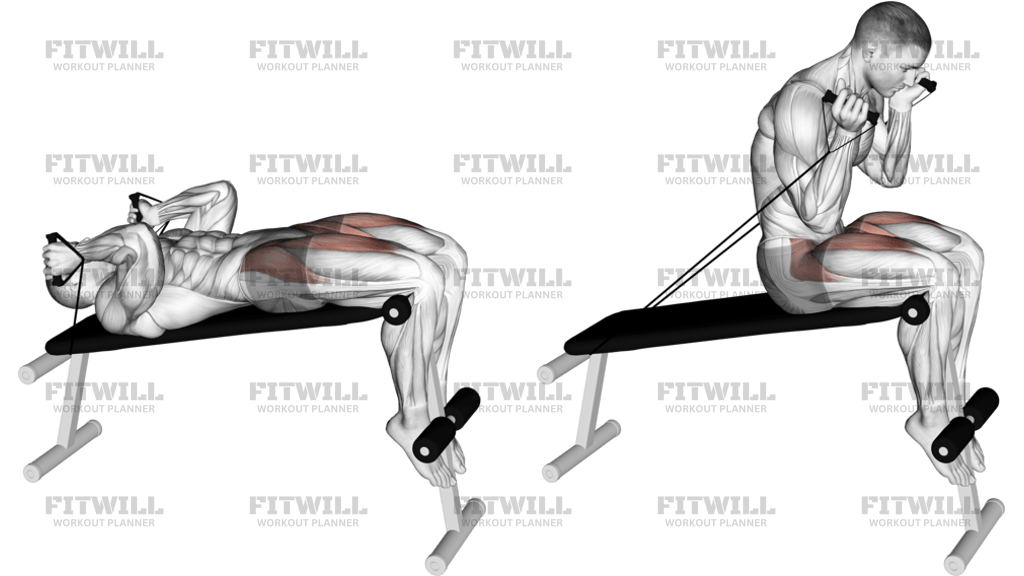
Band Decline Sit-Up is a decline-bench abdominal exercise that adds resistance to a classic sit-up by pulling against a band as you come upright. The decline angle increases the challenge on the way up and the band makes the top half of the rep feel heavier, so the exercise rewards smooth spinal flexion, honest range of motion, and control instead of speed.
The setup matters because the band tension and your foot lock decide whether the movement stays on your trunk or turns into a sloppy hip-driven pull. With your feet secured under the rollers, lie back on the decline bench, take the band handles or ends to your shoulders, and make sure the anchor stays low and behind the bench. That arrangement keeps the resistance line consistent and lets you sit up against the band instead of falling into the rep.
Most of the work should come from the rectus abdominis, with the obliques and hip flexors assisting as you roll the torso forward. The band can also slightly shift demand toward the upper abs because the resistance increases as you reach the top. If you overarch, yank with the arms, or lose the pelvis on the way down, the set becomes less about the abs and more about momentum and neck tension.
Use this exercise when you want a direct core-strength stimulus that is more challenging than a bodyweight decline sit-up but still easy to scale with lighter or heavier band tension. It fits well in accessory work, core circuits, or abdominal-focused sessions. The key is to keep each repetition clean, stop before the lower back starts to take over, and keep the descent controlled so the band does not pull you back too fast.
Because the band resistance changes through the range, small setup differences make a big difference in how the exercise feels. Start with enough tension to challenge the top of the rep without forcing you to jerk off the bench, and shorten the range if your lower back arches or your hip flexors dominate. Done well, this is a simple but effective way to train trunk flexion with a more demanding finish than a standard decline sit-up.
[ Workout Log & Planner ]
Put your next workout in Fitwill
Keep your plan and training log ready when you are.


Instructions
- Set the decline bench to a moderate angle and secure your feet under the ankle rollers.
- Attach or anchor the band low behind the bench, then sit on the pad and hold the handles or band ends near your shoulders or temples.
- Lie back with your lower back and mid-back supported by the bench and keep light tension on the band before you start.
- Tuck your chin slightly and brace your abdomen so your ribs stay down instead of flaring upward.
- Exhale and curl your torso up by peeling your shoulders and upper back off the bench.
- Sit all the way up only as far as you can without yanking with your arms or losing the foot lock.
- Squeeze the abs at the top for a brief moment while keeping the band under control.
- Lower yourself back to the bench slowly until your back is supported again and the band tension returns to the start position.
- Reset your brace before the next rep and repeat for the planned set.
Tips & Tricks
- Keep the band anchor low and behind you so the resistance stays consistent through the whole sit-up.
- If the band starts slack at the bottom, move farther from the anchor or shorten your grip until you feel tension right away.
- Do not pull the handles with your arms; your hands should stay anchored near the shoulders while the trunk does the work.
- Keep your feet pinned under the rollers so the hips do not pop open as you come up.
- Think about rounding the upper spine and ribs toward the pelvis instead of throwing the chest upward.
- Lower yourself on a slow count so the band does not snap you back to the bench.
- Stop a rep short if your neck starts to jut forward or you feel the lower back taking over.
- Choose a band that lets you sit up cleanly for every rep instead of forcing a partial swing.
Frequently Asked Questions
What muscles does a Band Decline Sit-Up train most?
The main target is the rectus abdominis, with the obliques and hip flexors helping to bring you up.
Can beginners perform this exercise?
Yes, but beginners should use a light band and a mild decline angle so they can control the full sit-up.
Where should the band be anchored?
Anchor it low and behind the bench so the pull stays directed toward the bottom of the sit-up instead of pulling you sideways.
How should I hold the band during the rep?
Hold the handles or band ends near your shoulders or temples and keep your elbows quiet so the arms do not turn the rep into a pull-down.
What is the most common mistake on this movement?
People yank with the neck or arms instead of curling the torso up under control.
How deep should the decline sit-up go?
Go down only as far as you can keep your ribs controlled and your lower back supported by the bench.
Is this different from a regular decline sit-up?
Yes. The decline bench creates more leverage, and the band increases resistance near the top of the rep.
How do I progress Band Decline Sit-Ups?
Use a stronger band, increase the decline angle, or add reps only if you can still lower under control.