Cable Standing Leg Curl
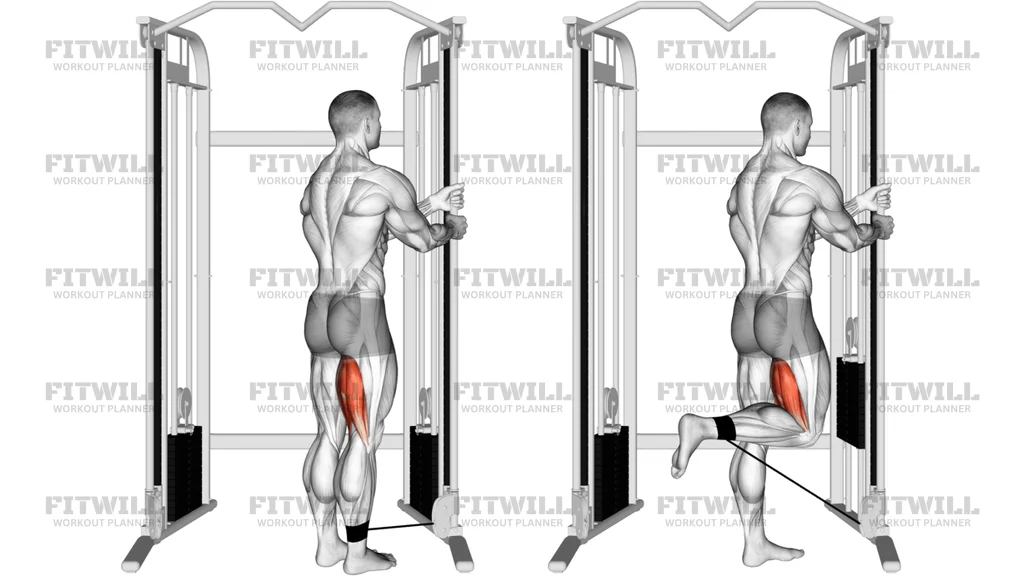
Cable Standing Leg Curl is a single-leg hamstring exercise done on a low pulley with an ankle strap. The standing setup keeps the hamstrings under steady cable tension while you train knee flexion one leg at a time. That makes it useful when you want a direct curl pattern without lying on a machine or relying on a bench for support.
The setup matters because the cable wants to pull the ankle forward and twist the hips as soon as the rep begins. Stand beside the stack, attach the cuff securely around the working ankle, and hold the upright or handles lightly for balance. Keep the support knee soft, the ribcage stacked over the pelvis, and the torso quiet so the hamstring can do the work instead of body sway.
Each repetition starts with the working leg nearly straight and the cable already under tension. Curl the heel back toward the glute by bending the knee, pause briefly at the top without arching the lower back, and then lower the foot slowly until the leg is almost straight again. The useful range is the one you can control while keeping the pelvis level and the cable path smooth.
This movement fits well as accessory hamstring work, unilateral leg training, or a lower-body finish when you want to expose left-right differences and add volume without loading the spine heavily. Light to moderate resistance usually works best because balance and pelvic control become the limiting factors before the hamstrings do. Controlled reps are more valuable here than chasing a heavy stack.
Keep the motion pain-free and precise. If the standing leg collapses, the hips open, or the torso starts swinging to help the curl, reduce the load and slow the lowering phase. A clean set should feel like the hamstring is pulling the heel back while the rest of the body stays organized and still.
[ Workout Log & Planner ]
Put your next workout in Fitwill
Keep your plan and training log ready when you are.


Instructions
- Attach a low-pulley cable to an ankle strap and fasten the cuff securely around the working ankle.
- Stand beside the cable stack, hold the upright lightly for balance, and plant the support foot flat on the floor.
- Keep the working leg slightly behind you with the knee almost straight, then square your hips and ribs toward the room.
- Soften the support knee, brace your midsection, and keep your torso tall instead of leaning hard into the machine.
- Curl the heel back toward your glute by bending the working knee while keeping the thigh mostly still.
- Squeeze briefly at the top of the curl without arching your lower back or letting the pelvis rotate open.
- Lower the foot slowly until the leg is nearly straight again and the cable stays under tension the whole time.
- Repeat for the planned reps, then return the ankle strap to the start position under control before stepping away.
Tips & Tricks
- Use an ankle cuff that sits snugly above the ankle bone so the strap does not slide or twist during the curl.
- A light forward hinge can help you feel the hamstring, but the movement should still come from knee flexion, not hip drive.
- Keep the thigh of the working leg quiet; if it swings backward a lot, the glute is taking over the motion.
- Hold the frame just hard enough to balance. If you are pulling yourself around the machine, the load is too heavy.
- Do not lock the support knee. A soft bend helps keep the pelvis level and reduces cheating through the low back.
- Lower the weight more slowly than you curl it so the hamstring keeps tension through the full range.
- Stop the top of the rep before your hips open or your lower back arches to chase a bigger range.
- Match both sides rep for rep, and start with the weaker leg first so fatigue does not hide the side-to-side difference.
Frequently Asked Questions
What muscles does Cable Standing Leg Curl work most?
It primarily trains the hamstrings, especially the knee-flexion role of the back of the thigh, with the glutes, calves, and trunk helping you stay balanced.
Do I need an ankle strap for this exercise?
Yes, a low cable and a secure ankle cuff are the intended setup. A handle is not a good substitute because the cable needs to sit on the lower leg.
Should my thigh move during the rep?
The thigh should stay mostly still. Think about bending the knee and bringing the heel toward the glute while keeping the pelvis square.
Can I hold the machine for balance?
Yes. A light grip on the upright is normal and often helpful, but you should not pull yourself through the rep with your arms.
Why do I feel this in my lower back?
That usually means the hips are rotating, the torso is swinging, or the load is too heavy. Reduce the weight and keep the ribs stacked over the pelvis.
Is this exercise beginner-friendly?
Yes, if you use light resistance and a stable hand position. Beginners usually do best with slow reps and a smaller range that stays fully controlled.
How heavy should I go on Cable Standing Leg Curl?
Choose a load that lets you curl and lower the ankle without bobbing, jerking, or losing balance. If the stack moves faster than your knee joint, it is too heavy.
What is a good alternative if I do not have a cable stack?
A lying or seated leg curl machine is the closest substitute. A stability-ball leg curl can also work if you want a bodyweight variation.