Bodyweight Rear Lunge
Bodyweight Rear Lunge is a bodyweight, knee-dominant lower-body exercise that trains the thighs one leg at a time. The rear step shifts most of the work to the front leg, which makes this movement useful for building quad strength, leg balance, and control without loading the spine or needing any equipment. Because the rep starts from a split stance, small changes in step length, torso angle, and knee tracking make a big difference in how the exercise feels.
This movement is especially effective when you want clean unilateral leg work that still feels natural and athletic. The front leg does most of the lifting, while the back leg mainly helps you balance and control the descent. A tall torso keeps the emphasis on the quads, while a slightly longer step back lets the front knee bend deeply without the heel lifting. If the step is too short, the front knee can jam forward; if it is too long, the set shifts away from the thighs and becomes harder to control.
During each repetition, lower straight down rather than reaching forward with the torso. The front foot should stay planted, the front knee should track in line with the toes, and the rear knee should travel toward the floor with control. At the bottom, the rear knee can hover just above the ground or lightly tap down if that is comfortable and stable. Drive back up through the full front foot and return to a tall standing position before starting the next rep.
Bodyweight Rear Lunge is useful in warm-ups, accessory blocks, home workouts, and beginner lower-body sessions because it teaches single-leg mechanics without external load. It also works well when you need to restore symmetry between legs or build tolerance for deeper knee bend. Keep the rep smooth and repeatable so the front thigh does the work instead of momentum, wobbling, or pushing off the back foot.
Use a reduced range, a slower tempo, or a hand support if balance limits the set before the legs do. The best version of this exercise is the one where each side looks identical, the pelvis stays level, and the front leg controls both the descent and the stand-up phase. When those pieces stay consistent, the rear lunge becomes a reliable quad-focused bodyweight pattern rather than just a balance drill.
[ Workout Log & Planner ]
Put your next workout in Fitwill
Keep your plan and training log ready when you are.


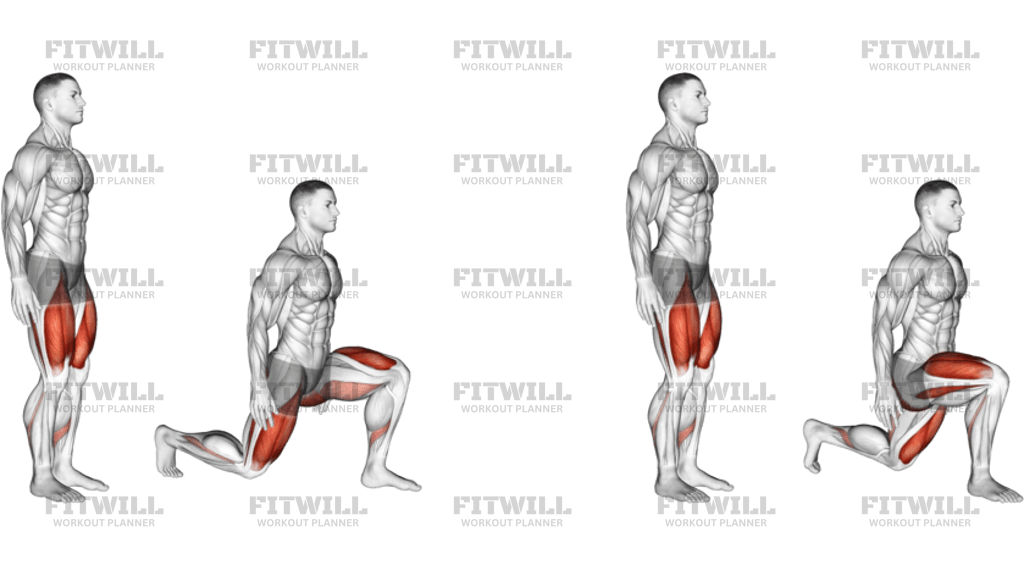
Instructions
- Stand tall with your feet about hip-width apart and your weight centered over both feet.
- Brace your midsection, keep your chest lifted, and point both toes forward or only slightly out.
- Step one leg straight back into a split stance, landing on the ball of the rear foot.
- Set the front foot flat and make sure the front heel stays down before you descend.
- Lower your body straight down by bending both knees, keeping most of your weight on the front leg.
- Let the rear knee travel toward the floor while the front knee tracks in line with the toes.
- Pause briefly near the bottom when the back knee is just above the floor or lightly touching if comfortable.
- Drive through the full front foot to stand back up, finishing tall without leaning back.
- Reset your stance and repeat on the same side or alternate sides with the same stride length.
- Inhale as you lower and exhale as you drive up.
Tips & Tricks
- Take a long enough step back that the front heel stays planted and the front shin can tilt forward naturally.
- Keep the torso tall if you want more quad emphasis; a bigger forward lean shifts work away from the front thigh.
- Let the rear foot act like a kickstand, not a push-off point.
- Watch the front knee so it tracks over the second or third toe instead of collapsing inward.
- Lower under control until the rear knee is close to the floor rather than bouncing out of the bottom.
- If balance is limiting you, touch a wall, rack, or chair lightly with one hand instead of shortening the range randomly.
- Use a shorter range only if it keeps the pelvis level and the front foot flat.
- Stop the set if the front knee starts shifting side to side or the torso starts rotating to cheat the rep.
Frequently Asked Questions
What muscles does Bodyweight Rear Lunge work most?
It primarily targets the quads on the front leg, with the glutes, adductors, and calves helping stabilize the movement.
Why step backward instead of forward?
Stepping back usually makes it easier to control the descent and keep the front foot planted, which is helpful for quad-focused bodyweight work.
Should my back knee touch the floor?
It does not have to touch. Lower until the rear knee is just above the floor, or make a light tap if that feels stable and pain-free.
How do I keep the front knee comfortable?
Use a longer rear step, keep the heel down, and let the knee track over the toes instead of forcing it far past the foot or collapsing inward.
Can beginners do this exercise?
Yes. It is a good beginner bodyweight pattern as long as the stance is stable and the descent stays controlled.
What is the most common mistake with the rear lunge?
People often make the step too short and tip forward, which turns the movement into a balance challenge instead of a clean leg exercise.
How can I make the rear lunge more quad-focused?
Keep your torso more upright, maintain full front-foot contact, and let the front knee bend deeply while the back knee drops straight down.
Can I alternate legs rep by rep?
Yes, but only if you can keep the same step length, depth, and posture on both sides. Otherwise, perform all reps on one side before switching.
How can I progress this movement without weights?
Slow the lowering phase, add a brief pause at the bottom, or increase range only if the front heel, knee, and pelvis stay controlled.