Rocket Jump
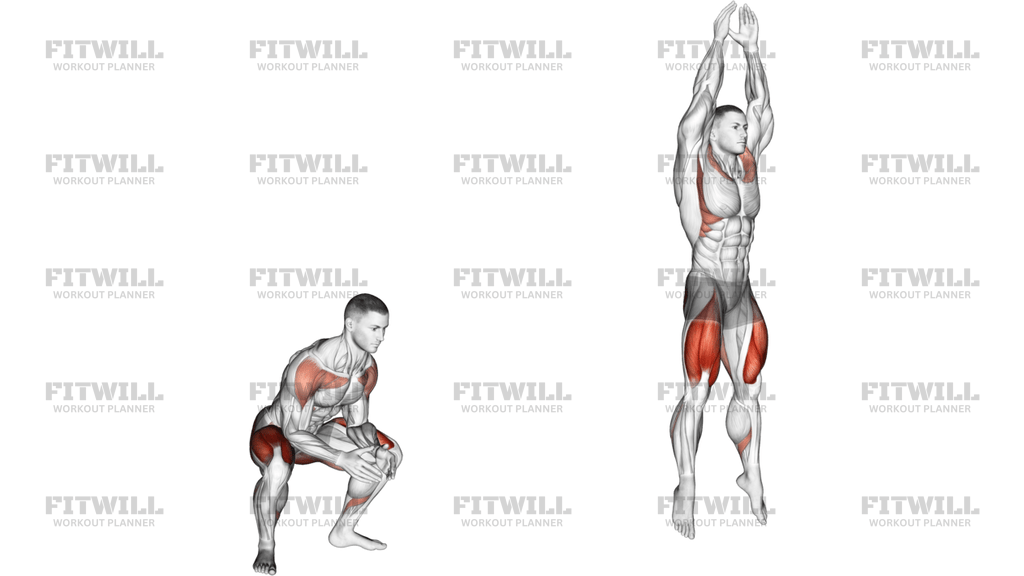
Rocket Jump is a bodyweight plyometric squat jump with an overhead reach. It is designed to load the thighs through a quick stretch-and-drive pattern, then challenge the calves, glutes, core, and shoulder position as you leave the floor and land again. The exercise is not about a long range or a heavy external load. It is about producing force cleanly from a compact athletic stance and then absorbing that force with control.
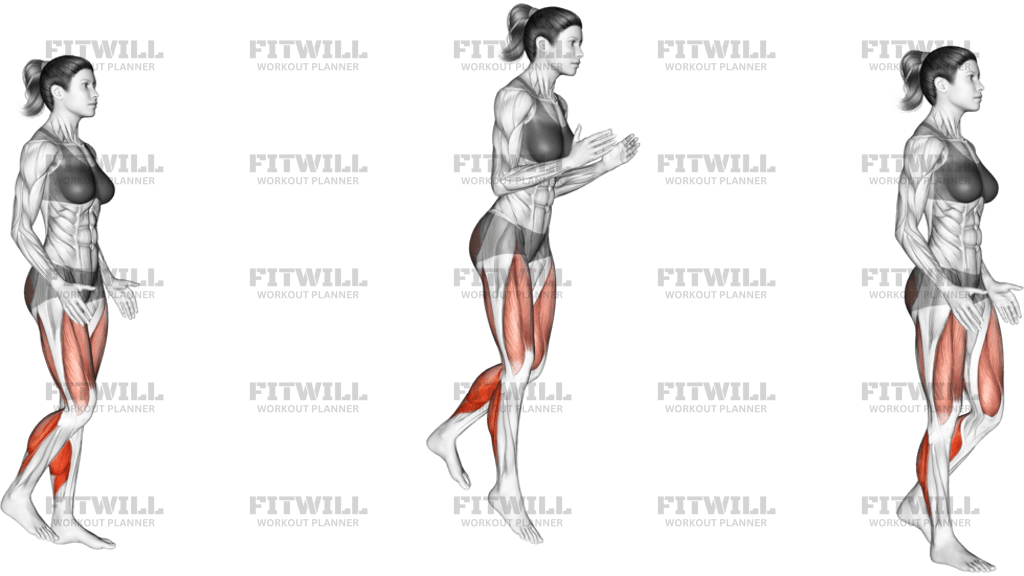
The setup matters because the quality of the jump depends on the quality of the preload. Start in a shallow squat with your feet about shoulder-width apart, chest lifted, and your weight centered over the middle of the foot. In the image, the arms travel up as you rise, so the upper body should help coordinate the jump rather than collapse forward. If you begin too deep or too upright, the rep becomes slow and awkward instead of explosive.
Each repetition should feel like one smooth sequence: load, drive, reach, and land. Sink into the squat, brace the trunk, then extend the ankles, knees, and hips together as you jump. Reach overhead at the top without arching the lower back, and land softly with the knees tracking over the toes. The landing is part of the exercise, not just the reset, so you should be able to stop the descent quietly and return to the squat with the same control you used on the takeoff.
Rocket Jump is useful when you want a bodyweight movement that builds power, coordination, and conditioning at the same time. It fits well in warm-ups, athletic circuits, and lower-body accessory work when the goal is to move fast without losing position. Keep the reps crisp, keep the jump height honest, and stop the set as soon as the landing gets noisy or the knees start to cave inward.
[ Workout Log & Planner ]
Put your next workout in Fitwill
Keep your plan and training log ready when you are.


Instructions
- Stand with your feet about shoulder-width apart and lower into a shallow squat with your chest up and your arms ready to assist the jump.
- Keep your weight centered over the middle of the foot and let your hips sit back enough that your knees stay aligned over your toes.
- Brace your trunk before you leave the floor so the torso stays organized through the jump.
- Drive through the floor and extend the ankles, knees, and hips together to jump vertically.
- Reach overhead as you rise, but keep the ribs from flaring and the lower back from arching.
- Land softly on the balls of your feet and then let the heels settle as you absorb the impact.
- Fold back into the squat under control, keeping the knees tracking in line with the feet.
- Reset your breath and repeat for the planned number of reps or until your landing quality drops.
Tips & Tricks
- Keep the squat shallow enough that you can jump immediately instead of sinking into a slow grind.
- Use the arm swing to help timing, not to yank your torso forward.
- Land quietly; a loud landing usually means the knees, hips, or ankles are not absorbing well.
- If your knees collapse inward on landing, reduce jump height and focus on pushing them out in line with the toes.
- Keep the chest proud on takeoff so the jump stays vertical instead of turning into a forward hop.
- Do fewer clean reps rather than chasing fatigue, because the movement loses power quickly when form breaks down.
- Use a flat, non-slip surface and enough open space overhead for the reach.
- If you cannot keep the trunk braced, shorten the jump and make the landing more deliberate.
Frequently Asked Questions
What muscles does Rocket Jump work most?
It mainly trains the thighs, with strong help from the glutes, calves, and core during the jump and landing.
Is Rocket Jump a good beginner exercise?
Yes, if you keep the jump small and the landing soft. Beginners should focus on control before trying to jump higher.
How deep should I squat before jumping?
Stay in a shallow athletic squat, roughly the depth you can hold while still exploding upward immediately.
What is the most common mistake with this jump?
People usually land too hard or let the knees cave inward. Both signs mean the jump is getting ahead of the landing mechanics.
Should my arms go overhead on every rep?
Yes, the overhead reach helps coordinate the jump. Just avoid over-arching the lower back as the hands rise.
How do I know if I am jumping too high?
If the landing becomes noisy, unstable, or delayed, the jump is probably higher than you can control cleanly.
Can Rocket Jump be used for conditioning?
Yes. It works well in short athletic circuits because it raises heart rate while still training lower-body power.
How can I make this exercise harder?
Increase the jump speed or slightly increase the jump height only if you can still land quietly and keep the knees tracking correctly.