Alternate Leg Raise
Alternate Leg Raise is a bodyweight floor exercise performed lying on your back while you alternate lowering one straight leg and lifting the other. It is a simple-looking drill, but the quality of the set depends on how well you keep the pelvis quiet and the lower back controlled. The movement is often used to build hip-flexor endurance, thigh tension, and trunk control at the same time.
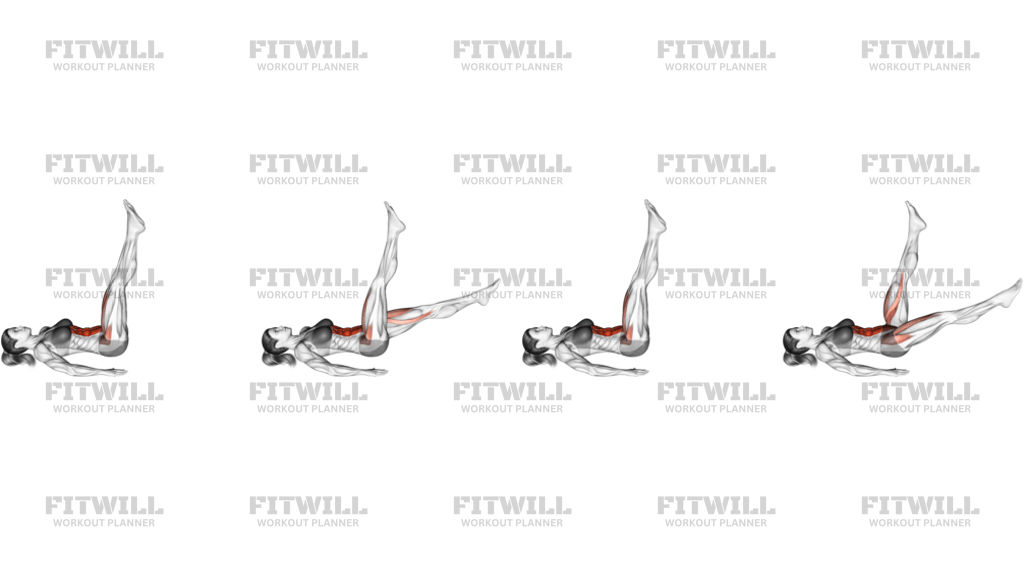
The image shows a supine setup with the torso flat, arms resting by the sides, and one leg held vertical while the other moves through the lowered position. That setup matters because the floor gives you immediate feedback: if the low back starts to arch or the hips start rocking, the range is too big or the tempo is too fast. A clean rep keeps the rib cage down and the pelvis steady while each leg moves independently.
Use the exercise as a controlled alternating pattern, not as a kick or swing. One leg lowers under control while the opposite leg stays long and active, then the legs switch without jerking the torso. The target is not to tap the floor at all costs. The target is to keep tension through the thighs and lower abdomen while maintaining a smooth, repeatable path.
This movement fits well in warmups, core blocks, accessory work, or conditioning circuits when you want bodyweight work that is easy to scale. Beginners can shorten the range, bend the knees slightly, or slow the pace if the low back wants to lift. If you cannot keep the lumbar spine down, the set should get easier, not more aggressive. Done well, Alternate Leg Raise builds control that carries over to sprinting, leg lifts, and other trunk-stability work without needing any equipment.
[ Workout Log & Planner ]
Put your next workout in Fitwill
Keep your plan and training log ready when you are.


Instructions
- Lie flat on your back on a mat with your arms resting by your sides and your palms pressing lightly into the floor.
- Flatten your lower back against the floor, draw your ribs down, and keep your neck relaxed before you begin.
- Lift one leg to a vertical position while keeping the other leg straight and active just above the floor.
- Keep both knees long but not locked so the legs stay controlled instead of snappy.
- Lower the working leg slowly until it is close to the floor without letting your back arch.
- As one leg lowers, bring the opposite leg back up to vertical and switch sides smoothly.
- Keep your hips square and avoid rocking side to side as the legs alternate.
- Breathe steadily, exhale during the hard part of each switch, and repeat for the planned reps.
Tips & Tricks
- Keep the low back pinned to the floor. The set should end or scale down the moment your lumbar spine starts to arch.
- Use a smaller range if your hamstrings or hip flexors pull your pelvis off the mat.
- Move one leg at a time with a smooth exchange. A jerky switch usually means the legs are swinging instead of working.
- Keep the lifted leg long and active rather than letting the knee bend as fatigue builds.
- Press your hands into the floor to help stop your torso from rolling when the legs alternate.
- Do not chase the floor with the lowering leg. Stop it a few inches above the mat if that is the deepest position you can control.
- Slow the lowering phase if the exercise turns into momentum work. A controlled descent is the training effect here.
- If the hip flexors take over completely, shorten the range and focus on keeping the lower abdomen braced.
Frequently Asked Questions
What muscle does Alternate Leg Raise target most?
It mainly trains the hip flexors and thigh tension, with the lower abs and deep core helping keep the pelvis steady.
Can beginners perform this exercise?
Yes. Beginners usually do best with a smaller range of motion, a slower pace, or a slight knee bend if the back starts to arch.
How low should the moving leg go?
Lower it only as far as you can keep your lower back flat. If the pelvis tips up, the range is too deep.
Should my legs stay straight during Alternate Leg Raise?
They should stay long and active, but a soft knee bend is fine if straight legs make it impossible to control the pelvis.
Why does my lower back lift off the floor?
The most common reasons are too much range, too much speed, or weak abdominal bracing. Reduce the depth until the back stays anchored.
What should my arms do during the exercise?
Keep them by your sides with the palms lightly pressing into the floor to help stabilize your torso.
Is this the same as a reverse crunch?
No. Alternate Leg Raise keeps the torso mostly fixed while the legs alternate; a reverse crunch uses more spinal curl and pelvic lift.
How can I make this exercise harder without adding weight?
Slow the lowering phase, hold one leg at vertical a little longer, or bring the working leg closer to the floor while keeping the low back flat.