Dumbbell Seated One-Arm Bicep Curl On Exercise Ball With Leg Raised
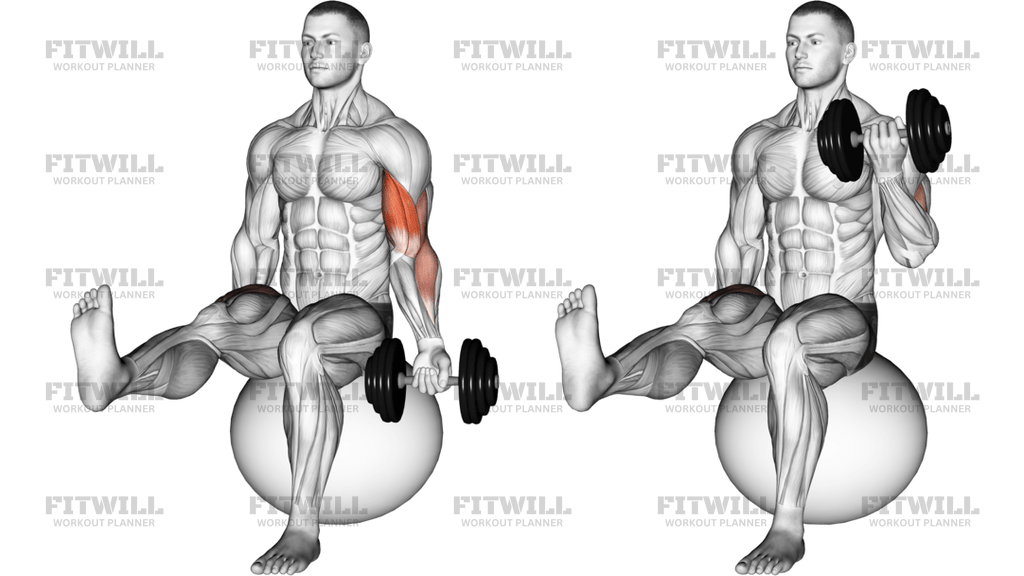
Dumbbell Seated One-Arm Bicep Curl On Exercise Ball With Leg Raised is a strict curling variation that trains the biceps while forcing you to stay organized on an unstable surface. Sitting on an exercise ball removes some of the support you get from a bench, and raising one leg increases the balance demand even more. That makes the exercise useful when you want arm work that also challenges body control and posture.
The main mover is the biceps brachii, with the brachialis and brachioradialis helping finish the curl and control the lowering phase. Your forearm flexors and shoulder stabilizers also work to keep the wrist, elbow, and upper arm lined up as the dumbbell travels. Because the setup is less stable than a seated curl on a bench, small shifts in posture can change how much tension stays on the arm.
Start by sitting tall on the ball with your feet set wide enough to stay balanced, then raise one leg as shown in the exercise variation. Keep your chest open, ribs stacked over your pelvis, and the working elbow close to your side. The goal is not to lean back and swing the dumbbell up, but to keep the upper arm quiet while the forearm rotates and flexes through a clean curl.
This movement is a good accessory choice for arm hypertrophy, unilateral training, and core-stability work when you want to eliminate cheating. The instability can make lighter loads feel harder, so quality matters more than weight. If the ball starts rolling or your torso rocks side to side, the dumbbell is probably too heavy or your setup is too narrow.
Use the curl when you want focused biceps work with a balance challenge, such as after your main press or pull work. It also fits well in home workouts because the exercise ball and a single dumbbell are enough to load it effectively. Keep the lowering phase controlled, reset your posture each rep if needed, and stop the set before your torso starts doing the work for your arm.
[ Workout Log & Planner ]
Put your next workout in Fitwill
Keep your plan and training log ready when you are.


Instructions
- Sit on an exercise ball with your feet planted, your torso tall, and one leg raised as shown for the movement.
- Hold a dumbbell in one hand with your palm facing forward and let the arm hang straight down beside the ball.
- Set your shoulders level, keep your ribs stacked over your pelvis, and pin the curling elbow close to your side.
- Brace lightly before each rep so the ball stays still and your upper arm does not drift forward.
- Curl the dumbbell toward your shoulder by bending only at the elbow, keeping the wrist straight and the upper arm quiet.
- Squeeze the biceps at the top without shrugging or leaning back to finish the rep.
- Lower the dumbbell slowly until the arm is almost straight and the elbow stays under control.
- Exhale as you curl up, inhale as you lower, and reset your posture before the next repetition.
- Switch arms or lower the foot back down only after you finish the set and can step off the ball safely.
Tips & Tricks
- Keep the raised leg still; if it swings or taps down, your balance challenge is too high for the load you chose.
- Use the ball as a balance tool, not a bouncing surface. A small shift is fine, but the hips should not rock with every rep.
- Let the elbow stay slightly in front of the seam of your shirt if needed, but do not let it drift all the way forward as you curl.
- A neutral wrist usually feels better than bending the hand back, especially near the top of the curl.
- If the shoulder starts rolling forward, the dumbbell is becoming too heavy or the set is getting too fatiguing.
- Lower for about two to three seconds so the biceps stay loaded instead of letting gravity drop the weight.
- Keep the upper arm quiet and think about closing the elbow joint, not throwing the dumbbell upward.
- Choose a lighter dumbbell than you would for a seated curl on a bench; the ball and raised leg already add difficulty.
- Stop the set when you start leaning back against the curl or twisting the torso to cheat the last few reps.
Frequently Asked Questions
What does Dumbbell Seated One-Arm Bicep Curl On Exercise Ball With Leg Raised work most?
The biceps are the main target, with the brachialis and brachioradialis helping during the curl and lowering phase.
Is Dumbbell Seated One-Arm Bicep Curl On Exercise Ball With Leg Raised good for beginners?
Yes, but start with a light dumbbell and keep the raised leg or ball position very steady. If balance is the limiting factor, lower the foot to the floor first.
Why raise one leg during Dumbbell Seated One-Arm Bicep Curl On Exercise Ball With Leg Raised?
Raising one leg reduces your base of support and makes it harder to cheat with torso sway. That extra instability forces cleaner arm work and more control.
What is the biggest mistake in this curl variation?
Leaning back and swinging the dumbbell is the main problem. Keep the elbow tucked and let the forearm do the work instead.
Should my elbow move during Dumbbell Seated One-Arm Bicep Curl On Exercise Ball With Leg Raised?
The elbow should stay close to your side with only a small amount of natural movement. If it travels far forward, the curl turns into a shoulder-dominant swing.
Can I do this with both feet on the floor instead of one leg raised?
Yes. Dropping the raised leg makes the movement easier and is a good option if the ball feels too unstable or you are learning the curl pattern.
How far should I lower the dumbbell?
Lower until the arm is almost straight and the biceps stay under tension, but stop short of locking the elbow hard if that bothers your joint.
Why does the ball make Dumbbell Seated One-Arm Bicep Curl On Exercise Ball With Leg Raised feel harder?
The ball keeps your torso from bracing against a bench, so your core and shoulder stabilizers have to work harder to keep the curl strict.
What weight should I use for Dumbbell Seated One-Arm Bicep Curl On Exercise Ball With Leg Raised?
Use a lighter load than a standard seated curl and choose the heaviest dumbbell you can lift without rocking the ball, shrugging, or twisting your torso.