Assisted Prone Rectus Femoris Stretch
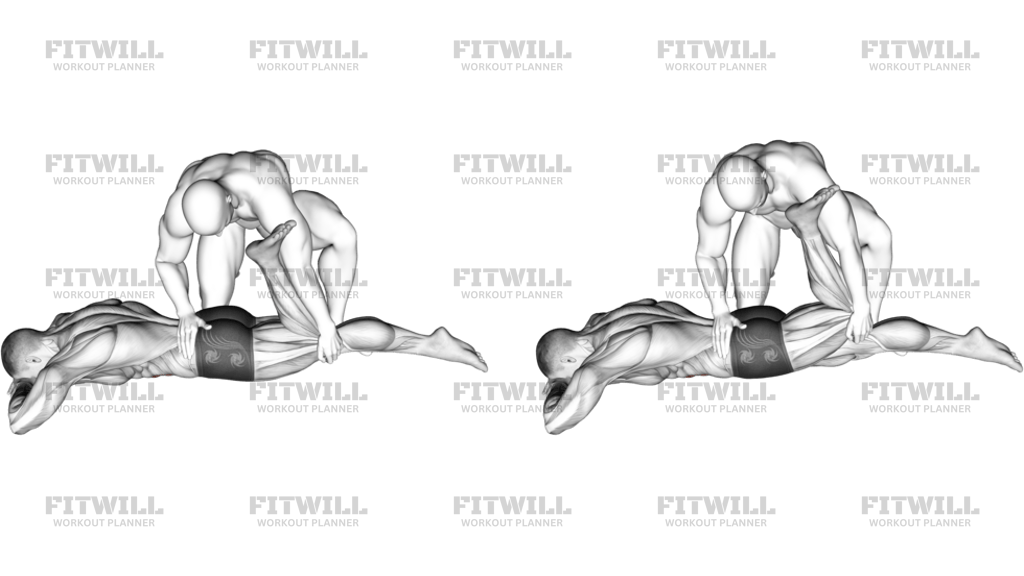
Assisted Prone Rectus Femoris Stretch is a partner-assisted mobility exercise for the front thigh and hip flexor line, performed face down on a mat while the pelvis stays pinned to the floor. The stretch places the rectus femoris under tension by combining knee flexion with a fixed, extended hip position, which is why the setup matters as much as the stretch itself. When the pelvis tips forward or the lower back arches, the movement shifts away from the target and into the spine.
The exercise is most useful when the goal is to restore length in the quadriceps after running, cycling, squatting, sprint work, or long periods of sitting. The assisting partner stabilizes the hip with one hand and guides the ankle or lower leg with the other, helping the lifter stay honest about range. That assistance should feel gradual and precise, not forced. The target sensation should build along the front of the thigh, not as a sharp pinch in the knee or an aggressive pull in the low back.
A clean repetition starts with a neutral pelvis, relaxed neck, and both hips square to the mat. From there, the knee is bent slowly so the heel moves toward the glute while the thigh stays down and the hip remains extended. Small adjustments in knee angle and pelvic pressure change the intensity a lot, so the best version is the one you can breathe through without losing position. Exhale into the stretch, keep the ribcage heavy, and stop the moment the lower back starts to lift.
Use this stretch as part of a warm-up for athletes who need better front-thigh mobility, or as a cooldown when the quads feel tight after lower-body training. It is also useful in rehab-adjacent mobility work because the prone position makes compensation easy to see and correct. If the knee is sensitive, reduce the bend angle or add a towel under the thigh; if the low back complains, shorten the range and increase pelvic control before trying to go deeper.
[ Workout Log & Planner ]
Put your next workout in Fitwill
Keep your plan and training log ready when you are.


Instructions
- Lie face down on a mat with both legs long, forehead relaxed, and hips square.
- Have your partner stand beside the working leg and place one hand over the back of the pelvis to keep the hip from lifting.
- With the other hand, support the ankle or lower shin and begin bending the knee so the heel travels toward the glute.
- Keep the front of the thigh and the top of the hip heavy against the mat as the knee folds.
- Stop the bend before the low back arches or the pelvis rolls to one side.
- Hold the stretch and breathe out slowly so the rectus femoris can lengthen without bracing.
- If the stretch eases, let the ankle travel a little farther only while the pelvis stays pinned down.
- Release the leg with control, straighten the knee, and repeat on the other side.
Tips & Tricks
- The pelvis should stay heavy on the mat; if it pops up, the stretch has moved into the low back.
- A small bend in the knee is enough at first, because the rectus femoris gets loaded quickly in this position.
- Keep the working hip pointing straight down instead of letting it open to the side.
- The best cue is a smooth heel-to-glute motion, not a forced yank on the ankle.
- Use a folded towel under the pelvis or thigh if the mat position feels bony or uncomfortable.
- Breathe out through the long hold and let the front of the thigh soften between exhalations.
- If the knee feels compressed, back off the bend slightly and keep the shin more vertical.
- Do not chase a bigger range by twisting the torso; the stretch should stay square and controlled.
Frequently Asked Questions
What does the Assisted Prone Rectus Femoris Stretch target?
It targets the rectus femoris, which is the straight-headed quad muscle that crosses both the hip and knee.
Why is this stretch done face down on a mat?
The prone position keeps the hip extended and makes it easier to keep the pelvis flat while the knee bends.
How should the partner apply pressure?
The partner should pin the pelvis gently and guide the lower leg slowly, increasing the stretch only as long as the hips stay square.
Where should I feel the stretch most?
You should feel it across the front of the thigh and sometimes near the hip, not as a sharp pull in the knee or low back.
How long should I hold each side?
A steady 20 to 40 second hold is a practical range, as long as the pelvis stays down and you can breathe normally.
Can I do this without a partner?
Yes, a strap or towel can substitute for the partner’s hand on the ankle, but you still need to keep the pelvis flat.
What is the most common mistake?
Letting the low back arch or the pelvis roll as the ankle gets pulled closer is the most common way to cheat the stretch.
Is this better for warm-up or cooldown work?
It is usually better as cooldown or mobility work, though athletes sometimes use a gentler version in a warm-up.