Lying Leg Hang Abductor Stretch
Lying Leg Hang Abductor Stretch is a side-lying bench stretch for the outer hip and upper thigh. The setup uses a flat bench and your own body weight, with one leg supported on the bench while the hanging leg relaxes over the edge. It is meant to create a controlled stretch through the hip abductors and the tissues around the outside of the pelvis, not to force a deep end range.
The bench matters because it fixes your torso and gives the leg a clear path to hang freely. If you slide too far off the edge or let the pelvis twist, the stretch quickly moves away from the outer hip and into the low back or front of the hip. A clean setup keeps your shoulders stacked, your trunk quiet, and the stretch where you can actually feel and control it.
This is a useful drill when the outside of the hip feels tight after lower-body training, long periods of sitting, or before exercises that need freer hip motion. It can also work as a cooldown stretch when you want to reduce tension around the glute medius, tensor fasciae latae, and the lateral hip line. The goal is a steady, repeatable position that lets the tissue open without joint pinching or twisting.
Perform each rep by settling into the position, relaxing the hanging leg, and breathing into the stretch instead of bouncing into it. A small change in hip angle or torso position can make a big difference, so adjust the bench edge and the amount of drop until the stretch is strong but still smooth. If the sensation shifts into sharp pain, numbness, or front-of-hip pinching, come out of the position and shorten the range.
Treat this as a controlled mobility drill, not a race for the deepest possible stretch. Done well, it should leave the outer hip feeling lengthened and easier to move, while the rest of the body stays calm and supported.
[ Workout Log & Planner ]
Put your next workout in Fitwill
Keep your plan and training log ready when you are.


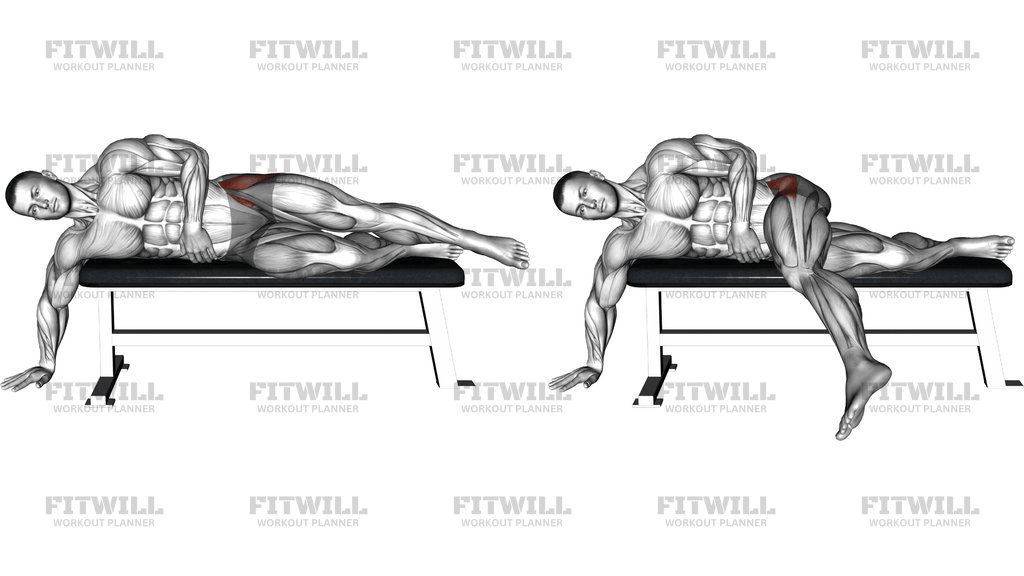
Instructions
- Place a flat bench on a stable surface and lie sideways along it with your hip near the edge.
- Support your head with the near-side forearm and keep your shoulders stacked so your torso does not roll forward or back.
- Let the leg you want to stretch hang off the edge of the bench with the knee relaxed and the foot hanging freely.
- Keep the supported leg and the rest of your torso quiet so the hanging leg can drop without compensation.
- Slowly let the hanging knee move toward the floor until you feel the stretch build along the outside of the hip and upper thigh.
- Exhale and settle into the position instead of pushing the leg downward or bouncing at the bottom.
- Hold the end range for a controlled stretch, then ease out only as far as needed to reset the hip.
- Repeat on the other side if you are working both hips.
Tips & Tricks
- The best stretch usually comes from a small adjustment in where your hip sits on the bench, not from forcing the knee lower.
- Keep the pelvis mostly square; if you roll the torso open, the outer-hip stretch gets replaced by a general twist.
- Let the hanging leg stay relaxed through the hip and knee so the bench, not your muscles, creates the drop.
- A slow exhale often increases the stretch more safely than pressing the leg down with your hand.
- If you feel the front of the hip jam, move your hip slightly farther from the edge and reduce the drop.
- Keep the neck supported and the upper trap relaxed so the position does not turn into an awkward side plank hold.
- Use a shallow range first and add depth only when the stretch feels clean and even along the outer thigh.
- Stop short of any sharp pull in the groin or low back; this should feel like a broad outer-hip lengthening.
Frequently Asked Questions
What does the Lying Leg Hang Abductor Stretch target most?
It mainly targets the hip abductors on the outside of the hip, especially the glute medius and tensor fasciae latae area.
Do I need equipment besides a bench?
No. A flat bench or similar firm edge is enough, since your body weight creates the stretch.
How do I know the setup is correct?
You should feel the stretch on the outside of the hanging leg's hip and upper thigh, not a twist through the low back.
Can beginners do this stretch?
Yes, as long as they keep the range small and let the leg hang naturally instead of forcing the knee toward the floor.
What is the most common mistake?
Rolling the torso open or pressing the hanging leg down too aggressively usually turns the stretch into a twist rather than a hip opener.
Should I hold the position or pulse it?
Hold it and breathe. Small, controlled holds are safer and usually more effective than bouncing into the bottom.
What if I feel pinching in the front of the hip?
Shorten the range, move your hip slightly away from the edge, and stop if the pinch does not go away.
Where does this fit in a workout?
It works well as a warm-up mobility drill, a cooldown stretch, or accessory recovery work after lower-body training.