Stationary Bike Run Version 3
Stationary Bike Run Version 3 is a seated cardio drill that uses a stationary bike to keep the legs turning in a smooth, repeatable rhythm. It is less about sprinting all-out and more about holding a clean pedal stroke with a steady torso, controlled breathing, and enough resistance to make the work feel purposeful. The movement is useful when you want conditioning without the joint impact of running, or when you need a machine-based effort that can be scaled easily from easy warm-up pace to hard interval work.
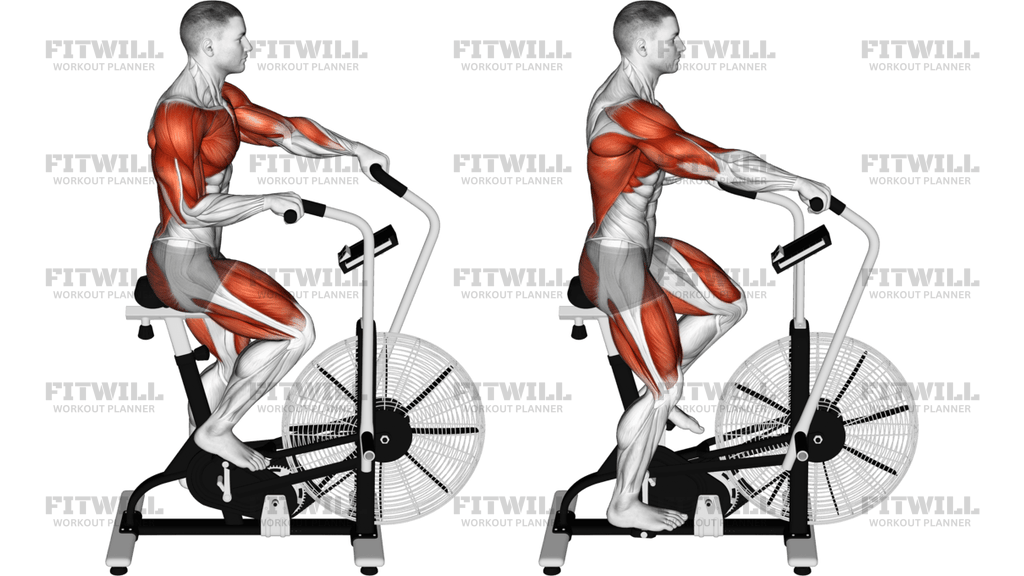
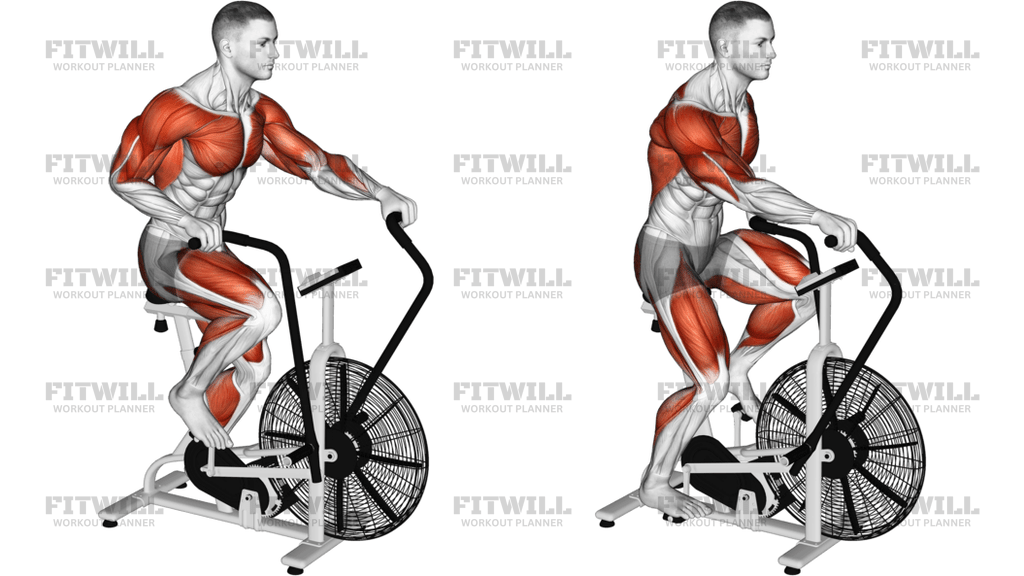
The setup matters because the bike only feels efficient when the saddle, handlebars, and foot position fit your body. Sit tall on the seat, place the balls of your feet securely on the pedals or in the cages, and let your hands rest on the front bars for balance and light support. In the image, the torso stays slightly hinged forward from the hips rather than rounded through the upper back, which keeps the stroke smooth and helps you drive power through the pedals instead of rocking side to side.
During the pedal cycle, think about pushing the downstroke through the whole leg and keeping the return smooth rather than stomping one side and letting the other leg collapse. A steady cadence with even pressure on both pedals makes the exercise feel more like controlled running mechanics and less like a choppy spin. Breathe in a regular rhythm, avoid holding your breath during harder pushes, and keep your shoulders quiet so the legs do the work.
Stationary Bike Run Version 3 fits well as a warm-up, an interval piece, or a low-impact conditioning block between strength sets. It can also work as a recovery tool when you want to raise heart rate without hammering the knees or ankles. The target is not just speed; it is a clean, repeatable effort that leaves you breathing hard while still maintaining posture, cadence, and smooth foot pressure.
Form breaks down when the seat is too low, the resistance is so light that the pedals spin away, or the rider pulls too hard on the handlebars. Keep enough resistance to control the stroke, let the knees track forward rather than flaring wide, and finish the set before your hips start bouncing on the saddle. If you treat each rep like a compact, controlled stride on the bike, the movement stays safer, more effective, and much easier to repeat across a workout.
Fitwill
Log Workouts, Track Progress & Build Strength.
Achieve more with Fitwill: explore over 9600 exercises with images and videos, access built-in and custom workouts, perfect for both gym and home sessions, and see real results.
Start your journey. Download today!




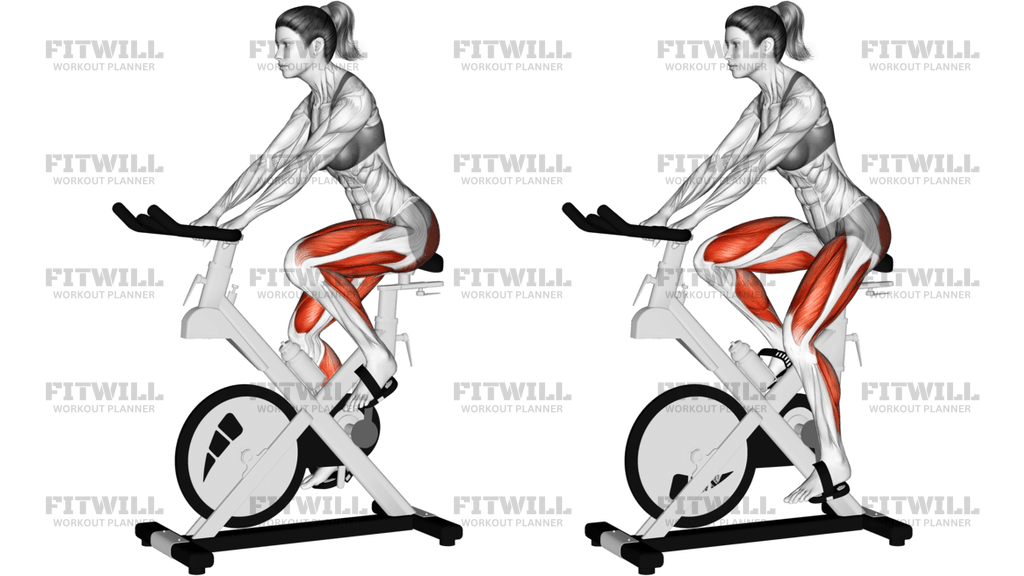
Instructions
- Adjust the saddle so your hips stay level and your knee has a slight bend at the bottom of the pedal stroke.
- Sit on the bike with your hands lightly on the front handlebars and the balls of your feet secured on the pedals or straps.
- Set your torso in a slight forward hinge from the hips, with your chest open and your shoulders relaxed away from your ears.
- Press one pedal down smoothly while the other leg comes back up, keeping both knees tracking straight ahead.
- Keep a steady cadence and let the legs circle the pedals without bouncing on the seat or rocking your torso side to side.
- Increase resistance only enough to keep the stroke controlled; the pedals should feel driven, not thrown.
- Breathe in a steady rhythm instead of holding tension in your neck, jaw, or upper back.
- If the effort is interval-based, finish the work period with the same posture you started with, then ease the pedals down for recovery.
- Stop the set if your hips start lifting off the saddle or your knees lose their forward track.
- Dismount carefully once the pedals slow to a comfortable stop.
Tips & Tricks
- A saddle that is too low makes the top of the stroke feel cramped and loads the front of the knees more than the legs.
- Keep your grip light enough that the bars support balance without turning the upper body into a brace.
- If your shoulders creep up, reduce the resistance or widen your chest instead of yanking harder on the handlebars.
- A smooth pedal circle beats a choppy stomp; the goal is even pressure through the downstroke and the return.
- Use enough resistance that the flywheel does not spin freely when you stand or accelerate.
- Keep both knees tracking forward rather than letting one knee drift outward on the harder side.
- If your lower back tightens, shorten the reach to the bars and hinge less aggressively from the hips.
- For intervals, choose a cadence you can repeat instead of sprinting the first round and fading early.
- Keep your feet planted through the forefoot; sliding to the toes can make the stroke unstable.
- Finish the set when your hips start to bounce, because that usually means the load or cadence is too aggressive.
Frequently Asked Questions
What muscles does Stationary Bike Run Version 3 work?
It mainly challenges the quads, glutes, hamstrings, calves, hip flexors, and core while your heart and lungs do the bulk of the conditioning work.
Is Stationary Bike Run Version 3 good for beginners?
Yes. The seated setup makes it easy to scale with light resistance, and beginners can focus on saddle height, smooth pedaling, and short work intervals before building intensity.
How should the saddle be set on Stationary Bike Run Version 3?
Set the seat so your knee stays slightly bent at the bottom of the pedal stroke. If your hips rock or your knees feel jammed at the top, the saddle is likely too low.
Should I stay seated or stand up for Stationary Bike Run Version 3?
This version is best kept seated, with a small forward hinge and light hand support on the bars. Standing usually changes the rhythm and makes the set less controlled.
Why do my knees flare out on Stationary Bike Run Version 3?
That usually means the seat is too wide for your setup, the resistance is uneven, or you are losing line through the pedal stroke. Keep both knees traveling forward over the pedals.
Can I use Stationary Bike Run Version 3 for intervals?
Yes. It works well for steady-state or interval training as long as you keep the cadence and resistance high enough to challenge you without bouncing on the saddle.
What should I hold on the handlebars?
Rest your hands lightly on the front bars for balance and upper-body quieting. You should not need to pull yourself through the stroke.
What if my lower back feels tight during Stationary Bike Run Version 3?
Reduce how far you reach to the bars, sit a little taller, and avoid forcing a deep hinge. A tight lower back usually means the torso is collapsing or the bike fit is off.