Standing Calf Raise On A Staircase
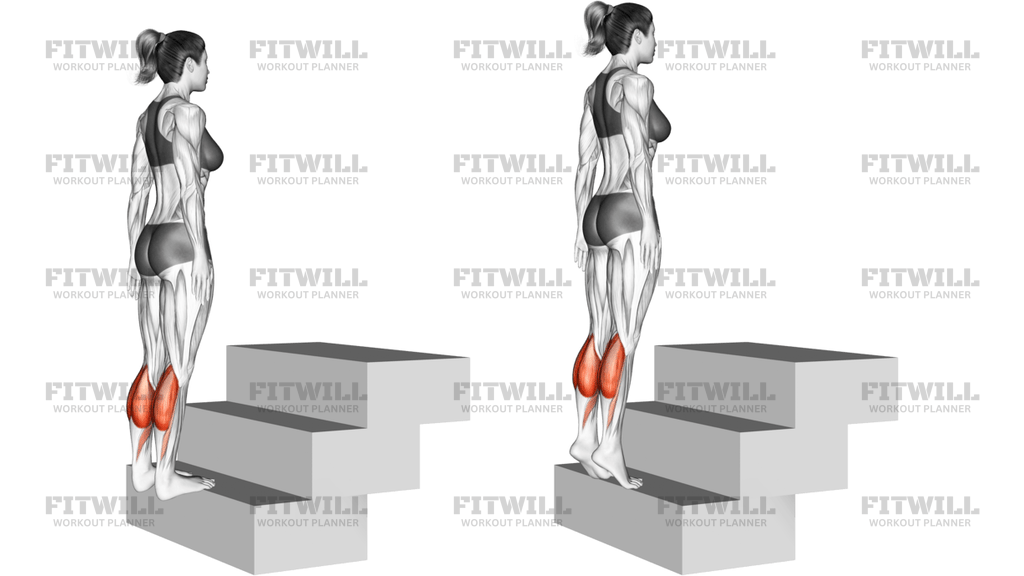
Standing Calf Raise On a Staircase is a simple bodyweight calf exercise that uses the edge of a stair to let your heels sink below the level of the step before you rise as high as possible onto your toes. That extra drop makes the movement more demanding than a flat-floor calf raise because it gives the calves a clearer stretch at the bottom and a stronger squeeze at the top. It is a practical option when you want direct calf work without needing a machine, dumbbells, or a dedicated calf block.
This exercise primarily trains the calves, especially the gastrocnemius, with the soleus helping to stabilize and produce ankle extension through the full rep. Because you are balancing on a narrow surface, the smaller muscles around the ankle and foot also have to keep the pressure centered and prevent the foot from rolling inward or outward. That balance demand is part of the value of the exercise, but it only helps if the movement stays smooth and controlled.
The setup matters more here than people often expect. Place the balls of your feet on the edge of the stair, keep your heels free to travel below the step, and stand tall with the ankles stacked under the hips. If you need balance support, touch a railing lightly rather than leaning on it. From there, let the heels lower under control until you feel a stretch through the lower calf, then drive straight up through the big toe and second toe until you are high on the forefoot.
Good reps are deliberate, not bouncy. The calf should do the work from the stretched bottom position to the fully raised top position, with the knees staying steady and the torso quiet. On the way down, resist the urge to drop quickly or use the stair like a springboard, because that takes tension away from the calf and shifts stress into the Achilles tendon and ankle joint. A short pause at the top can help you feel the contraction more clearly.
Standing Calf Raise On a Staircase fits well as accessory work after squats, runs, jumps, or lower-body strength sessions, and it can also be useful in warmups when you want to wake up the feet and ankles before heavier lifting. It is beginner-friendly if you keep the range modest and use support for balance, but it becomes much more challenging when you slow the lowering phase, add a pause, or switch to one leg. As with any calf movement, the goal is clean repetition quality: consistent range, steady balance, and no pain in the Achilles or front of the ankle.
[ Workout Log & Planner ]
Put your next workout in Fitwill
Keep your plan and training log ready when you are.


Instructions
- Stand on the edge of a stair with the balls of your feet on the lip and your heels hanging free.
- Place your feet about hip-width apart and keep your weight centered over the big toe and second toe.
- Hold a railing or wall lightly only if you need balance help.
- Let your heels lower below the step until you feel a stretch through the calves.
- Keep your knees straight but not locked while you stay tall through the torso.
- Drive through the balls of your feet and rise as high as you can onto your toes.
- Squeeze the calves briefly at the top without rocking forward or rolling the ankles outward.
- Lower back under control to the stretched position and keep the descent smooth.
- Repeat for the planned reps, then step down carefully when the set is finished.
Tips & Tricks
- Use the stair edge that lets your heel drop freely without your arch collapsing off the step.
- A light fingertip on the railing is fine, but do not let your arms carry your bodyweight.
- Keep pressure on the big toe and second toe so the ankle does not drift to the outside edge.
- Pause for a second in the bottom stretch if your Achilles tolerates it; skip the pause if it feels sharp.
- A slower lowering phase usually makes this exercise more effective than chasing a fast bounce.
- Keep the knees quiet and nearly straight to bias the gastrocnemius more strongly.
- If you bend the knees a little, the movement shifts some work toward the soleus.
- Single-leg reps are a good progression when two-legged raises become too easy on the stair.
- Stop the set if you feel pinching in the front of the ankle or pain along the Achilles tendon.
Frequently Asked Questions
What muscles does Standing Calf Raise On a Staircase work?
It mainly works the calves, especially the gastrocnemius, with the soleus and smaller ankle stabilizers helping throughout the rep.
How low should my heels go on the stair edge?
Lower only until you feel a strong calf stretch without the heel dropping so far that the ankle feels compressed or unstable.
Should I hold the railing during Standing Calf Raise On a Staircase?
You can touch the railing lightly for balance, but avoid pushing through it or using it to help you rise.
Why do my ankles roll outward when I do this on a staircase?
That usually happens when the pressure shifts to the outer edge of the foot. Keep the load centered over the big toe and second toe so the ankles stay stacked.
Is Standing Calf Raise On a Staircase better with straight knees or bent knees?
Straight knees emphasize the gastrocnemius more, while a small knee bend shifts a bit more work toward the soleus.
Can beginners do Standing Calf Raise On a Staircase?
Yes. Beginners should start with both feet, a small controlled range, and light balance support until the ankle path feels stable.
What if I feel this in my Achilles tendon instead of my calves?
Reduce the bottom depth, slow the descent, and stop if the tendon feels sharp or irritated. The stretch should be strong but controlled, not painful.
What is a good progression for this exercise?
Move from two-legged raises to slower eccentrics, then add a pause at the top or switch to single-leg reps for more challenge.