Dumbbell Deadlift
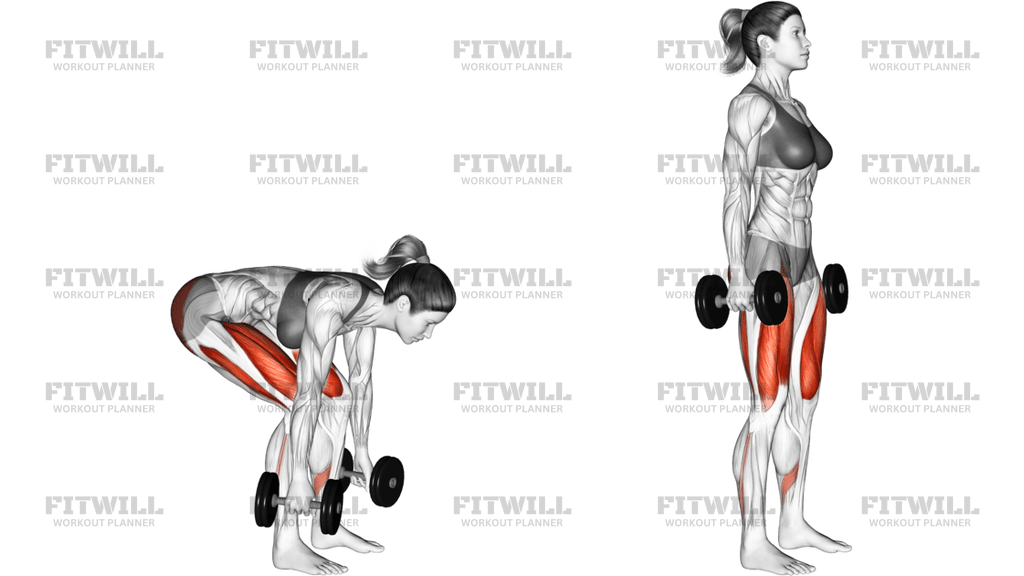
Dumbbell Deadlift is a classic hip-hinge strength exercise built around two dumbbells and a floor start. The lift trains the posterior chain through a controlled pull from the ground, with the legs, hips, back, and grip all contributing to each rep. In the image, the dumbbells begin beside the feet on the floor and travel close to the body as you stand, which is the key to keeping the movement efficient and safe.
The Dumbbell Deadlift is especially useful when you want to practice hinge mechanics without committing to a barbell. Because the weights sit outside the legs, the setup asks you to organize your stance, keep the spine neutral, and let the hips and knees share the work instead of turning the rep into a squat. That makes the exercise valuable for general strength, lower-body conditioning, and learning how to brace before a heavier hinge pattern.
Setup matters a lot here. Start with feet about hip-width apart, dumbbells just outside the shoes, and shins close enough to the weights that you can grab them without rounding forward. The chest should stay long, the shoulders packed down, and the neck neutral so the torso can hinge from the hips while the arms stay straight. If the dumbbells drift away from the legs, the lever gets longer and the lower back has to work harder to keep the load organized.
On the way up, drive the floor away and extend the hips and knees together until you stand tall. The dumbbells should slide up the line of the legs rather than swinging in front of you, and the top position should finish upright with the glutes engaged rather than leaning back. Lower the weights by sending the hips back first, then bending the knees as the dumbbells pass the thighs and shins. That controlled descent keeps tension on the posterior chain instead of dumping the load into the lower back.
Use Dumbbell Deadlift when you want a simple, repeatable hinge that can fit into lower-body sessions, full-body training, or accessory work after squats or presses. It is often a better choice than a barbell for lifters who need a shorter range, more individual arm freedom, or a setup that is easier to reset between reps. Keep every repetition crisp, stop the set if the back starts to round, and choose a load that lets you stand up and return to the floor without losing position.
Fitwill
Log Workouts, Track Progress & Build Strength.
Achieve more with Fitwill: explore over 9600 exercises with images and videos, access built-in and custom workouts, perfect for both gym and home sessions, and see real results.
Start your journey. Download today!




Instructions
- Stand with your feet about hip-width apart and place a dumbbell on the floor just outside each shoe.
- Hinge at the hips and bend the knees until you can grip the dumbbells with straight arms and the handles centered under your shoulders.
- Set your chest long, pull your shoulders down away from your ears, and keep your neck in line with your spine.
- Brace your midsection before the first pull so your torso stays firm as you leave the floor.
- Drive through your heels and midfoot to lift the dumbbells, letting the hips and knees extend together.
- Keep both dumbbells close to your legs as they travel upward, avoiding any forward swing in front of the knees.
- Finish the rep standing tall with the glutes squeezed and the shoulders stacked over the hips, not leaned back.
- Lower the dumbbells by pushing the hips back first, then bending the knees as the weights pass the thighs and shins.
- Set the dumbbells back on the floor with control, reset your brace, and repeat for the next rep.
Tips & Tricks
- Keep the dumbbells brushing the legs on the way up and down so the load stays close to your center of gravity.
- If your lower back rounds as the dumbbells pass the knees, shorten the range and stop the descent higher on the shins.
- Think about pushing your hips back toward a wall behind you before you bend the knees on the way down.
- Keep pressure through the whole foot, especially the heel and midfoot, instead of rolling onto the toes.
- Use a grip width that lets your arms hang naturally outside the legs without forcing the shoulders forward.
- Lock your lats in by imagining you are squeezing the dumbbells into your sides even though the arms stay straight.
- Exhale as you pass the hardest part of the lift, then reset your breath before the next repetition.
- Choose a load that lets you set the dumbbells down quietly; if they slam, the descent is probably too fast.
- Stop the set when the weights start drifting away from the shins or your torso starts rising before the hips.
Frequently Asked Questions
What muscles does Dumbbell Deadlift work most?
It mainly trains the glutes, hamstrings, spinal erectors, and grip, with the upper back and core helping keep the torso organized.
Is Dumbbell Deadlift good for beginners?
Yes, it is a good hinge drill for beginners because the dumbbells are easy to reset and the range can be kept short while you learn position.
Should the Dumbbell Deadlift start from the floor every rep?
It can, and that is how the image shows it. Starting from the floor gives you a clean reset, but if mobility is limited you can raise the starting height slightly with blocks or plates.
How low should I lower the dumbbells in Dumbbell Deadlift?
Lower them as far as you can while keeping a flat back and the dumbbells close to your shins. If the spine rounds, stop higher.
What is the biggest mistake in Dumbbell Deadlift?
Letting the dumbbells drift away from the legs is the biggest problem because it turns the lift into a long-lever pull that is harder on the lower back.
Can I replace barbell deadlifts with Dumbbell Deadlift?
For lighter training blocks, yes. Dumbbells are usually better for moderate loading, cleaner resets, and unilateral grip freedom, but they are not a perfect substitute for maximal barbell work.
Why do my hamstrings feel tighter than my back during Dumbbell Deadlift?
That usually means the hinge is working well. If the stretch feels too aggressive, reduce the depth slightly and keep the shins more vertical on the descent.
Do I need to touch the floor with the dumbbells every rep?
No, but touching down lightly between reps is fine if you can keep your brace and back position. If contact makes you lose posture, stop just above the floor instead.