Barbell Step-Up
Barbell Step-Up is a unilateral lower-body strength exercise performed with a barbell racked across the upper back while you step onto a bench or box with one leg. It trains the hips, glutes, quads, and trunk to produce force while keeping the pelvis level and the torso steady.
The height of the bench matters because the working leg should do most of the lifting. A box that is too high turns the movement into a balance fight and often shifts work away from the target leg; a lower bench lets you step cleanly and press through the whole foot.
Each rep starts with the entire working foot planted on the bench, the ribs stacked over the pelvis, and the bar fixed against the upper back. Drive through the midfoot and heel to stand tall over the bench, then lower under control by sending the hips back slightly as the trailing foot returns to the floor.
Use this movement for single-leg strength, glute and quad hypertrophy, or athletic leg drive. It also reveals left-to-right strength differences quickly, so smooth reps are more useful than bouncing off the floor or launching with the back leg. Stop the set if the knee caves in, the torso swings, or you have to jump to finish the rep.
[ Workout Log & Planner ]
Put your next workout in Fitwill
Keep your plan and training log ready when you are.


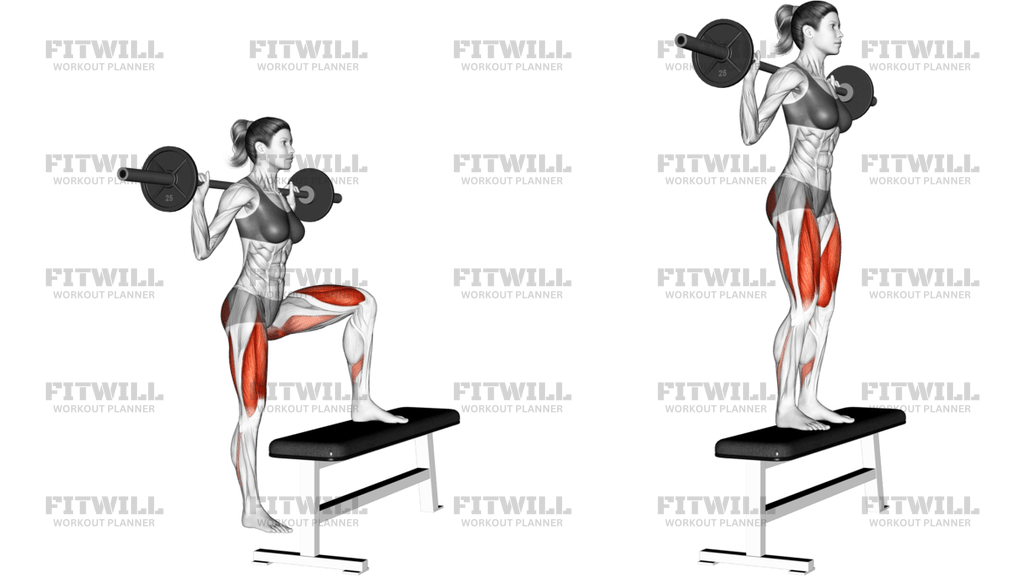
Instructions
- Set a bench or box in front of you and rack the barbell across your upper back in a back-squat position.
- Stand close enough that your working foot can land fully on the bench without reaching or hopping.
- Place the whole foot of the working leg on the bench and keep the other foot on the floor behind you.
- Brace your torso, keep your chest tall, and square your hips toward the bench.
- Drive through the midfoot and heel of the foot on the bench until the working leg straightens and your body rises tall.
- Keep the trailing leg quiet and avoid pushing off the floor to help the ascent.
- Lower yourself slowly by bending the working knee and sending the hips back a little as the trailing foot returns to the floor.
- Reset your stance before the next rep and keep your breathing smooth throughout the set.
Tips & Tricks
- Choose a bench height that lets the working thigh stay close to parallel or slightly above parallel at the bottom.
- Keep the bar tight on your upper back by pulling your shoulder blades back and down before each rep.
- Plant the whole foot on the bench, not just the toes, so the heel can help you drive up.
- Track the knee over the second or third toe instead of letting it collapse inward.
- Use a lighter load than you would for back squats because balance is a bigger limiter here.
- Lower under control for 2-3 seconds so the working leg owns the descent.
- Exhale as you stand up and re-brace before the next step down.
- Stop the set if the trailing leg starts kicking off the floor or you need to bounce to stand.
Frequently Asked Questions
What does Barbell Step-Up work most?
It primarily loads the glutes, quads, and hips while the core keeps the torso steady under the bar.
Should the bar sit on my back or in front of me?
This version uses a back-rack position, with the bar resting across the upper back like a back squat.
How high should the bench be for a step-up?
Use a bench height that lets you step up without bouncing or leaning hard. If your pelvis tilts or your back leg has to jump, the box is too high.
Can I push off the floor leg to help?
No. The working foot on the bench should do the lifting. A hard push from the floor leg turns the rep into a hop instead of a controlled step-up.
Should both feet end up on the bench at the top?
That is optional. The important part is that you finish tall over the bench with the working leg doing the work and without losing tension or balance.
What is the most common form mistake?
The biggest mistake is using too much momentum, which often shows up as knee collapse, torso swing, or a jump from the trailing leg.
Is Barbell Step-Up a good substitute for lunges or split squats?
Yes. It is a strong unilateral alternative when you want single-leg leg drive with a more vertical torso and a fixed step.
Can beginners do this exercise?
Yes, but only with a low box, light barbell load, and very strict balance. Many beginners should master bodyweight step-ups first.