Barbell Front Squat
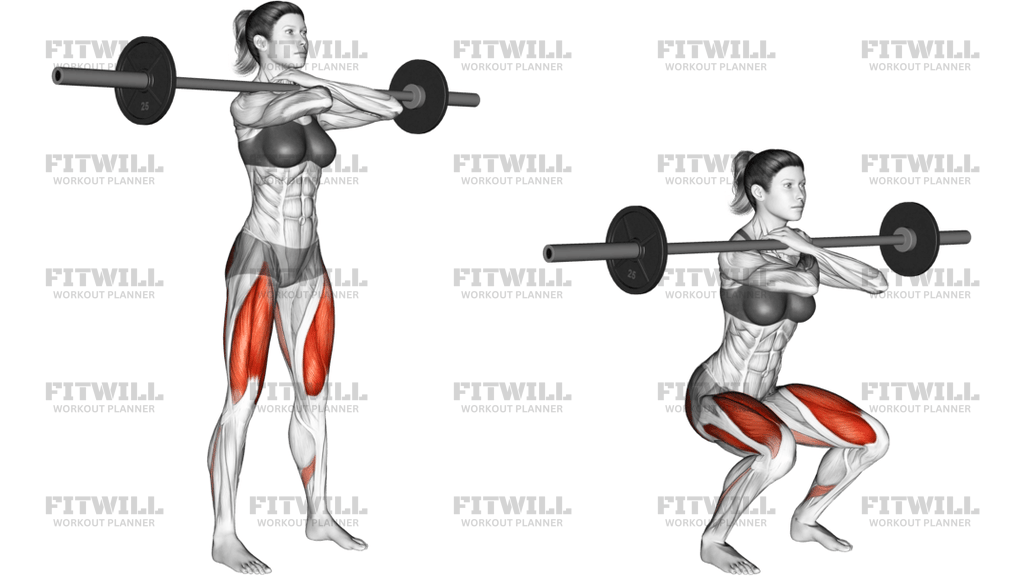
Barbell Front Squat is a quad-dominant squat performed with the barbell racked across the front of the shoulders. In this version, the arms cross in front of the chest to help support the bar while the elbows stay lifted and the torso remains more upright than in a back squat. That front-loaded position shifts the center of mass forward, which makes the quads work hard while also demanding strong upper-back position, trunk bracing, and steady balance through the feet.
The setup matters because the front rack determines how cleanly you can descend and stand up. If the bar drifts forward, the torso collapses, or the elbows drop, the squat turns into a fight for survival instead of a controlled strength exercise. A good front squat starts with the bar secured high on the front delts, feet planted firmly, ribs stacked over the pelvis, and pressure spread across the whole foot. The goal is to keep the chest tall without over-arching the lower back.
During each rep, sit down between the heels while letting the knees travel forward and outward in line with the toes. Keep the elbows high enough to prevent the bar from rolling, then drive up by pushing the floor away and extending the knees and hips together. The descent should be smooth and controlled, the bottom position should stay tight, and the ascent should finish with the bar still fixed on the front rack rather than drifting off the shoulders.
This exercise is useful for building leg strength, upright squat mechanics, and position under load. It shows up in strength programs, Olympic lifting support work, and general lower-body training because it rewards precision more than brute force. Beginners can learn it with light load, but shoulder, wrist, and thoracic mobility limitations may require a crossed-arm grip, a strap-assisted front rack, or a reduced range until the position feels stable and pain-free.
[ Workout Log & Planner ]
Put your next workout in Fitwill
Keep your plan and training log ready when you are.


Instructions
- Stand with the barbell resting across the front of your shoulders and cross your arms so each hand supports the opposite side of the bar.
- Lift your elbows forward and up until your upper arms are close to parallel with the floor, then set your feet about shoulder-width apart.
- Stack your ribs over your pelvis, brace your trunk, and keep your whole foot planted before you unlock the knees.
- Sit down between your heels by bending the knees and hips together while keeping the chest tall and the bar fixed on the front delts.
- Let the knees track in line with the toes and keep the elbows high so the bar does not roll forward.
- Lower under control until your thighs reach a depth you can keep stable without losing the upright torso.
- Drive up from the bottom by pressing the floor away, straightening the knees and hips together, and keeping the heels down.
- Exhale as you pass the hardest part of the ascent, then reset your breath and brace before the next repetition.
- Re-rack the bar only after you finish the set with control and the front rack still secure.
Tips & Tricks
- If the bar wants to roll forward, raise the elbows first instead of trying to save the rep with a bigger lean.
- Keep pressure through the midfoot and heel so the knees can travel forward without tipping you onto your toes.
- A narrow stance often makes the torso fold; set the feet just wide enough that the hips can descend between them.
- Crossed arms should support the bar, not squeeze it hard into the throat. The bar belongs on the front delts, not the neck.
- Pause briefly in the bottom only if you can keep the torso tall and the bar path clean.
- Use lighter loads than a back squat would allow; the front rack usually limits loading before the legs do.
- If wrist or shoulder mobility is the limiter, use a strap-assisted front rack or reduce depth until the position is stable.
- Stop the set when the elbows drop or the chest collapses, because those are the first signs the front rack is failing.
Frequently Asked Questions
What muscle does Barbell Front Squat target most?
The quads are the primary movers, with the glutes, upper back, and core working hard to keep the front rack stable.
Why are my elbows supposed to stay high in the front squat?
High elbows help keep the bar pinned to the front delts and prevent it from rolling forward as you descend and stand up.
Can beginners perform this exercise?
Yes, but start light and learn the front rack position before adding load. A crossed-arm grip is often easier than a clean grip when mobility is limited.
How low should I squat on this movement?
Go as low as you can while keeping the chest tall, heels planted, and elbows up. Depth is useful only if the bar path stays controlled.
What is the most common mistake in a barbell front squat?
Letting the elbows drop is a major one, because it usually leads to the bar rolling forward and the torso folding over.
Is the crossed-arm front rack the same as a clean-grip front rack?
The squat pattern is the same, but the crossed-arm version reduces wrist and shoulder demand. It is a useful option when the clean grip is uncomfortable.
What should I do if the front rack hurts my wrists or shoulders?
Use a lighter load, work on front rack mobility, or switch to a strap-assisted grip until the position feels pain-free and stable.
How is a front squat different from a back squat?
Front squats keep the torso more upright and usually shift more demand to the quads and upper back, while back squats allow more hip loading.