Dumbbell Reverse-Grip Incline Row
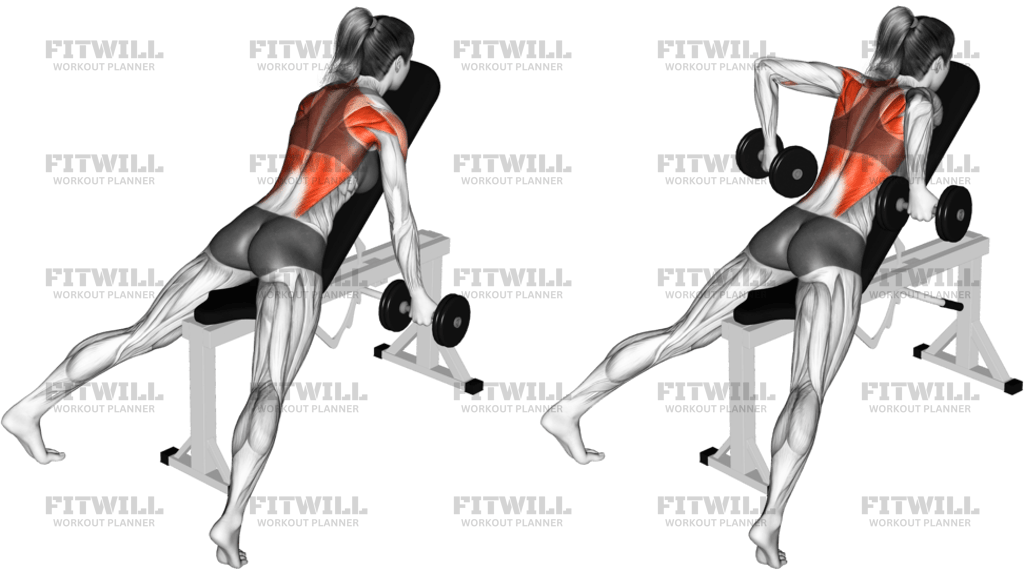
The Dumbbell Reverse-Grip Incline Row is a chest-supported rowing variation performed on an incline bench with an underhand grip. The setup removes most of the need to hinge or brace against gravity, so the back, rear shoulders, and arms can work through a strict pulling path. It is a useful option when you want to train upper-back control without using momentum or loading the lower back.
The reverse grip changes the elbow path and usually keeps the upper arm a little closer to the torso. That makes it a strong variation for lat-driven rowing, while the mid-back, rear delts, and biceps still contribute to the pull. When the bench angle is correct and the chest stays planted on the pad, the row feels clean and repeatable instead of turning into a shrug or a swing.
The setup matters because the bench supports your trunk and defines the pull angle. With the chest fixed to the incline pad, you can focus on pulling the dumbbells toward the lower ribs or upper waist, then lowering them under control until the arms are long again. A smooth range of motion, a neutral neck, and steady breathing keep the repetition honest and make it easier to feel the working muscles.
This exercise fits well in back-focused hypertrophy work, accessory pulling blocks, or any session where you want strict scapular control with less spinal fatigue than a free bent-over row. It is especially useful if you want to practice rowing with a tucked elbow path and a stronger lat emphasis. Load it only as heavy as you can row without lifting the chest, yanking the weights, or losing the underhand wrist position.
Use a bench angle that supports the chest without forcing the shoulders into an awkward position, and keep the shoulders away from the ears throughout the set. If the dumbbells start touching the bench, the torso starts lifting, or the elbows flare high, the weight is usually too heavy. The best reps feel controlled on the way up and even slower on the way down, with the bench doing the stabilizing so the pulling muscles can do the work.
Fitwill
Log Workouts, Track Progress & Build Strength.
Achieve more with Fitwill: explore over 9600 exercises with images and videos, access built-in and custom workouts, perfect for both gym and home sessions, and see real results.
Start your journey. Download today!




Instructions
- Set an incline bench to about 30 to 45 degrees and lie chest-down with your sternum and upper ribs supported by the pad.
- Plant your feet wide enough to feel stable and let the dumbbells hang straight under your shoulders with palms facing up.
- Keep your neck long, eyes down, and lower back quiet against the bench before you start the first rep.
- Brace your abdomen, then pull both elbows back and slightly in toward your sides.
- Drive the dumbbells toward your lower ribs or upper waist instead of straight out to the sides.
- Pause briefly at the top while keeping your shoulders down and your chest in contact with the bench.
- Lower the weights slowly until your arms are straight again and you feel a controlled stretch through the back.
- Inhale on the lowering phase, exhale as you row, and reset your shoulders before each next rep.
Tips & Tricks
- Keep a straight wrist in the underhand grip so the dumbbell sits over the forearm instead of bending the hand back.
- Think about pulling the elbows toward your back pockets; that cue usually keeps the lat path cleaner than flaring wide.
- Do not let the chest peel off the incline pad, or the set turns into a body English row instead of a supported row.
- Choose a bench angle that lets your elbows travel behind the torso without cramping the front of the shoulder.
- A short pause at the top helps you finish the pull with the back instead of bouncing the dumbbells off momentum.
- Lower the dumbbells under control so the shoulders can reach forward a little at the bottom without losing tension.
- If the dumbbells hit the bench or each other, narrow the path slightly or lighten the load.
- Stop the set when you start shrugging, arching hard, or losing the underhand wrist position.
Frequently Asked Questions
What muscles does the Dumbbell Reverse-Grip Incline Row work?
It emphasizes the lats and mid-back, with help from the rear delts, lower traps, rhomboids, biceps, and forearms.
Why use a reverse grip on the incline row?
The underhand grip usually keeps the elbows tucked more easily, which can shift the row toward the lats and make it easier to feel the pull in the back of the torso.
How high should the bench be set?
A 30 to 45 degree incline is the usual starting point. Lower angles often feel more lat-focused, while steeper angles can bring in more upper back.
Where should the dumbbells travel?
Pull them toward the lower ribs or upper waist, not toward the chest. That path keeps the elbows tucked and matches the movement shown in the image.
Do my feet matter on this exercise?
Yes. A wide, planted stance helps keep the bench stable and prevents your torso from shifting as the dumbbells get heavier.
Can beginners do this row?
Yes. The bench support makes it beginner-friendly if you start light and keep the chest on the pad while you learn the underhand pulling path.
What is the most common form mistake?
Raising the chest off the bench and turning the row into a loose swing. That usually means the load is too heavy or the bench angle is off.
Is this the same as a chest-supported dumbbell row?
It is the same basic setup, but the reverse grip changes the elbow path and usually makes the row feel more lat-biased.