Cable Shrug
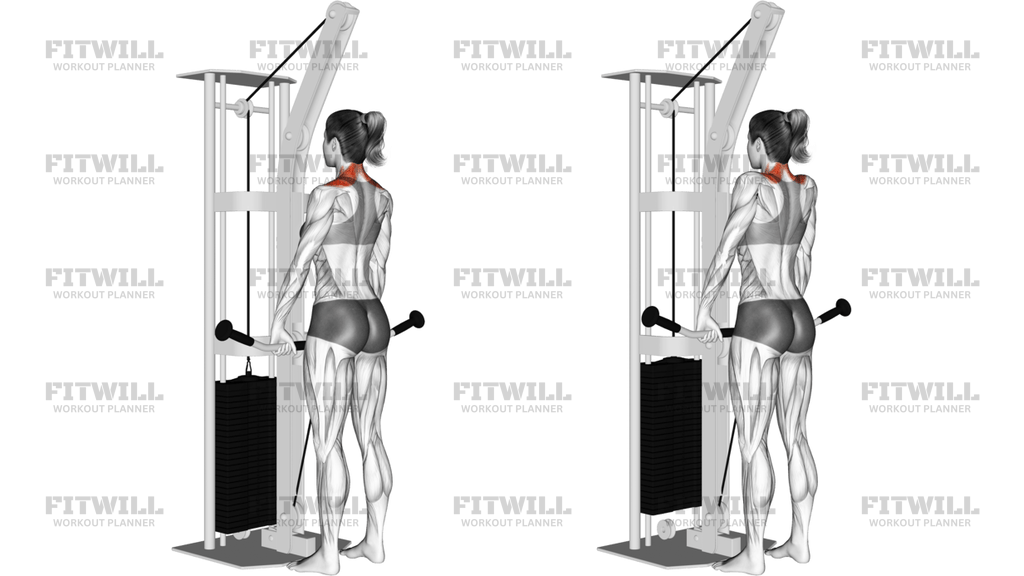
Cable Shrug is a standing cable exercise for the upper back and neck that emphasizes shoulder elevation against constant cable tension. In the image, the lifter stands facing away from the stack with the handles kept at the sides, which keeps the resistance smooth from the bottom to the top of each shrug. That setup makes the exercise useful when you want a strict trap-focused movement without the swing and loading spikes that often show up in heavier free-weight shrugs.
The main training target is the upper trapezius, with the levator scapulae and smaller shoulder-girdle stabilizers helping manage the movement. Grip, posture, and cable position matter because the shrug is small and easy to fake with body English if the load is too heavy. Keeping the arms long and the neck neutral lets the shoulders travel straight up and straight down instead of drifting forward or rolling in circles.
A clean rep starts with the cable stack low, the torso tall, and the feet planted about hip width apart. Step far enough away from the machine to keep tension on the cables while the handles rest near the outer thighs. From there, shrug the shoulders up toward the ears, pause briefly at the top, and lower under control until you feel the traps lengthen again. The elbows should stay mostly straight, and the torso should stay stacked instead of leaning back to chase a bigger range.
Cable Shrug is a good accessory choice for back, shoulder, or upper-trap work, especially when you want steady resistance and a controlled tempo. It can fit after compounds, in a focused hypertrophy block, or as a lighter posture-and-bracing drill. Because the movement is easy to overload with momentum, the best results come from a load you can lift without bending the elbows, shrugging the shoulders forward, or losing the position of the head and ribcage.
If the repetition stays crisp, the upper traps should do the work while the rest of the body remains quiet. Use the stretch at the bottom and the brief squeeze at the top to control the set, then end the set before the neck tightens or the shoulders start to circle. That makes Cable Shrug a simple but precise way to train shrug strength and upper-back tension.
[ Workout Log & Planner ]
Put your next workout in Fitwill
Keep your plan and training log ready when you are.


Instructions
- Set the cable pulleys low, attach the handles, and stand facing away from the machine with a handle in each hand at your sides.
- Step forward until the cables stay taut, with your feet about hip width apart and your arms hanging long beside your thighs.
- Stack your ribs over your pelvis, soften the knees, and keep your chin level so the neck stays long.
- Brace lightly, then lift both shoulders straight up toward your ears without bending the elbows or leaning back.
- Pause for a moment at the top while keeping the handles close to your legs and the neck relaxed.
- Lower the shoulders slowly until they return to the start and you feel a controlled stretch through the upper traps.
- Keep the torso still and the wrists neutral so the cables do not swing or pull you off balance.
- Repeat for the planned reps, then walk the handles back to the stack before letting go.
Tips & Tricks
- Choose a load that lets the shoulders rise vertically; if the torso leans or the elbows bend, it is too heavy.
- Keep the handles near the outer thighs instead of letting them drift forward in front of the body.
- Think "up and down," not "roll the shoulders"; shrugging circles the joint and turns the rep sloppy.
- Do not pinch the shoulder blades together hard, because this movement is shoulder elevation rather than a row.
- Keep the neck long at the bottom and avoid jutting the chin forward when you drive into the top.
- A one-second pause at the top makes it easier to feel the upper traps doing the work.
- Lower the shoulders under control so the bottom position stays smooth instead of dropping suddenly.
- If grip fails before the traps, use straps or a lighter load so the set stays trap-dominant.
Frequently Asked Questions
What muscles does Cable Shrug train?
It mainly trains the upper trapezius, with the levator scapulae and other shoulder-girdle stabilizers assisting.
Why stand facing away from the cable machine?
Facing away keeps the cables taut at the sides, which gives the shrug a smoother resistance curve and makes it easier to keep the handles close to your legs.
Should my elbows bend during the shrug?
No. Keep the arms long so the shoulders do the lifting instead of turning the rep into a curl or a pull.
Can beginners use the cable shrug?
Yes. A light load with a short pause at the top is a good way to learn the vertical shrug path.
What is the biggest form mistake?
The most common error is rolling the shoulders or leaning back to create a bigger-looking rep instead of shrugging straight up.
How heavy should the cable stack be?
Heavy enough to challenge the traps, but light enough that the neck stays relaxed and the handles do not swing away from your thighs.
Is Cable Shrug different from a dumbbell shrug?
Yes. The cable version keeps tension more consistent through the whole rep, especially at the bottom, where dumbbells can feel less loaded.
What should I feel at the bottom of the rep?
You should feel a controlled stretch through the upper traps, not a sharp pull in the neck or a collapse of the shoulders.