Cable Standing Shoulder External Rotation
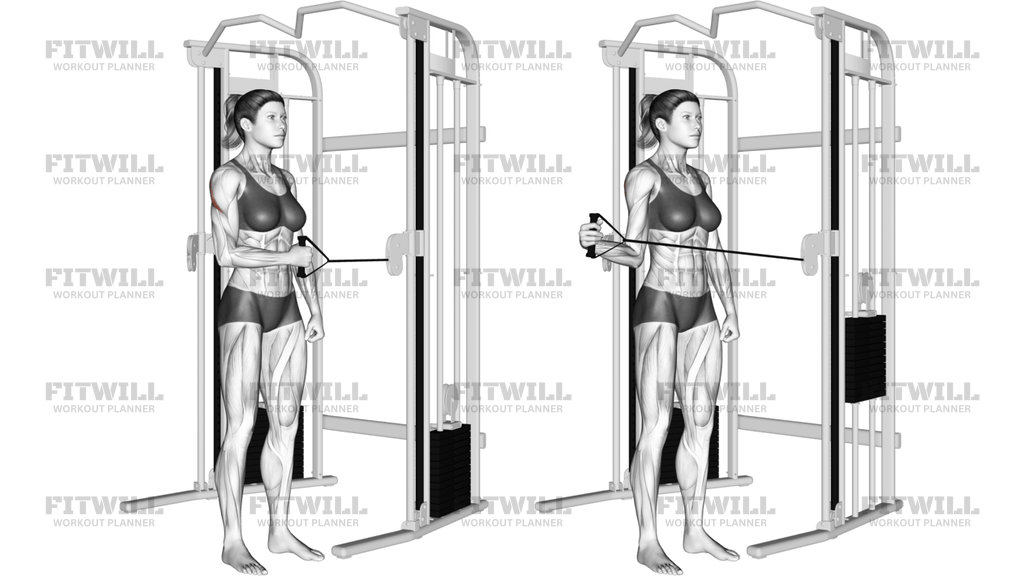
Cable Standing Shoulder External Rotation is a controlled rotator-cuff drill that trains the shoulder to rotate outward while the upper arm stays pinned at your side. It is useful for building the small stabilizers that help keep the shoulder organized during pressing, reaching, and overhead work. The cable keeps constant tension on the joint, so every rep asks for steady control instead of speed or momentum.
The setup matters more here than in many bigger lifts. Stand side-on to the cable stack with the pulley set around elbow height, hold a single handle, and bend the working elbow to about 90 degrees so the forearm starts across the front of your torso. Keep the elbow lightly tucked against your ribs, the wrist neutral, and the torso tall so the rotation comes from the shoulder rather than from the hand drifting or the body twisting.
As you rotate the forearm outward, the upper arm should stay nearly still and the shoulder should feel compact rather than shrugged. The hand moves in a short arc away from the stomach until you reach a strong, controlled end range, then you return slowly to the start with the cable still under tension. That small range is the point of the exercise: it lets you train the external rotators cleanly without turning the movement into a row or a torso rotation.
Cable Standing Shoulder External Rotation is especially useful as warm-up work, accessory volume, or preparation for pressing and throwing sessions. It can also help lifters who tend to feel the front of the shoulder take over when the arm moves away from the body. Because the resistance is light and the lever is short, the exercise usually responds best to patient, crisp reps rather than heavy loading.
Treat each rep like a technique check. If the elbow leaves the ribs, the chest turns, or the shoulder creeps upward, the load is too heavy or the stance is too loose. Smooth control, a stable base, and a calm return phase will do more for this exercise than forcing a bigger range or chasing fatigue.
[ Workout Log & Planner ]
Put your next workout in Fitwill
Keep your plan and training log ready when you are.


Instructions
- Set the cable pulley at about elbow height and attach a single handle.
- Stand sideways to the stack, step far enough away to create light tension, and bend the working elbow to 90 degrees.
- Tuck the working elbow against your ribs, keep the wrist straight, and let the forearm rest across the front of your torso to start.
- Plant both feet, lift your chest tall, and keep the shoulder blade quiet instead of rolling forward.
- Exhale and rotate the forearm outward away from your stomach while the upper arm stays pinned in place.
- Stop when the forearm reaches a strong open position without the elbow drifting off the ribs or the torso turning.
- Pause briefly at the end of the rotation, then inhale as you lower the handle back under control.
- Repeat for the planned reps, then release tension and switch sides before resetting the stack.
Tips & Tricks
- Keep the cable lined up with your forearm; if the handle pulls up or down, move the pulley to elbow height.
- A folded towel between the elbow and ribs can help keep the upper arm from sliding forward.
- Use a load that lets the wrist stay neutral; if the wrist bends back, the weight is too heavy.
- The working shoulder should rotate, not shrug; if the neck tightens, reduce the load and shorten the range.
- Do not let the chest twist toward the machine to cheat the rotation.
- The return phase should be slower than the lift so the rotator cuff stays under control the whole time.
- A small, clean range is better than forcing the hand farther back and losing the elbow position.
- Higher reps usually work better than heavy singles or doubles for this movement.
Frequently Asked Questions
What does Cable Standing Shoulder External Rotation train most?
It mainly trains the shoulder external rotators, especially the rotator cuff muscles that help steady the joint when the arm is working by your side.
Where should the pulley and handle be set for Cable Standing Shoulder External Rotation?
Set the pulley around elbow height and use a single handle so the cable tracks cleanly across the forearm instead of pulling the shoulder up or down.
Should my elbow stay on my ribs during Cable Standing Shoulder External Rotation?
Yes. Keeping the elbow lightly pressed to the ribs is what isolates the rotation and stops the exercise from turning into a full-arm swing.
How heavy should the cable load be?
Light enough that you can rotate the forearm without the wrist bending, the torso twisting, or the shoulder hiking up. This exercise usually works best with controlled, higher-rep sets.
What are the most common mistakes with this movement?
The biggest errors are letting the elbow drift away from the side, twisting the chest toward the machine, and using momentum to snap the handle open.
Can beginners do Cable Standing Shoulder External Rotation?
Yes, if they start very light and keep the upper arm fixed. It is a good beginner-friendly accessory as long as the shoulder feels smooth and pain-free.
Why do I feel this more in the back of my shoulder than my chest?
That is expected. The movement is meant to load the rotator cuff and rear shoulder area, not the pressing muscles in the front of the body.
How is this different from external rotation with a dumbbell or band?
The cable keeps steadier tension through the whole rep, which makes it easier to control the return and keep the forearm path consistent.