Deep Push-Up
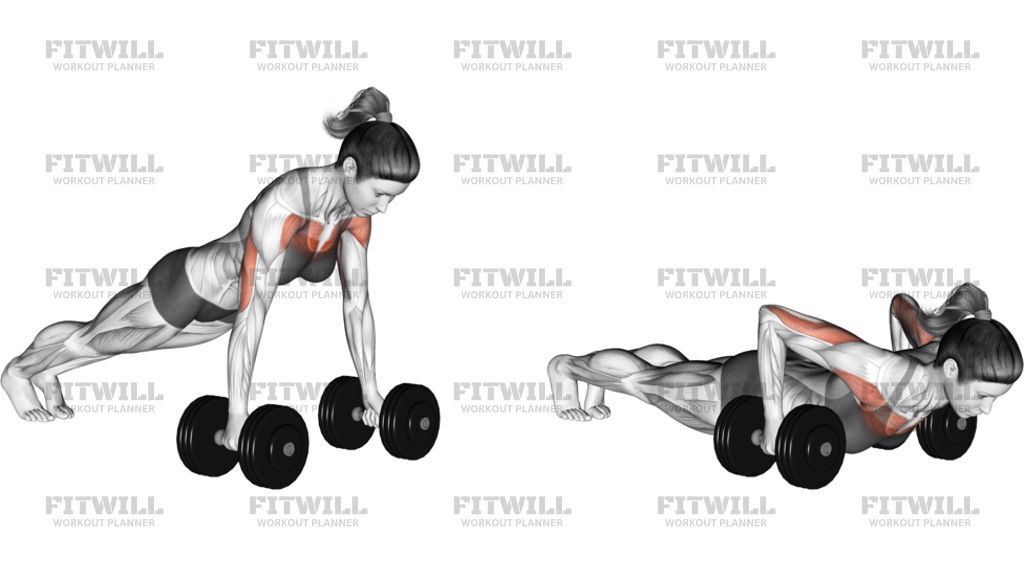
Deep Push-Up is a dumbbell push-up variation that lets your chest sink slightly below the level of your hands while keeping the wrists in a neutral grip. The dumbbells act like compact handles, which can make the bottom position feel cleaner and more natural than a flat-palmed push-up, especially for lifters who want extra range without forcing the wrists into extension.
The main emphasis is on the pecs, with the front shoulders, triceps, and core helping you hold a rigid plank and press back to the top. In anatomy terms, the primary work centers on the Pectoralis major, with support from the Anterior deltoid, Triceps brachii, and Rectus abdominis. The exercise is most useful when you want a bodyweight push that demands strict control, a strong chest stretch, and a stable shoulder position from start to finish.
The setup matters because the dumbbells need to stay stable and far enough apart to let the torso travel between them. A good rep begins with the hands stacked under the shoulders, the feet planted back, the glutes tight, and the ribs pulled down so the body stays in one long line. From there, lower under control until the chest reaches a deeper bottom position than a standard push-up, but only as far as the shoulders can stay packed and pain-free.
At the bottom, the extra depth should come from the chest and shoulder girdle moving through a controlled range, not from the lower back collapsing or the elbows flaring wildly. Press the floor away through the dumbbells, keep the neck long, and finish each rep with the torso and hips rising together. This variation is a strong choice for accessory chest work, calisthenics progressions, or strength-focused upper-body sessions, but it should be scaled back if the front of the shoulder complains or if the dumbbells are too unstable to trust.
[ Workout Log & Planner ]
Put your next workout in Fitwill
Keep your plan and training log ready when you are.


Instructions
- Place two stable dumbbells on the floor shoulder-width apart, then grip the handles with your hands stacked directly over them.
- Walk your feet back into a straight plank so your head, ribs, hips, and heels form one line.
- Tighten your glutes and brace your abs so your lower back does not sag when you lower.
- Lower your chest between the dumbbells with your elbows tracking about 30 to 45 degrees from your torso.
- Keep descending until your chest is slightly below the level of the dumbbells, only as deep as your shoulders can control.
- Pause briefly at the bottom without sinking into the shoulders or losing tension through the midline.
- Press the dumbbells into the floor and drive your body back up as one piece until your elbows are straight.
- Reset at the top with the shoulder blades controlled, then repeat for the planned number of reps while inhaling on the way down and exhaling as you press.
Tips & Tricks
- Use hex dumbbells or another stable handle shape so the base does not roll as you press.
- Treat the deeper bottom position as optional; stop where the front of the shoulder still feels organized.
- Keep the wrists stacked over the handles instead of reaching forward, which turns the rep into a shoulder dump.
- Let the chest travel down between the dumbbells, not just the nose toward the floor.
- If your elbows flare straight out, narrow the angle slightly and shorten the depth.
- Keep the feet a little wider if the extra range makes your hips twist or sway.
- Lower slowly enough to own the stretch in the pecs before you drive back up.
- If the dumbbells feel shaky, switch to a more stable surface before adding load or reps.
Frequently Asked Questions
What makes Deep Push-Up different from a regular push-up?
The dumbbells raise your hands and let your chest travel a little deeper at the bottom, so the pecs work through more range.
Why use dumbbells instead of flat hands?
The handles keep your wrists neutral and create a cleaner bottom position than a flat-palmed push-up for many lifters.
Which muscles do Deep Push-Ups work most?
The pecs do most of the work, with the front shoulders, triceps, and core helping stabilize and press.
How deep should my chest go?
Only as low as your shoulders can stay controlled. The goal is a little extra range, not forcing your chest to collapse below the handles.
Should my elbows flare out?
No. A moderate angle, roughly 30 to 45 degrees from your torso, usually keeps the shoulders in a better pressing path.
Can beginners do this variation?
Yes, but only if the dumbbells are stable and the bottom position stays pain-free. An incline version is a better first step for many beginners.
What is the biggest form mistake?
Letting the hips sag or the shoulders dump forward at the bottom. The torso should move as one solid plank.
What should I use if the dumbbells feel unstable?
Use push-up handles, parallettes, or a sturdy elevated surface until you can keep the setup steady.