Incline Scapula Push-Up
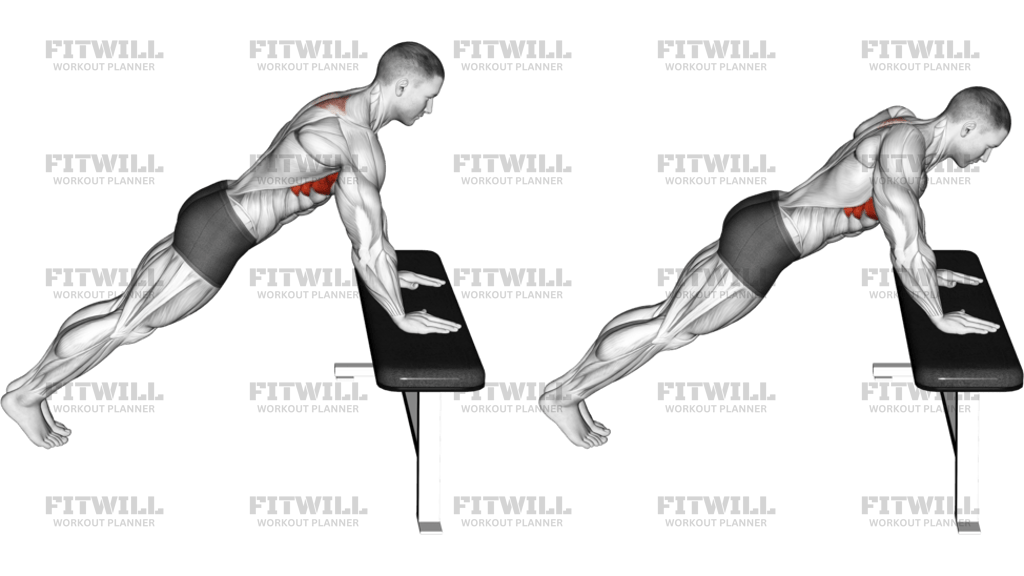
Incline Scapula Push-Up is a body-weight scapular control drill performed with the hands on an elevated surface, usually a bench or box, and the body held in a straight line from head to heels. Unlike a standard push-up, the elbows stay almost locked while the shoulder blades do the work: you let the chest sink slightly between the shoulders, then press the support away and round the upper back a little at the top.
That small movement looks simple, but it trains an important pattern for pressing mechanics and shoulder health. The exercise teaches you to control scapular protraction and retraction under load, which helps the serratus anterior, chest, front shoulders, triceps, and trunk coordinate instead of letting the shoulders collapse forward or the rib cage flare. The incline makes the drill more approachable than a floor version because it reduces the amount of body weight you have to control.
Setup matters more here than in many other push-up variations. Place the hands shoulder-width apart on the bench, walk the feet back until the body is rigid, and keep the neck long with the gaze a little ahead of the hands. From that position, the shoulder blades should glide, but the hips should not sag and the elbows should not bend into a true press. If the motion turns into a regular push-up, the drill loses its purpose.
Use the repetition to feel the difference between sinking between the shoulders and actively pushing the support away. On the descent, keep tension through the abs and glutes so the torso stays in one line. At the top, reach the upper back gently without shrugging hard or letting the lower back arch. Breathe steadily, usually a slow inhale as you allow the chest to move down and an exhale as you press away and spread the shoulder blades.
This movement fits well in warm-ups, shoulder-prep work, or accessory blocks when you want cleaner pressing mechanics, better scapular awareness, or a less aggressive body-weight option than a floor scapula push-up. It is also useful for beginners who need to build confidence in a plank position before progressing to lower inclines, floor versions, or full push-ups. Keep the reps smooth, the range controlled, and the shoulders moving from the blades rather than from momentum.
Fitwill
Log Workouts, Track Progress & Build Strength.
Achieve more with Fitwill: explore over 9600 exercises with images and videos, access built-in and custom workouts, perfect for both gym and home sessions, and see real results.
Start your journey. Download today!




Instructions
- Place your hands shoulder-width apart on a bench or other stable elevated surface and step your feet back into a straight-line plank.
- Keep your elbows nearly straight, your wrists under your shoulders, and your body rigid from head to heels.
- Brace your abs and glutes so your ribs do not flare and your lower back does not sag.
- Let the chest sink slightly between the shoulders by allowing the shoulder blades to retract.
- Without bending the elbows into a full push-up, press the bench away and spread the shoulder blades at the top.
- Keep the head in line with the spine and avoid shrugging toward the ears.
- Move with a short, controlled range so the torso stays stable while the scapulae glide.
- Exhale as you press away and inhale as you lower into the next rep.
- Finish each rep in a strong plank before starting the next one.
Tips & Tricks
- If your elbows are bending a lot, raise the bench higher or shorten the range so the exercise stays scapular-focused.
- Think about moving the shoulder blades, not doing a chest press.
- Keep the shoulders away from the ears; the motion should come from protraction and retraction, not a shrug.
- A slight upper-back round at the top is normal; an arched lower back is not.
- Keep the feet planted and squeeze the glutes so the plank line stays straight.
- Use a slower lowering phase if you lose control when the chest moves toward the bench.
- Stop before the range becomes sloppy; quality scapular motion matters more than rep count.
- This is a better warm-up drill than a fatigue exercise, so leave several reps in reserve.
Frequently Asked Questions
What does Incline Scapula Push-Up train most?
It mainly trains scapular control in a plank position, especially protraction and retraction around the shoulder blades.
Can beginners perform this exercise?
Yes. The incline makes it easier than a floor version because you support more of your body weight on the bench.
Should my elbows bend during the rep?
Only a little. The drill is meant to move through the shoulder blades, not turn into a full incline push-up.
How high should the bench be?
Use a height that lets you keep a straight plank and control the scapular motion. A higher bench is usually easier.
Where should I feel this exercise?
You should feel it around the shoulder blades, upper chest, front shoulders, and trunk bracing rather than in the lower back.
What is the biggest form mistake?
Letting the elbows turn it into a regular push-up or letting the hips sag while chasing range of motion.
Is this the same as a push-up plus?
It is very close. Both focus on the top-end reach and scapular protraction, but this version is done on an incline.
How can I make it harder?
Lower the incline, slow down the tempo, or pause in the fully pressed-away position without letting the elbows soften.