Barbell Split Squat
Barbell Split Squat is a staggered-stance lower-body strength exercise built around a barbell resting across the upper back. One leg stays forward and grounded while the other leg works as a rear support, so each repetition asks the hips, knees, and trunk to stay organized while the front leg does the majority of the lifting. It is especially useful when you want unilateral leg strength without the balance demands of a full walking lunge.
The biggest training effect usually comes from the front leg, with the glutes and quadriceps doing most of the work and the hamstrings, adductors, calves, and core helping stabilize the body. In anatomy terms, the main work centers on the Gluteus maximus, with help from Quadriceps, Biceps femoris, Rectus abdominis, and Erector spinae. That makes the exercise useful for building leg strength, improving side-to-side symmetry, and training the pelvis to stay controlled under load.
Setup matters a lot because the stance determines the entire rep. A front foot that is too close will force the knee forward and make balance messy; a stance that is too long will turn the movement into an awkward hip hinge. The best setup usually leaves the front foot flat, the rear heel lifted, the torso stacked over the hips, and enough distance between the feet to let both knees bend comfortably as you descend. The bar should stay pinned in a stable back-rack position so the torso can work as one solid unit.
Each rep should travel mostly straight down and then back up, not forward and back. Lower with control until the rear knee approaches the floor and the front thigh reaches a depth you can own without twisting or bouncing. Drive up through the front midfoot and heel while keeping the ribs down, the pelvis square, and the bar steady. If the load is too heavy, the body will usually lean, rotate, or push off the rear leg early, which defeats the point of the exercise.
Use Barbell Split Squat when you want focused leg work that carries over to squats, athletic positions, and general lower-body strength. It fits well in strength blocks, hypertrophy work, and unilateral accessory training, especially when you want the glutes to work hard without needing a machine. Start light enough to keep the front heel planted, the back knee under control, and the rep smooth from the first descent to the final stand.
Fitwill
Log Workouts, Track Progress & Build Strength.
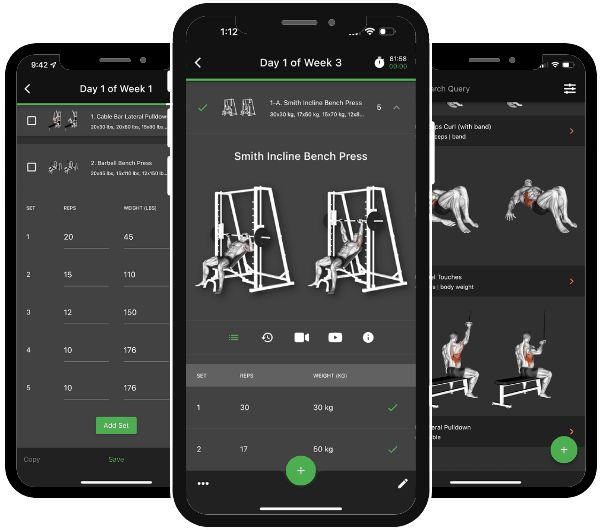
Achieve more with Fitwill: explore over 5000 exercises with images and videos, access built-in and custom workouts, perfect for both gym and home sessions, and see real results.
Start your journey. Download today!


Instructions
- Set a barbell across the upper back and step into a split stance with the front foot flat and the rear heel lifted.
- Place the front foot far enough forward that both knees can bend without the front heel peeling up.
- Square the hips and ribs, then brace the trunk before you start the descent.
- Lower straight down by bending both knees, keeping most of the weight over the front leg.
- Let the rear knee travel toward the floor while the front knee tracks in line with the toes.
- Pause briefly near the bottom without bouncing or relaxing the brace.
- Drive up through the front midfoot and heel until both legs are straight but not locked hard.
- Reset your stance, breathe, and repeat all reps on the same side before switching if that is how the set is programmed.
Tips & Tricks
- Keep the barbell centered and steady on the upper back instead of letting it roll toward the neck.
- Use stance length to target the lift: a slightly longer split usually shifts more work to the glute, while a shorter one feels more quad-dominant.
- Keep the front heel glued down; if it lifts, the stance is usually too short or the load is too heavy.
- Let the rear leg bend and assist balance, but do not push off it to finish the rep.
- Track the front knee in the same direction as the toes to avoid twisting the knee inward.
- A small forward torso lean is normal, but collapsing at the waist usually means the load is too high.
- Lower slowly enough that you can control the bottom position instead of dropping into the stretch.
- Exhale as you drive up, then re-brace before the next descent.
Frequently Asked Questions
What muscle does Barbell Split Squat target most?
The front leg usually gets the biggest load, especially the glutes and quadriceps.
Can beginners perform this exercise?
Yes, if they start with a light barbell and a stance they can balance without wobbling.
How heavy should I train this movement?
Use a load that lets you keep the front heel down, the torso stable, and the rear leg from taking over.
Where should my front foot be in a barbell split squat?
Far enough forward that you can lower straight down without the front heel lifting or the knee collapsing inward.
Should the rear knee touch the floor?
It does not need to slam into the floor, but it should travel close enough to show a full controlled descent.
How is this different from a lunge?
A split squat uses a fixed stance, while a lunge usually involves stepping in and out of the rep.
Why does the barbell matter here?
The barbell adds a stable external load that makes the legs and trunk work together without needing a machine.
What is the most common form mistake?
Most people lean forward, bounce out of the bottom, or push off the rear leg instead of loading the front leg.
Can I use this for glute-focused training?
Yes. A slightly longer stance and a controlled descent usually put more emphasis on the glutes.