Landmine Lateral Raise
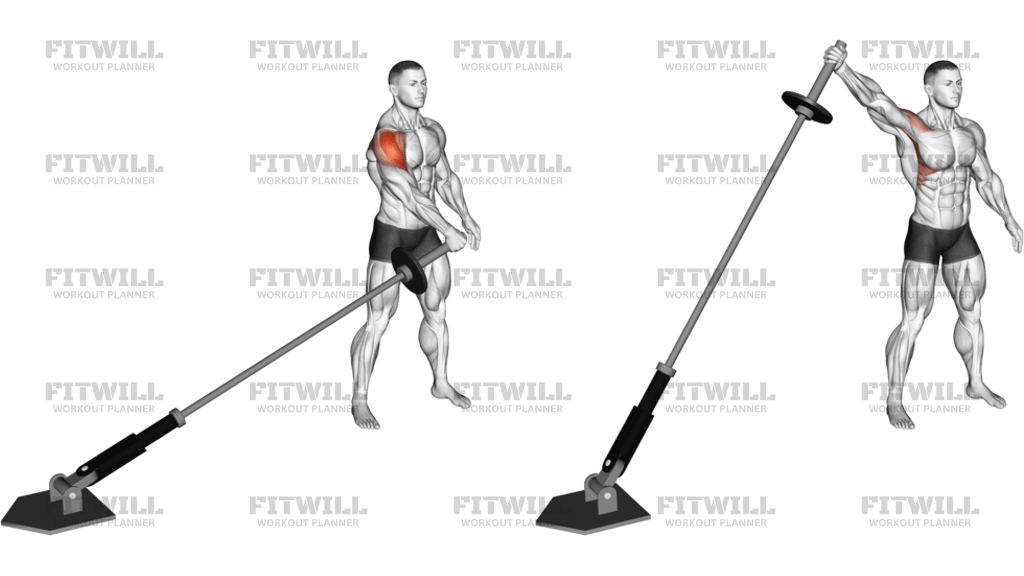
Landmine Lateral Raise is a standing single-arm shoulder exercise that uses the free end of a barbell anchored in a landmine. In the image, the lifter stands beside the bar with the working shoulder closest to the sleeve, holding the end of the bar and guiding it through a diagonal arc away from the hip. That landmine path changes the feel of a classic lateral raise: the resistance starts lighter near the bottom, then climbs smoothly as the arm rises.
The exercise primarily targets the deltoids, especially the side head, while the upper traps, rhomboids, and triceps help steady the shoulder and control the bar path. In anatomy terms, the main work centers on the deltoids with support from the trapezius, rhomboids, and triceps brachii. Because the bar travels in the landmine plane rather than straight out to the side, many lifters find it easier to keep tension on the shoulder without forcing an awkward wrist or elbow position.
Good setup matters here more than with a simple dumbbell raise. Stand tall, keep your ribs stacked over your pelvis, and start with the bar near the front of the opposite hip so the first part of the rep feels organized rather than yanked upward. A slight bend in the elbow is fine, but the arm should stay long enough to create a clear lever. If you drift too upright, shrug hard, or twist through the torso, the movement turns into a mix of trap shrug and body English instead of a clean shoulder raise.
Each repetition should follow the same diagonal path: sweep the bar up and out until the working hand reaches about shoulder height or slightly above, then lower it back under control. The shoulder should feel like it is lifting the bar along an arc, not punching it overhead. Keep the neck long, the wrist neutral, and the free hand relaxed or lightly braced for balance. Exhale as the bar rises and inhale as it returns.
This variation is useful when you want unilateral shoulder work, a shoulder-friendly alternative to straight lateral raises, or an accessory lift that keeps tension on the delts without needing heavy loading. It fits well in hypertrophy blocks, warmups, and upper-body accessories. Use a load that lets you keep the bar path smooth, the torso still, and the top position controlled from the first rep to the last.
Fitwill
Log Workouts, Track Progress & Build Strength.
Achieve more with Fitwill: explore over 9600 exercises with images and videos, access built-in and custom workouts, perfect for both gym and home sessions, and see real results.
Start your journey. Download today!




Instructions
- Anchor one end of the barbell in a landmine and stand beside the free end so the working shoulder is closest to the sleeve.
- Hold the end of the bar with the outside hand, keep the wrist neutral, and let the bar start near the front of the opposite hip.
- Set your feet hip-width or in a small split stance, keep your torso tall, and soften the knees for balance.
- Brace your ribs down before the first rep so the torso stays stacked instead of leaning and twisting.
- Lift the bar in a smooth diagonal arc out and up, leading with the elbow and keeping the shoulder from shrugging.
- Raise until the working hand reaches about shoulder height or slightly above, staying in the landmine plane.
- Pause briefly at the top without losing neck length or turning the raise into a press.
- Lower the bar along the same arc back to the starting position under control.
- Exhale on the lift, inhale on the lowering phase, and stop the set if the torso starts swinging or the shoulder rolls forward.
Tips & Tricks
- Use less load than you would for a dumbbell lateral raise; the long landmine lever gets harder fast as the arm rises.
- Keep the wrist stacked over the forearm so the bar does not fold the hand backward at the top.
- Think about reaching up and out rather than yanking the bar with the traps.
- A small step away from the anchor can keep the shoulder under tension through more of the rep.
- If the bar drifts too far in front of you, the movement starts looking like a front raise and the side delt loses work.
- Keep the free shoulder quiet; rotating the torso usually means the load is too heavy or the stance is too narrow.
- Let the negative last a little longer than the lift so the shoulder keeps working on the way down.
- Stop when the trap starts taking over or the bar path changes from a clean arc into a jerk.
Frequently Asked Questions
What muscle does Landmine Lateral Raise target most?
The side delts are the main target, with the upper traps, rhomboids, and triceps helping stabilize the bar.
Can beginners perform this exercise?
Yes. Beginners usually do well with a light load because the landmine arc is easier to control than a heavy strict lateral raise.
Where should the bar travel during the rep?
The bar should travel in a smooth diagonal arc from the front of the opposite hip to about shoulder height or slightly above.
What is the most common mistake with the bar end?
Letting the bar swing or twist at the top is the big one. Keep the end of the bar moving under control instead of letting momentum take over.
Should I stay perfectly upright or lean?
Stay tall with a stacked torso. A tiny lean away from the anchor is fine, but big side bending turns the raise into a body-English lift.
Why use a landmine instead of a dumbbell for lateral raises?
The landmine creates a more natural arc and often feels friendlier on the shoulder because the resistance builds as the arm rises.
Do I need a handle on the bar for this movement?
No. You can hold the end of the bar directly, but a landmine handle or sleeve grip can make the setup more comfortable if your gym has one.
Can I use this in a shoulder workout with other raises?
Yes. It pairs well with rear-delt work or dumbbell raises, especially when you want one unilateral movement that keeps tension on the side delt.