Korean Dips
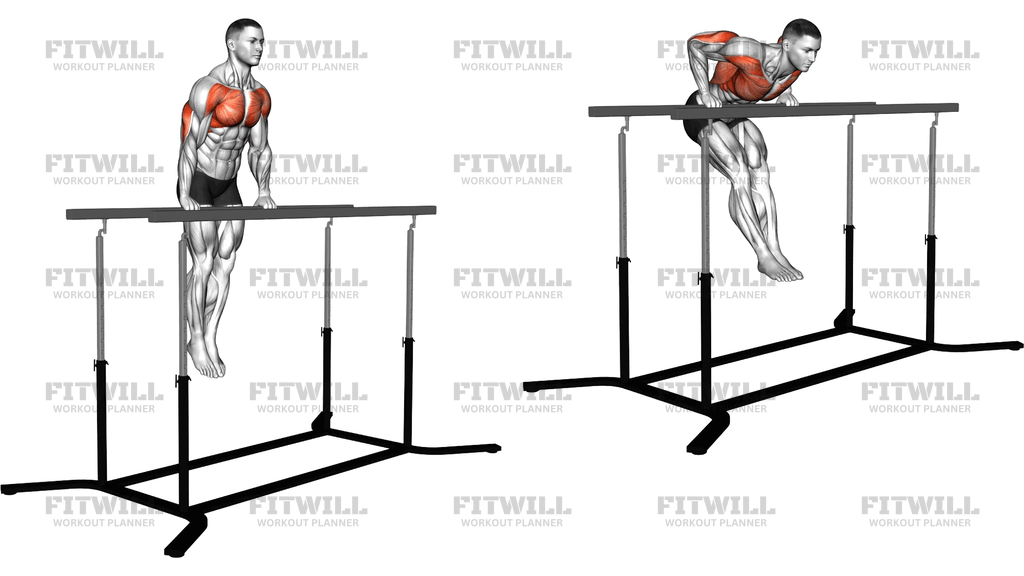
Korean Dips are a bodyweight pressing exercise performed on parallel bars with the torso pitched slightly forward. The movement places the shoulders and chest under a long stretch at the bottom and asks you to finish each rep with controlled elbow extension and a firm top position. That makes it useful for building pressing strength, chest involvement, triceps support, and shoulder stability when the setup is done well.
The visible setup matters because Korean dips are not just a shallow dip variation. You begin between the bars with straight arms, shoulders packed down, and the torso held tight so the body moves as one unit. The forward lean shifts more of the effort toward the pecs while still demanding strong triceps and front delts. If the shoulders drift forward, the ribs flare, or the body swings, the exercise quickly turns from a controlled strength drill into a loose shoulder stress test.
A good repetition starts by lowering in a smooth arc until you feel a strong stretch across the chest and front of the shoulders without losing control of the scapulae. From there, drive the bars down, keep the chest lifted, and press back to full support without shrugging. The goal is not maximum depth at any cost; it is a repeatable range where the shoulders stay centered and the elbows track consistently from rep to rep.
This exercise fits well in chest or upper-body sessions when you want bodyweight loading with a bigger stretch than standard straight-bar or parallel-bar dips. It can be progressed by changing tempo, adding load, or increasing the number of clean reps, but it should always stay pain-free and disciplined. If the front of the shoulder feels pinchy at the bottom, shorten the range, reduce forward lean, or switch to a more joint-friendly pressing variation until your control improves.
[ Workout Log & Planner ]
Put your next workout in Fitwill
Keep your plan and training log ready when you are.


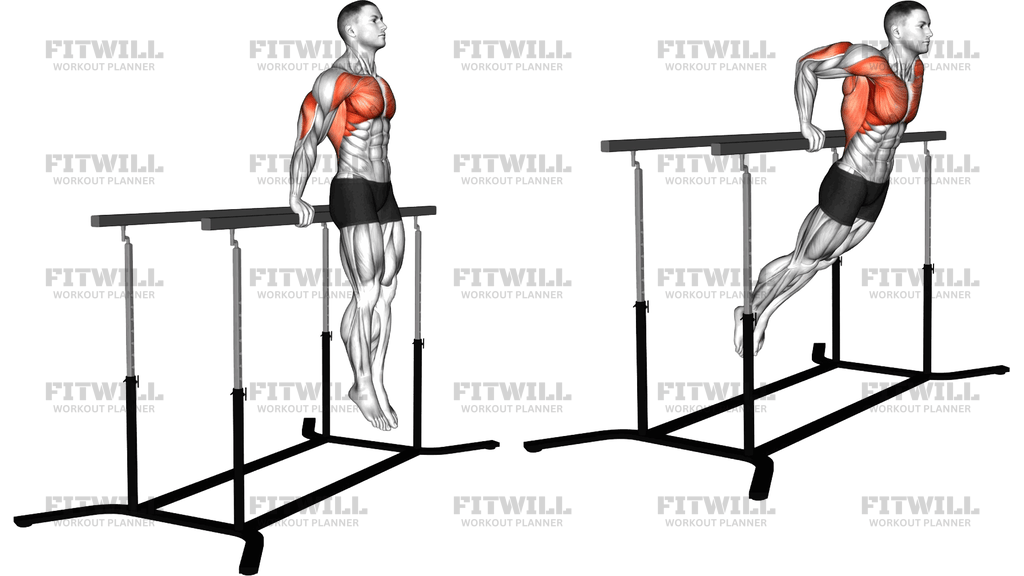
Instructions
- Set up between the parallel bars and grab each bar with a neutral grip, arms straight and shoulders pressed down away from your ears.
- Lean the torso slightly forward, keep the legs together or lightly crossed, and hold the body rigid before the first rep.
- Let the shoulders stay packed while you lower under control, allowing the chest to travel forward between the bars instead of sinking straight down.
- Bend the elbows and descend until you feel a strong chest and front-shoulder stretch without losing shoulder control or bouncing at the bottom.
- Keep the ribs from flaring and the neck long as you reverse the rep from the stretched position.
- Drive the bars down and back while pressing the body upward, extending the elbows until you return to a tall support position.
- Finish each rep with the shoulders still depressed, chest tall, and elbows locked without shrugging into the top.
- Inhale on the way down, exhale through the press, and reset your brace before the next repetition.
- Repeat for the planned number of reps, stopping the set if the bottom position becomes unstable or painful.
Tips & Tricks
- Keep the bars close enough that your shoulders can stay stacked over your hands instead of drifting wide and unstable.
- A small forward lean is enough to load the chest; over-leaning usually turns the bottom position into a shoulder strain.
- Think about moving the chest between the bars, not simply dropping the hips straight down.
- Use a controlled lowering phase so the front of the shoulder is loaded, but avoid forcing extra depth once the shoulder starts to roll forward.
- If you feel the elbows flare hard, narrow the arc and keep the forearms more vertical through the descent.
- Keep the legs quiet and crossed if needed so the lower body does not swing and steal tension from the press.
- Do not shrug at the top; the support position should feel active through the lats and lower traps, not jammed into the neck.
- Choose a rep range that lets you own the bottom stretch, because sloppy depth is the fastest way to turn this into a shoulder irritation drill.
Frequently Asked Questions
What does Korean Dips emphasize most?
They emphasize the chest strongly, with triceps and front shoulders helping through the press.
How is this different from a regular dip?
Korean dips use a more pronounced torso lean and a longer chest stretch between the bars, so the chest usually feels more involved.
Where should my shoulders be at the top?
They should stay depressed and stable in a tall support position, not shrugged up toward the ears.
How deep should I go on the bars?
Lower only as far as you can keep the shoulders packed and the chest controlled; depth should come from position, not collapse.
Why do my shoulders feel more involved than my chest?
Usually the torso is too upright, the forward lean is too small, or the bottom position is too short to load the pecs well.
Can I do Korean dips if I am new to dips?
Yes, but start with a small range of motion and strict control, because the stretched bottom position is the hardest part.
What is the most common mistake on this movement?
Letting the body swing and letting the shoulders roll forward at the bottom are the biggest technique failures.
How can I make Korean dips easier?
Reduce depth, keep a more upright torso, and focus on smooth reps instead of chasing a long stretch.