Dumbbell Bent-Over Single-Arm Row Version 2
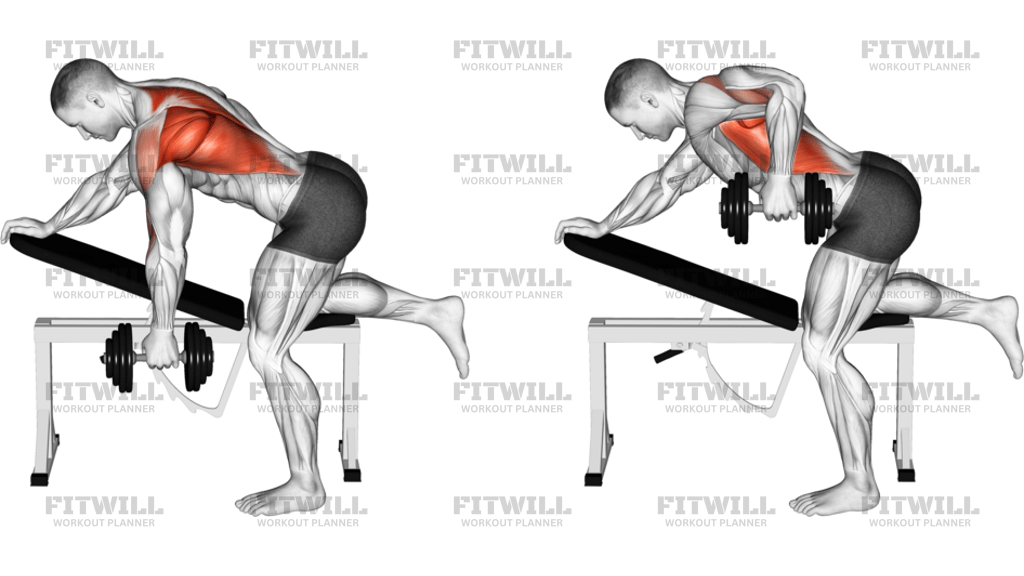
Dumbbell Bent-Over Single-Arm Row Version 2 is a bench-supported rowing exercise where one hand and the same-side knee brace the body while the other arm pulls a dumbbell from a dead hang to the side of the torso. The setup lets you train one side at a time and focus on a clean pull path instead of trying to balance the load with the whole body. It is a practical back builder for lifters who want more control over range, shoulder position, and torso stability.
The main training effect comes from the lat, upper-back, rear-shoulder, and arm muscles working together to move the dumbbell while the trunk resists twisting. Because one side is supported on the bench, the exercise makes it easier to keep tension on the rowing side and harder to hide mistakes with momentum. That also makes it useful when you want to compare left and right sides or keep the set honest with a stricter range.
The setup matters. Your support hand should sit under the shoulder, the support knee should be planted on the bench, and the working foot should stay firmly on the floor so your torso can hinge into a strong, stable position. From there, let the dumbbell hang straight down, then row it toward the hip or lower ribs while keeping the elbow close to the body. The goal is a smooth pull, a brief squeeze at the top, and a controlled lowering phase without rotating the shoulders open.
Use this movement in back-focused strength work, accessory training, or unilateral pulling sessions where you want cleaner technique than a free-standing bent-over row usually allows. Keep the neck long, the ribs quiet, and the torso still enough that the working arm does the lifting. If the dumbbell starts pulling you into a twist or the lower back begins to take over, the load is too heavy or the setup has drifted out of position.
[ Workout Log & Planner ]
Put your next workout in Fitwill
Keep your plan and training log ready when you are.


Instructions
- Place one hand and the same-side knee on a flat bench, with the support hand under the shoulder and the working foot planted on the floor.
- Hinge forward until your torso is nearly parallel to the bench and let the dumbbell hang straight down from the working shoulder.
- Keep your hips square, your neck long, and your ribs down before you start the first rep.
- Brace your midsection, then begin the pull by driving the elbow back and slightly up.
- Keep the working arm close to your side as the dumbbell travels toward your hip or lower ribs.
- Squeeze the back briefly at the top without twisting the torso or shrugging the shoulder.
- Lower the dumbbell slowly until the arm is fully extended and the shoulder stays controlled.
- Reset your brace between reps and repeat for the planned number of repetitions on one side before switching.
Tips & Tricks
- Stack the support shoulder over the hand so the bench helps stabilize the whole upper body.
- Think about pulling the elbow toward the hip if you want more lat involvement.
- Keep the working elbow close to your ribs instead of flaring it wide behind you.
- Do not let the torso rotate open at the top; the bench support should let the arm move, not the trunk.
- Lower the dumbbell with control so the shoulder can reach full stretch without yanking the joint.
- Choose a load that you can pause with at the top without losing body position.
- Keep the neck neutral and avoid looking up, which usually turns the row into a shrug.
- If your lower back starts doing the work, reduce the load or re-check the hinge angle.
Frequently Asked Questions
What muscles does Dumbbell Bent-Over Single-Arm Row Version 2 work?
It mainly trains the lats and upper back, with the rear delts, biceps, grip, and core helping to control the row.
Why is one hand and one knee supported on the bench?
The bench support gives you a stable base so the working side can row without the torso and lower back stealing the effort.
Where should the dumbbell travel during the row?
Pull it toward the side of your torso, usually near the hip or lower ribs, while keeping the elbow close to your body.
Should my torso move while I row?
It should stay mostly still. A little natural shift is fine, but twisting open or swinging the torso means the load is too heavy.
Can beginners do this dumbbell row?
Yes. The bench support makes it beginner-friendly as long as the load stays light enough to keep the torso steady.
What is the most common form mistake with this row?
Jerking the dumbbell up with body rotation or shrugging the shoulder instead of driving the elbow back smoothly.
What bench position works best for this exercise?
A flat bench is the simplest option because it gives you a clear support point for the hand and knee while keeping the row path easy to control.
How do I know the weight is too heavy?
If you cannot pause at the top, keep the elbow close, and lower the dumbbell slowly without twisting, the load is too heavy.