Wall-Assisted Decline Push-Up
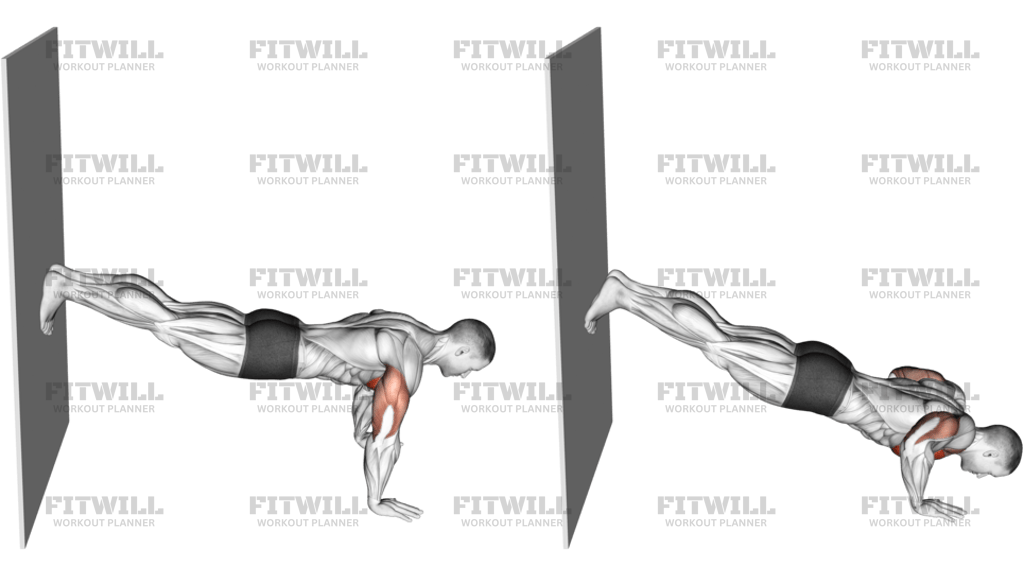
Wall-Assisted Decline Push-Up is a bodyweight pressing exercise performed with the feet braced against a wall and the hands on the floor. The wall fixes the foot position so you can hold a long, straight line from shoulders through hips to heels while you press, which makes the decline angle more stable and usually more demanding than a standard push-up.
This setup shifts a meaningful share of the work to the chest, front delts, and triceps while the core and glutes keep the torso from sagging or twisting. In anatomy terms, the main drivers are the Pectoralis major, with help from the Anterior deltoid, triceps brachii, and Rectus abdominis. Because the feet are elevated against the wall, the shoulder and trunk position matter more than in a flat push-up, and sloppy setup shows up quickly as rib flare, lumbar arching, or a drifting hand position.
A clean rep starts in a solid plank with the hands planted slightly wider than shoulder width, fingers spread, and the elbows soft but locked in by the shoulder girdle. Keep the feet pressed flat into the wall, squeeze the glutes, and pull the ribs down before you lower. From there, bend the elbows and lower the chest between the hands without losing the straight-body line. The descent should feel controlled, not dropped, and the press back up should finish with the floor pushed away evenly through both palms.
This exercise works well as a stronger push-up variation for accessory work, upper-body strength blocks, or bodyweight conditioning when you want more load on the pressing muscles without external equipment. It is also useful for teaching people to keep tension through the trunk while pressing. If the wall angle makes it too difficult, shorten the lever with a standard push-up or raise the hands instead; if the shoulders or wrists complain, reduce range of motion and keep the elbows closer to the torso. The goal is a stable, repeatable press that stays clean from the first rep to the last.
[ Workout Log & Planner ]
Put your next workout in Fitwill
Keep your plan and training log ready when you are.


Instructions
- Place your hands on the floor slightly wider than shoulder width and set your feet flat against the wall behind you.
- Straighten your legs so your body forms one long line from shoulders to heels, with your hips neither sagging nor piking up.
- Spread your fingers, press evenly through both palms, and keep your shoulders stacked over or just slightly in front of your wrists.
- Squeeze your glutes and brace your ribs down so your trunk stays rigid before the first rep.
- Inhale as you bend your elbows and lower your chest toward the floor between your hands.
- Keep your elbows angled back about 30 to 45 degrees from your torso instead of flaring them wide.
- Descend until your chest is close to the floor or until your shoulder position starts to change.
- Exhale and press the floor away to return to the starting plank without bouncing off the bottom.
- Reset the feet on the wall if they slip, then repeat for the planned number of reps.
Tips & Tricks
- Press the tops of the feet or the balls of the feet firmly into the wall so the lower body stays anchored while you move.
- Keep your head in line with your spine; looking far forward usually causes the ribcage to flare and the low back to sag.
- If the wall angle feels too steep, move the feet lower on the wall before you change anything else.
- Keep the ribs tucked and the glutes tight so the chest lowers as one unit instead of the hips dropping first.
- Let the shoulder blades move naturally, but do not shrug toward the ears at the top of the rep.
- Use a controlled descent of about two to three seconds so the chest and triceps do the work instead of momentum.
- Stop the set if the feet slide on the wall or the wrists collapse inward, because both usually mean fatigue is taking over.
- If the lower position irritates the shoulders, shorten the range and keep the elbows a little closer to the torso.
Frequently Asked Questions
What muscles does Wall-Assisted Decline Push-Up work most?
The main emphasis is on the chest, with the front shoulders and triceps helping strongly through the press.
Why are the feet placed against the wall?
The wall anchors the feet so you can keep a stable decline position and focus on pressing without losing body tension.
How low should my chest go on each rep?
Lower until your chest is close to the floor and your shoulders stay organized; do not force extra depth if your low back or shoulders start to compensate.
Should my elbows flare out wide?
No. Keep them angled back roughly 30 to 45 degrees so the press stays controlled and the shoulders are not overloaded.
Is Wall-Assisted Decline Push-Up beginner friendly?
It can be too demanding for some beginners. If the decline angle is too hard, switch to a standard push-up or raise the hands instead.
What usually goes wrong with the torso position?
People often let the ribs flare and the hips sag, which turns the rep into a loose back extension instead of a solid press.
What is a good way to make the movement easier?
Move the feet lower on the wall, shorten the range of motion, or use a less demanding push-up variation.
How should I breathe during the rep?
Inhale on the way down, keep the torso braced at the bottom, and exhale as you press back to the top.