Resistance Band Upper Body Lying Air Bike
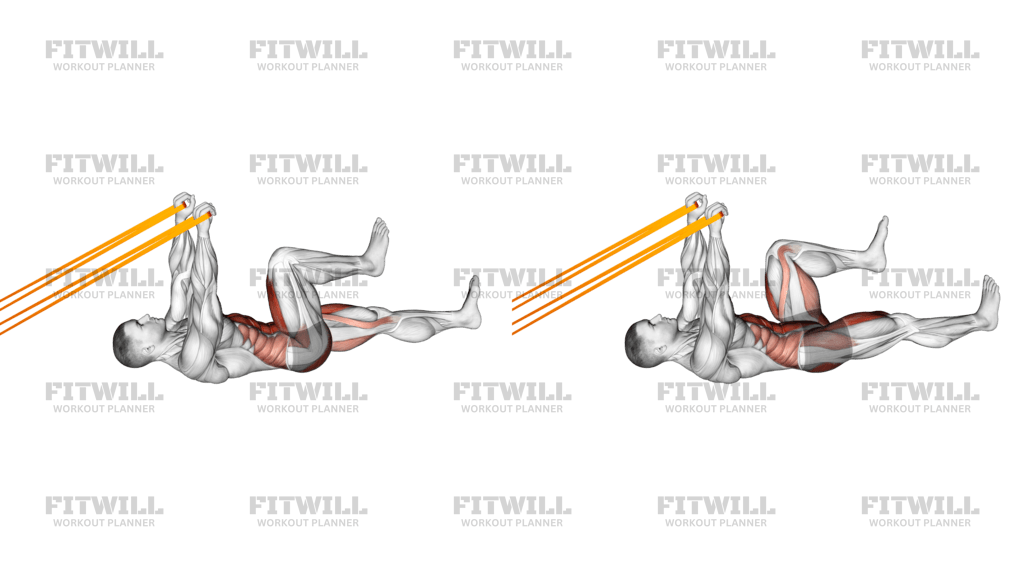
Resistance Band Upper Body Lying Air Bike is a supine core drill performed while holding a resistance band overhead and cycling the legs in an alternating bicycle pattern. The band adds tension through the arms, shoulders, and upper trunk while the lower body performs the air-bike motion, so the exercise demands coordination instead of isolated leg work. It is useful for building abdominal control, hip-flexor endurance, and the ability to keep the ribs and pelvis organized when the arms and legs are moving at the same time.
The setup is the part that makes the exercise work well. Lie flat on a mat, keep the band anchored overhead or slightly behind your head, and reach into the band so your arms stay long and under light tension. The goal is not to yank the band. It is to create a steady pull that makes the upper body stay engaged while the torso remains quiet. If the shoulders shrug or the low back arches, the load is too heavy or the anchor is too aggressive.
Each repetition should look like a controlled bicycle pedal in the air. One knee comes toward the chest as the opposite leg extends away, then the sides switch smoothly without letting the pelvis rock. The upper body should stay braced and the arms should remain steady against the band, while the abs control the rotation and extension. A clean rep feels rhythmic, but not fast or sloppy.
This movement fits well in core training, conditioning blocks, or warmups where you want trunk control under continuous tension. It can also be used as accessory work when you want to challenge the abs without heavy spinal loading. Keep the range of motion honest, because bigger leg swings usually come from momentum rather than better work. If the neck starts to strain or the lower back lifts off the floor, shorten the bicycle arc and reduce the band demand.
Use this exercise when you want a floor-based drill that ties together upper-body isometric tension and lower-body cycling coordination. It is best treated as a quality movement, not a race. Smooth transitions, steady breathing, and a quiet pelvis matter more than cranking out a huge number of reps.
Fitwill
Log Workouts, Track Progress & Build Strength.
Achieve more with Fitwill: explore over 9600 exercises with images and videos, access built-in and custom workouts, perfect for both gym and home sessions, and see real results.
Start your journey. Download today!




Instructions
- Anchor the resistance band overhead or slightly behind your head, then lie on your back on a mat.
- Grip the band with both hands and reach your arms straight up over your chest so the band stays lightly tensioned.
- Press your lower back into the floor and set your ribs down before you start the first rep.
- Lift both legs into the starting bicycle position with one knee bent and the other leg ready to extend.
- Extend one leg away as the opposite knee comes toward your chest, keeping your torso still.
- Switch legs smoothly so the pedals alternate without jerking your hips or shoulders.
- Keep pulling gently against the band while your arms stay steady and your neck stays relaxed.
- Exhale through the effort and continue for the planned number of reps or time.
- Lower both feet back to the floor and ease the band tension when the set is complete.
Tips & Tricks
- Keep the band taut, but not so heavy that it pulls your shoulders off the floor.
- If your lower back arches, shorten the leg extension instead of pushing for a bigger bicycle motion.
- Think about keeping your ribs heavy against the mat so the abs control the movement instead of the hips swinging.
- Move one leg at a time with a clear switch; sloppy double-leg motion usually means the set is too fast.
- Keep your hands stacked above the chest so the band tension stays even through both arms.
- Let the pelvis stay quiet. If it rocks side to side, reduce the range and slow the tempo.
- A slower switch between legs makes the core work harder than a fast, shallow pedal.
- Stop before your neck starts reaching forward, because that usually means the abs are no longer doing the job.
Frequently Asked Questions
What muscles does Resistance Band Upper Body Lying Air Bike work most?
It mainly trains the abdominals and hip flexors, with extra work from the shoulders and upper trunk as you hold the band overhead.
Where should I anchor the band for this exercise?
Anchor it overhead or slightly behind your head so you can keep light tension without shrugging or losing the floor position.
Should my lower back stay on the floor the whole time?
Yes. Keep the low back pressed down as you pedal the legs, and shorten the range if it starts to arch.
What is the biggest mistake with the leg motion?
The most common error is swinging the legs too far or too fast, which turns the exercise into momentum instead of trunk control.
Can beginners use this movement?
Yes, but start with a light band and a small bicycle range so you can keep the pelvis stable and the breathing smooth.
Is this more of a core drill or a cardio drill?
It is mainly a core-control exercise, but continuous reps can also drive your heart rate up if you keep the pace steady.
How can I make this exercise harder?
Increase the band tension, slow the leg switches, or extend each leg a little farther while keeping the low back down.
What should I do if my neck gets tired?
Relax the head, keep the chin slightly tucked, and reduce the leg range if you start trying to curl your shoulders forward.