Bulgarian Jump Squat
Bulgarian Jump Squat is a rear-foot-elevated plyometric split squat built for lower-body power, single-leg strength, and coordination. The back foot rests on a bench behind you while the front leg does the real work, so the exercise loads the quads and glutes hard without needing external weight. Because the movement is explosive, the quality of your setup matters as much as the jump itself.
The bench position, front-foot distance, and torso angle determine whether the rep feels athletic or unstable. If your front foot is too close, the knee shoots forward and the landing gets cramped. If it is too far away, you lose tension and the jump becomes a reach instead of a powerful drive. The goal is a split stance that lets you sink under control, then spring straight up and land softly back into the same pattern.
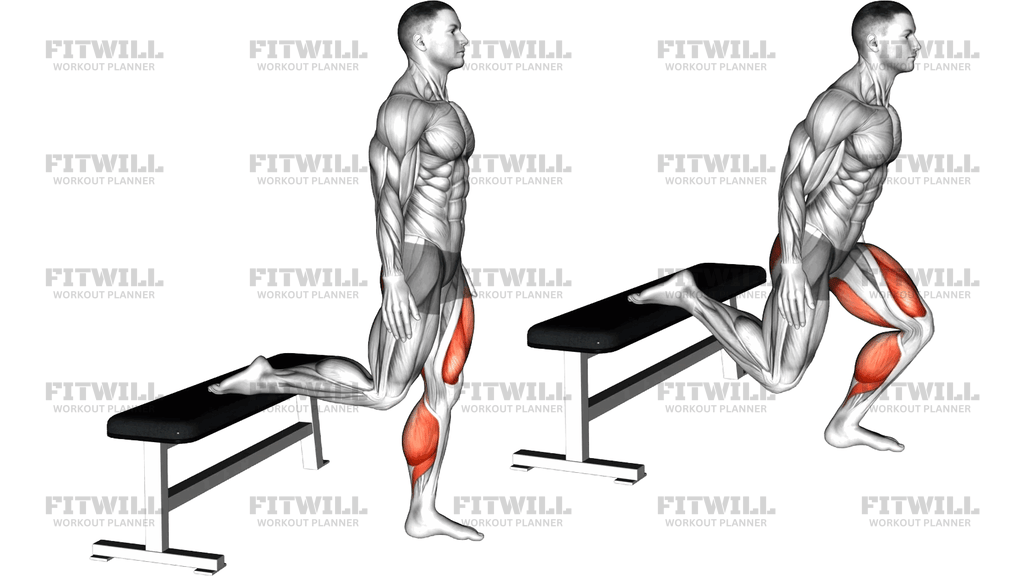
In the image, the rear foot stays elevated on the bench while the front leg carries the load through the bottom position and into the jump. Keep the hips square, the front knee tracking over the toes, and the chest slightly inclined so the front leg can absorb force. On the way down, lower far enough to load the front thigh and glute; on the way up, drive through the front midfoot and finish with an explosive but controlled takeoff.
Use this variation when you want unilateral power work, athletic conditioning, or a harder progression from a standard Bulgarian split squat. It works well in lower-body sessions as a primer, a power block, or a finisher when you still have good landing mechanics. It is not a beginner-friendly place to learn balance, so reduce the challenge first if you cannot keep the torso steady or land quietly.
The safest reps are the ones you can repeat with the same landing every time. Avoid bouncing off the back foot, collapsing the front knee inward, or turning the jump into a broad leap. Stop the set when the landing gets loud, the hips twist, or the front heel starts to lift before takeoff.
[ Workout Log & Planner ]
Put your next workout in Fitwill
Keep your plan and training log ready when you are.


Instructions
- Place the top of your back foot on a bench behind you and stand tall facing away from it.
- Step your front foot forward far enough that you can lower without your heel lifting or your knee jamming forward.
- Square your hips and keep most of your weight over the front leg; let the back leg act as a balance point, not a driver.
- Lower into a split squat until the front thigh is close to parallel and the back knee moves toward the floor.
- Pause briefly at the bottom to feel the front leg loaded and the torso steady.
- Drive forcefully through the front midfoot and jump straight up from the split stance.
- Land softly back in the same split stance with bent knees and the front knee tracking over the toes.
- Reset your balance before the next rep instead of bouncing off the rear foot or rushing the landing.
- Inhale on the descent and exhale sharply as you explode upward for each repetition.
Tips & Tricks
- A slightly forward torso lean helps the front leg load the jump without tipping the pelvis.
- Pick a bench height that lets your rear leg stay relaxed; if the back hip feels pinched, the bench is too high.
- Keep the front heel heavy on the way down so the jump starts from the whole foot, not just the toes.
- Use a smaller jump and a quieter landing if your knee caves inward or your balance wobbles.
- The back foot should stay light; do not push off it to fake height.
- A front foot placed a little farther from the bench usually gives a cleaner knee path and better landing room.
- Think about jumping up, not forward; a long leap usually breaks the split stance and stresses the landing.
- If the landing gets noisy, shorten the set or slow the tempo because the plyometric quality is gone.
Frequently Asked Questions
What muscles does Bulgarian Jump Squat work?
It mainly trains the front leg's quads and glutes, with the calves, adductors, and core helping stabilize each landing.
How is this different from a Bulgarian split squat?
The split squat is slow and strength-focused, while this version adds a jump so the exercise becomes more explosive and plyometric.
Should my back foot push off the bench?
No. The rear foot should stay light and quiet while the front leg produces almost all of the force.
How low should I go before jumping?
Lower until the front thigh is close to parallel and you can feel the front leg loaded without losing balance or collapsing the torso.
Why does my front knee drift forward too much?
That usually means the front foot is too close to the bench. Step it slightly farther forward so the shin can stay more stacked over the foot.
Is this a good exercise for beginners?
Not as a first choice. Most beginners should learn the static Bulgarian split squat first, then add the jump once balance and landing control are solid.
What should I feel if the form is correct?
You should feel strong loading in the front thigh and glute, plus a controlled stretch in the rear hip, not strain in the low back.
How do I make the landing safer?
Jump a little lower, land with bent knees, keep the front heel down, and reset each rep until you can make the landing quiet and stable.