Bench Assisted One-Arm Push-Up
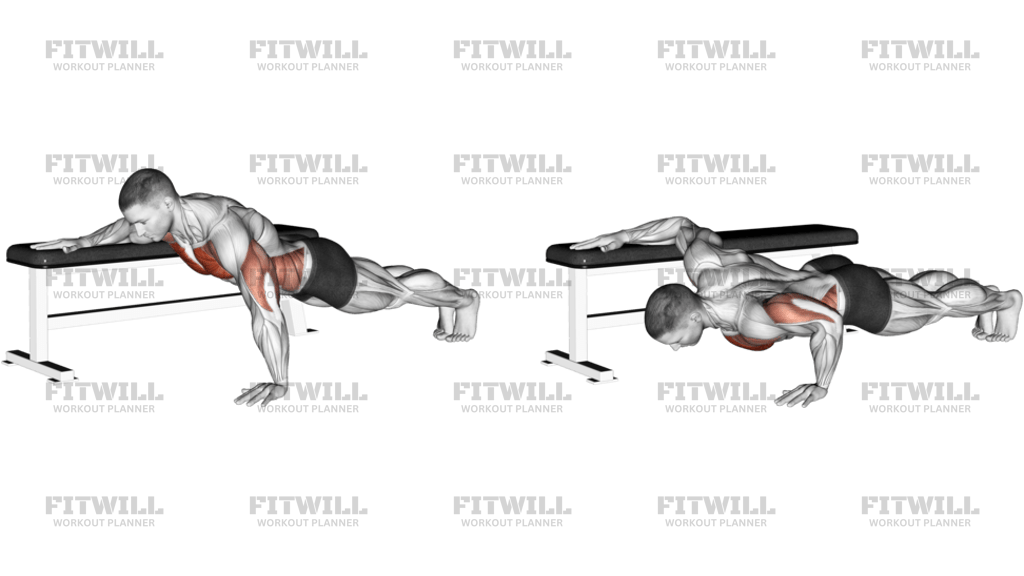
Bench Assisted One-Arm Push-Up is a staggered push-up variation that lets you train one-sided pressing strength without jumping straight to a full one-arm floor push-up. One hand is on the bench and the other is on the floor, which creates an uneven support base and shifts more of the pressing demand to the lower hand while the elevated hand helps with balance and load sharing. The result is a demanding chest, shoulder, triceps, and core exercise that also exposes weak links in hip control and shoulder stability.
The setup matters more here than in a standard push-up. The bench hand should be flat and planted, the floor hand should sit under or slightly outside the shoulder, and the feet need to be wide enough to stop the torso from twisting. A straight line from head to heels is the goal, but the body will naturally want to rotate toward the lower hand as fatigue builds. Keeping the hips square and the rib cage controlled is what turns this from a sloppy twist into a useful strength drill.
At the bottom, lower under control until the chest approaches the floor and both shoulders stay organized rather than collapsing forward. Press back up by driving through the floor hand and keeping the bench-side shoulder from shrugging or drifting. The descent should feel smooth, not rushed, and the ascent should finish with the arms locked out only after the chest and trunk have done their work. Breathe in on the way down and exhale as you press away from the floor.
This variation is useful when you want to build toward a true one-arm push-up, clean up asymmetries between left and right sides, or add a hard bodyweight press to an upper-body session without equipment changes beyond a bench. It can also be scaled by changing the bench height, widening or narrowing the feet, or slowing the tempo. Keep the motion pain-free and symmetrical enough to repeat with the other side, and stop the set if the shoulder collapses, the hips spin open, or the lower back starts sagging.
[ Workout Log & Planner ]
Put your next workout in Fitwill
Keep your plan and training log ready when you are.


Instructions
- Place one hand flat on the bench and the other hand flat on the floor under or just outside the shoulder.
- Walk your feet back into a long plank and set them wide enough to resist twisting.
- Square your hips and ribs before you start the first rep.
- Lower your chest toward the floor under control while keeping both elbows tracking naturally and not flaring hard out to the sides.
- Keep the bench hand active for balance, but let the floor hand do the main pressing work.
- Pause briefly when your chest is close to the floor without collapsing the shoulder or arching the low back.
- Press the floor away to return to the top while keeping the torso level.
- Exhale as you press up and inhale as you lower.
- After the set, step in and switch sides so the other arm gets the same setup.
Tips & Tricks
- Use a bench height that lets you keep your torso steady; a higher support is easier, while a lower support makes the press much harder.
- Keep your feet wider than a normal push-up stance if your hips want to rotate toward the floor hand.
- The floor-side hand should stay under enough load to train strength, but the bench hand should not become a passive hanger.
- Do not let the shoulder over the floor hand sink toward your ear on the way down or the way up.
- If your elbow flares sharply, turn the hand slightly and keep the upper arm at a more natural angle.
- Move slowly enough that you can stop at the bottom without bouncing off the floor.
- Keep the neck long and look slightly ahead of your hands instead of dropping your head.
- Choose a rep range that lets every repetition look the same; once the hips start spinning or the low back sags, end the set.
- Match left and right sides carefully because the asymmetry makes side-to-side differences easy to hide.
Frequently Asked Questions
What muscles does Bench Assisted One-Arm Push-Up train?
It trains the chest, triceps, front shoulders, and core, with the floor-side obliques and hip stabilizers working hard to keep the body from twisting.
Which hand should feel the hardest work?
The hand on the floor usually carries most of the pressing load, while the bench hand helps with balance and load sharing.
Is this a true one-arm push-up?
No. It is a progression toward a one-arm push-up, but the bench support reduces the load and makes the pattern more manageable.
How wide should my feet be?
Wide enough to keep the hips from rolling open. If you feel the torso twisting hard toward the working arm, widen the stance.
How low should I go on each rep?
Lower until the chest is close to the floor and the shoulders stay controlled. Stop sooner if the supporting shoulder collapses or the low back starts to arch.
Can beginners use this exercise?
Yes, if they start with a higher bench, wide feet, and short sets. It is still demanding, so quality matters more than rep count.
What is the most common mistake?
The most common mistake is letting the torso rotate and the bench-side shoulder shrug, which turns the rep into a sloppy half twist.
How can I make it harder?
Use a lower bench, bring the feet closer together, slow the lowering phase, or pause briefly near the bottom before pressing back up.
Should I switch sides?
Yes. Train both sides separately so the lower hand and bench-hand positions are mirrored and any strength imbalance becomes obvious.