Static Lunge
Static Lunge is a stationary split-stance lower-body exercise that trains the front leg through a deep knee and hip bend while the back leg stays planted behind you. Because the feet do not travel, it is a clean way to build unilateral leg strength, balance, and hip control without the stepping rhythm of a walking lunge.
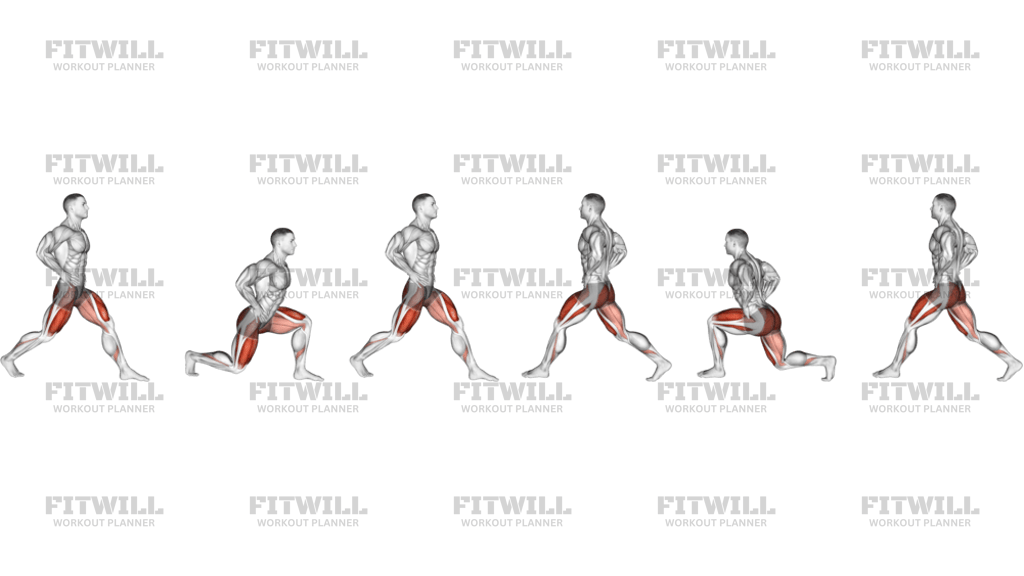
The image shows a long split stance with the rear heel lifted and the torso mostly upright, so this movement should be coached as a controlled lunge pattern rather than a forward step. The front foot does most of the work, the back leg supports balance, and the hips stay square as you lower and rise in the same track.
Static lunges are useful when you want stronger quads, glutes, adductors, and knee stability with minimal equipment. They are easy to scale from bodyweight to dumbbells at your sides, a goblet hold, or other front-loaded variations as long as the stance stays balanced and the pelvis does not twist open.
Good reps are deliberate. Lower straight down between your feet, let the front knee travel in line with the toes, lightly tap or hover the back knee near the floor, then drive through the whole front foot to stand back up. Keep the torso tall enough to keep pressure on the front leg instead of collapsing forward, and use the same stance length and depth on both sides so the set stays even.
[ Workout Log & Planner ]
Put your next workout in Fitwill
Keep your plan and training log ready when you are.


Instructions
- Stand in a long split stance with one foot forward and the other behind you, keeping both feet pointed mostly straight ahead.
- Shift your weight so the front foot is flat and the back heel is lifted, with your hips squared toward the front.
- Hold dumbbells at your sides or keep your hands on your hips if you are doing the bodyweight version.
- Brace your torso and lower straight down by bending both knees, not by stepping forward or backward.
- Keep the front knee tracking over the middle toes as the back knee drops toward the floor.
- Lower until the back knee is just above the ground or lightly touches, while keeping your chest tall and your balance steady.
- Drive through the front heel and midfoot to stand back up, straightening both legs without snapping the knees hard at the top.
- Complete all reps on one side, then switch legs and match the stance length and depth.
Tips & Tricks
- Take a long enough stance that your front heel stays down and your front knee does not shoot far past your toes.
- Keep the front foot tripod planted: big toe, little toe, and heel should all stay loaded.
- A slight forward torso lean is normal, but a big fold usually means the stance is too short or the load is too heavy.
- Let the back knee travel straight down instead of drifting behind you.
- Keep the pelvis square; rotating open usually shifts work away from the front leg.
- If balance is the limiter, shorten the range a little before adding load.
- Use a slower lowering phase to build more control and reduce bouncing at the bottom.
- Stop the set if the front knee caves inward or the back foot starts sliding.
Frequently Asked Questions
What muscle does Static Lunge target most?
It mainly trains the front-leg quads and glutes, with the hamstrings, adductors, and calves helping with stability.
Is Static Lunge the same as a split squat?
In practice, yes. Many coaches use the terms interchangeably for a stationary lunge with the feet held in place.
Should my back knee touch the floor?
It can lightly touch or hover just above the floor, as long as you keep control and do not collapse onto it.
How wide should my stance be?
Long enough that both knees can bend comfortably and the front heel stays down, but not so long that you lose balance or overreach.
Can I do this exercise with dumbbells?
Yes. Dumbbells at your sides are the most common loading option once the bodyweight version feels stable.
Why does my front knee wobble inward?
That usually means the stance is too narrow, the load is too heavy, or the hip is not staying active through the descent.
Which leg should I feel working?
The front leg should do most of the work; the back leg is there mainly for balance and support.
Is Static Lunge a good beginner exercise?
Yes, if you start with a short range and bodyweight only. It is a useful way to learn single-leg control before progressing to heavier unilateral leg work.