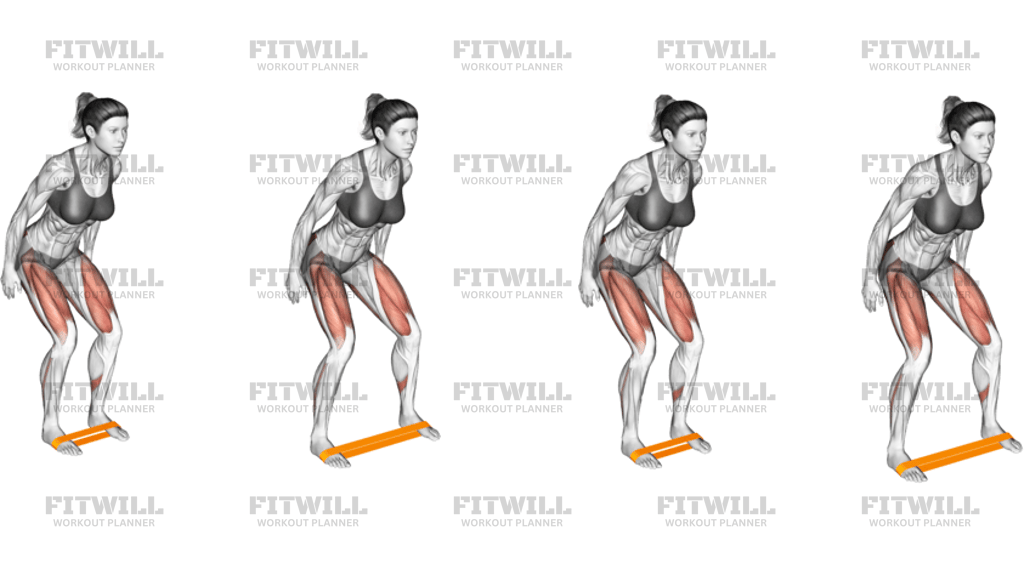
Band Standing Hip Extension
Band Standing Hip Extension is a single-leg glute isolation exercise done with a low band anchor and a light support hold on a rack or post. One ankle works against the band while the other leg stays planted, so the movement trains hip extension without needing a bench, floor, or machine. It is a useful accessory drill for glute activation, hip control, and cleaner lower-body mechanics.
The setup matters because the band angle and your distance from the anchor determine how smooth the resistance feels through the range. If you stand too close, the band may go slack too early; if you stand too far away, you may have to lean or twist to keep tension. The goal is to keep the torso tall, the ribs stacked over the pelvis, and the pelvis square while the working leg moves back behind the body.
The main work should come from the glute of the kicking leg, with the hamstrings helping and the stance leg, core, and upper body providing balance. In anatomy terms, the primary mover is the Gluteus maximus, with support from the Biceps femoris, Rectus abdominis, and Erector spinae. If you feel the lower back taking over, the kick is usually traveling too far or the torso is leaning forward to cheat the range.
Perform each repetition by pressing the leg straight back from the hip, not by swinging the foot or arching the spine. The ankle stays controlled, the pelvis stays level, and the movement stops when the glute is fully contracted and the trunk is still organized. A brief squeeze at the back of the rep helps reinforce the target muscle without turning the exercise into a momentum drill.
This movement fits well in warm-ups, accessory work, or glute-focused sessions where you want a controlled unilateral pattern with low joint stress. It is also practical for beginners who need a simple way to learn hip extension and balance before moving to heavier glute work. Keep the band light enough to move smoothly, and prioritize a clean line of motion over height, speed, or range that you cannot control.
Fitwill
Log Workouts, Track Progress & Build Strength.
Achieve more with Fitwill: explore over 9600 exercises with images and videos, access built-in and custom workouts, perfect for both gym and home sessions, and see real results.
Start your journey. Download today!




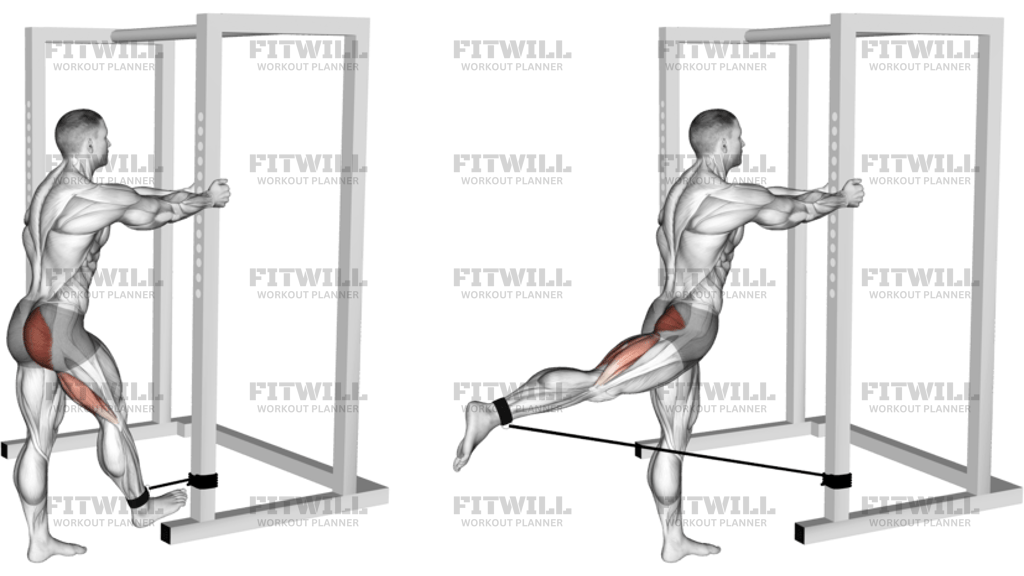
Instructions
- Stand facing a low band anchor and hold the rack or upright post with both hands at chest height.
- Loop the band around the working ankle and step the standing foot far enough forward to create light tension at the start.
- Shift most of your weight onto the standing leg, keep the hips square, and leave a soft bend in the standing knee.
- Stack your ribs over your pelvis and set the working foot under the hip before the first rep.
- Brace your trunk, then drive the working leg straight back from the hip while keeping the torso tall.
- Stop the backward drive when the glute is fully squeezed and the lower back still feels neutral.
- Pause for a brief squeeze at the back of the rep without leaning harder into the rack.
- Return the leg slowly to the start position under control and keep tension in the band.
- Finish the set, reset your stance and band tension, then repeat on the other side.
Tips & Tricks
- Hold the rack lightly so your arms stabilize you without pulling your body forward.
- Keep the standing knee soft and the foot tripod planted; locking the knee makes the pelvis wobble.
- If the lower back arches at the top, shorten the range and finish the rep with the glute instead of the spine.
- Choose a band that lets you pause behind the body without snapping the leg forward on the return.
- Think of driving the heel back and slightly up, not flicking the toes or swinging the whole leg.
- Keep both hip bones facing the anchor; opening the working hip reduces glute tension and invites rotation.
- Use a slower return than drive phase so the band does not yank you off balance.
- Exhale as the leg moves back and inhale as it comes forward to help keep the ribs stacked.
Frequently Asked Questions
What muscle does Band Standing Hip Extension target most?
The gluteus maximus is the main target, with the hamstrings helping and the core stabilizing the torso.
Can beginners perform this exercise?
Yes. Beginners usually do best with a light band and one or both hands on the rack for balance.
Where should my hands go during the setup?
Use the rack, upright, or post for a light support hold at about chest height so you can stay tall without hanging on it.
How far back should the working leg move?
Only drive it back until the glute is fully contracted and the pelvis stays square; do not chase height with a low-back arch.
Why does this exercise sometimes hit the lower back?
That usually happens when the torso leans forward or the leg swings too far behind the body, turning the rep into lumbar extension.
Can I do this with a cable instead of a band?
Yes. A low cable ankle strap or a glute kickback machine can give a similar hip-extension pattern with a different resistance feel.
Should the standing knee stay straight?
No. Keep a soft bend so the stance leg can balance the body and the pelvis does not drift or lock out.
How many reps make sense for this movement?
It is commonly used for moderate to higher reps, such as 12 to 20 per side, because control matters more than heavy loading.