Medicine Ball Half Kneeling Chest Push
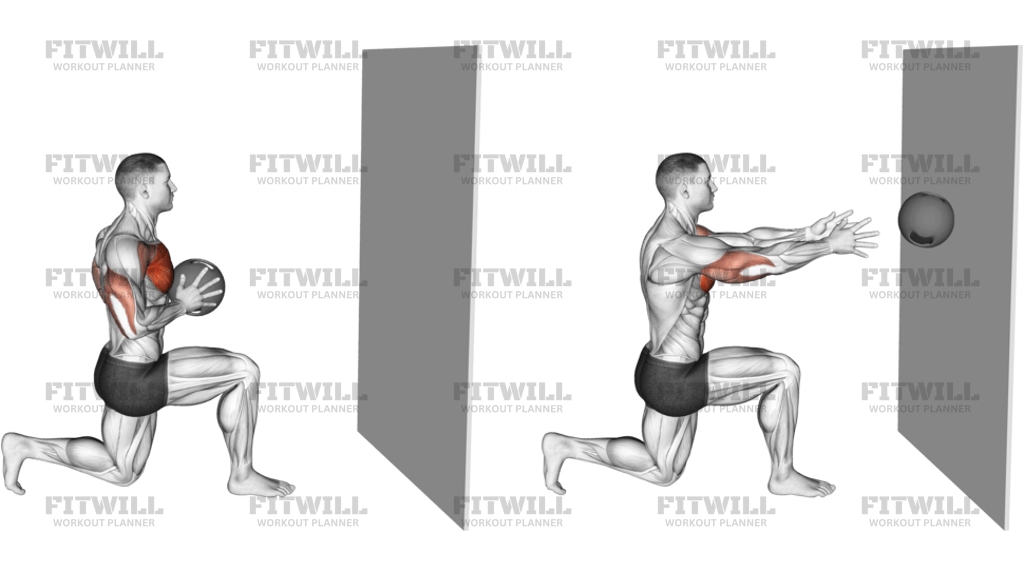
Medicine Ball Half Kneeling Chest Push is a half-kneeling horizontal pressing drill that sends a medicine ball straight forward into a wall from chest height. It is a simple way to train forceful pressing mechanics while you keep the torso quiet, the pelvis square, and the rib cage stacked over the hips.
The half-kneeling position changes the exercise from a simple arm press into a full-body stability drill. With one knee down and the opposite foot planted, you have to keep your front shin vertical, your back-side hip extended, and your trunk from twisting as the ball leaves your chest. That makes the exercise useful for chest, front shoulder, and triceps work, but also for the core and glutes that keep the press clean.
A good setup matters because the wall distance decides whether the rep feels crisp or awkward. Start close enough that the ball reaches the wall at chest level with both elbows tracking forward, not flared wide. Hold the ball tight to the sternum before each rep, then press it straight ahead instead of letting one shoulder drift forward or one side of the pelvis rotate open.
As you press, think about driving the ball in a straight line and finishing with the arms extended without shrugging the shoulders. If the ball rebounds, receive it softly and bring it back to the chest under control before the next rep. The best repetitions look smooth, aligned, and repeatable rather than forced.
This drill is commonly used as an accessory press, a warm-up for upper-body power work, or a core-biased pressing variation when you want less load but more control. It works well for athletes and general lifters who need pressing output without standing momentum, and it can be scaled easily by changing ball weight, wall distance, or rep speed.
Fitwill
Log Workouts, Track Progress & Build Strength.
Achieve more with Fitwill: explore over 9600 exercises with images and videos, access built-in and custom workouts, perfect for both gym and home sessions, and see real results.
Start your journey. Download today!




Instructions
- Set up in a half-kneeling stance facing a wall, with one knee on the floor, the opposite foot flat in front, and the medicine ball held at your sternum.
- Square your hips and shoulders to the wall, keep your front foot planted, and bring your ribs down so your torso starts stacked over your hips.
- Position yourself close enough that a straight press sends the ball to chest height on the wall without reaching or leaning forward.
- Brace your midsection and keep the down-knee-side glute lightly engaged before the ball leaves your chest.
- Press the medicine ball straight forward from the chest by extending both elbows at the same time.
- Finish with the arms long and the shoulders level, without letting your lower back arch or your torso rotate.
- If the ball rebounds, absorb it softly with bent elbows and guide it back to the sternum under control.
- Reset the half-kneeling position, re-brace, and repeat for the planned number of reps on one side before switching sides.
Tips & Tricks
- Choose a medicine ball that lets you hit the wall crisply without needing a big torso lean to create speed.
- Keep the front knee and foot still; if the knee slides or the heel lifts, the setup is too unstable for the load.
- Press the ball on a straight path from sternum to wall instead of letting one hand drift higher than the other.
- Stop the rep if your rib cage flares hard at the finish, because that usually means the low back is stealing the work.
- Use the down-knee-side glute to keep the pelvis from tipping forward as the ball leaves the chest.
- Let the elbows extend together so the press finishes evenly through both sides of the chest and triceps.
- If the wall is too close, the ball will feel jammed; if it is too far, you will have to chase the target and lose posture.
- Keep your neck long and your chin neutral so the head does not jut toward the wall with each rep.
Frequently Asked Questions
What does the Medicine Ball Half Kneeling Chest Push train?
It mainly trains horizontal pressing power through the chest, front shoulders, and triceps, while the half-kneeling stance forces the core and hips to stay organized.
Why is it done from a half-kneeling position?
Half kneeling removes leg drive and standing momentum, so the press has to come from the upper body and trunk instead of a whole-body push.
How far should I stand from the wall?
Stand close enough that the ball reaches the wall at chest height with a straight path. If you have to lean or shrug to make contact, adjust your distance.
Can beginners do this exercise?
Yes, as long as the medicine ball is light enough to control and the wall distance is set so the rep stays clean and repeatable.
What is the most common mistake?
Letting the torso rotate or the lower back arch while the ball travels to the wall is the most common breakdown.
What weight medicine ball should I use?
Use the lightest ball that still gives a decisive press and clean rebound control. This drill is about speed, alignment, and positioning more than heavy loading.
Is this more of a strength move or a power move?
It can be used for both, but the wall press version is often programmed as a power or accessory drill because the intent is fast, crisp force production.
What should I do if the ball bounces back hard?
Soften the catch with bent elbows and reset your torso before the next rep. If the rebound is difficult to control, use a lighter ball or stand slightly farther from the wall.