Cable Seated Horizontal Shrug
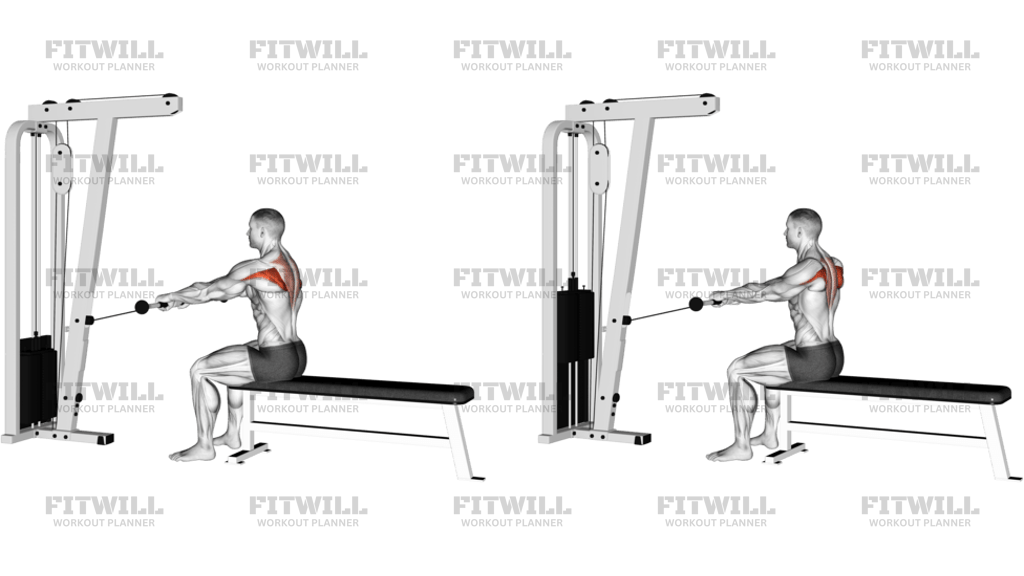
Cable Seated Horizontal Shrug is a seated cable exercise built around horizontal scapular motion rather than elbow flexion. The image shows a lifter sitting upright on a flat bench, facing the cable stack, with the cable set at about chest height and a single handle held with straight arms. From that position, the shoulders travel back and slightly down as the shoulder blades squeeze together, then return forward under control. That makes the movement useful for training upper-back control, posture, and scapular stability without asking you to row the handle to your torso.
The exercise is most often used to teach clean shoulder-blade movement. Because the arms stay long, the rep is driven by the shoulder girdle instead of the biceps or a big torso swing. The working range is short, but it should feel deliberate: reach forward enough to let the shoulder blades glide, then pull the shoulders back until the chest feels open and the upper back is working. A small pause at the end of the pull helps remove momentum and makes the contraction easier to feel.
Setup matters here because the seated position can either keep you honest or turn the rep into a lean-back row. Sit tall on the bench with both feet planted, keep the ribcage stacked over the pelvis, and line the handle up with the center of the chest. The cable should stay taut from the first rep, but the torso should not drift backward as the shoulders move. If the bench is too far from the stack, you will lose tension at the start; if it is too close, the cable angle can force the shoulders into an awkward path.
This movement is a good accessory for lifters who want better scapular control for rows, pulldowns, pressing, or posture-focused work. It can also be used as a lighter activation drill when the upper back tends to dominate with the arms instead of the shoulder blades. Keep the load modest, the neck relaxed, and the repetitions smooth. The goal is clean scapular retraction and controlled return, not a big shrugging heave or a fast tug on the handle.
[ Workout Log & Planner ]
Put your next workout in Fitwill
Keep your plan and training log ready when you are.


Instructions
- Set a cable pulley at about chest height and attach a single handle.
- Sit on a flat bench facing the stack and plant both feet firmly on the floor.
- Hold the handle with both hands, arms long, and scoot back until the cable is lightly tensioned.
- Stack your ribs over your pelvis and keep your chest tall without leaning back.
- Start each rep by letting the shoulder blades glide forward just enough to lengthen the upper back.
- Pull the shoulders back and slightly down so the shoulder blades move together while the elbows stay nearly straight.
- Pause briefly when the upper back is fully contracted and the handle has not moved much farther than your chest line.
- Return the shoulders forward in a controlled manner until you feel the same starting stretch, then repeat.
Tips & Tricks
- Think about moving your shoulder blades, not rowing the handle toward your body.
- Keep the elbows soft but nearly fixed so the biceps do not turn this into a curl.
- If your torso rocks backward, the stack is too heavy or the bench is too far from the pulley.
- Let the shoulders reach forward on the way down so the upper back gets a clear stretch each rep.
- Use a short pause at the back of the movement to make the contraction easier to feel.
- Keep your neck long and avoid jutting the chin forward as the shoulders retract.
- Choose a load that lets the cable stay smooth; jerky cable travel usually means you are yanking with momentum.
- If the handle sits too low or too high, adjust the pulley before loading the set so the pull stays level with the chest.
Frequently Asked Questions
What does Cable Seated Horizontal Shrug train?
It trains scapular control and upper-back retraction with the arms kept long, so the work stays on the shoulder blades rather than a full rowing pattern.
Is this the same as a seated cable row?
No. A row bends the elbows and brings the handle toward the torso; this version keeps the elbows nearly straight and focuses on moving the shoulder girdle.
Where should the cable and handle be set up?
Set the pulley around chest height so the handle can travel horizontally while you sit upright on the bench.
What should I feel during the pull?
You should feel the upper back working as the shoulder blades come together, with very little change in elbow angle.
Why should I avoid leaning back?
Leaning back turns the exercise into a body English row and reduces the scapular work that makes this movement useful.
Can beginners use this exercise?
Yes. It is beginner-friendly if the load stays light enough to keep the torso still and the cable path smooth.
What is a common mistake with the handle position?
Pulling the handle too far toward the stomach usually means the elbows are bending too much and the exercise is drifting into a row.
How can I make the movement harder without cheating?
Use a slightly heavier load, hold the squeeze for a second, or slow the return while keeping the shoulders under control.