Band Overhead Single-Arm Triceps Extension
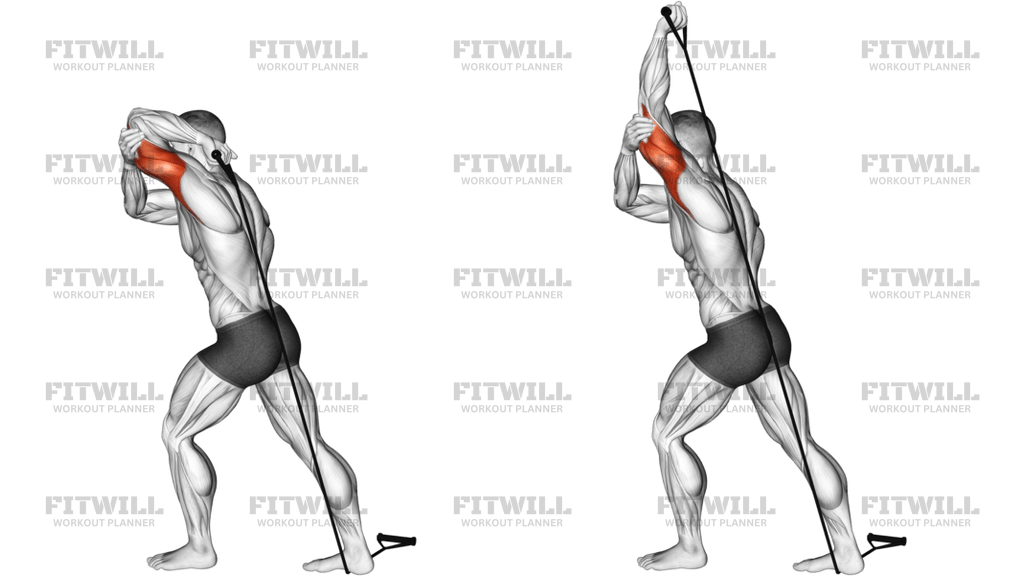
Band Overhead Single-Arm Triceps Extension is a standing isolation exercise that uses a resistance band to train elbow extension while your upper arm stays lifted beside your head. The image shows a split stance with the band anchored under the foot, which creates constant tension from the bottom of the rep to the top and makes small changes in arm angle matter. That is why the setup matters so much: if the band drifts, the torso leans too far, or the elbow swings away from the head, the load stops behaving like a triceps exercise and starts turning into a full-body compensation drill.
This movement is most useful when you want direct triceps work without a bench or machine. It is especially good for home workouts, warm-ups before pressing, or accessory work after compound upper-body lifts. The band keeps the resistance curve smooth, so the hardest part of the rep is usually near lockout. That makes control at the top more important than chasing speed or using momentum. The working arm should stay long overhead, the elbow should point mostly forward, and the shoulder should stay packed rather than flaring around the ribcage.
A clean repetition starts with the band secured under the working side of the stance and the same-side arm held overhead. From there, bend only at the elbow to lower the hand behind the head, then extend the elbow until the arm is straight again. The upper arm should stay nearly fixed, and the torso should remain quiet. If the ribs flare, the lower back arches, or the shoulder rotates open to help finish the rep, the band is too heavy or the setup is too unstable.
Because this is a single-arm band exercise, it also exposes side-to-side differences very clearly. One arm may lock out smoothly while the other loses position or twists the torso to finish the rep. That is normal, and it is useful information. Keep the reps slow enough to notice whether the elbow path stays consistent and whether both sides can keep the same stance, brace, and overhead position.
Use this exercise when you want targeted triceps tension with simple equipment and a low joint-impact setup. It pairs well with presses, dips, pushdowns, and other arm-focused accessories, but it also works as a stand-alone finisher when you want to isolate the back of the upper arm. Stay inside a pain-free range, keep the shoulder and elbow aligned, and choose a band tension that lets you repeat the same clean arc on every rep.
[ Workout Log & Planner ]
Put your next workout in Fitwill
Keep your plan and training log ready when you are.


Instructions
- Step on the band with the working-side foot and take a split stance so you can stay balanced without shifting your hips.
- Hold the handle or band end in one hand and raise that arm overhead, with the elbow bent and the upper arm beside your head.
- Brace your ribs down and keep your neck long before you start the first rep.
- Keep the elbow pointed mostly forward and let the forearm fold behind your head without letting the upper arm drift.
- Press the hand upward by extending the elbow until the arm is straight and the triceps are fully shortened.
- Pause briefly at the top without locking the shoulder backward or leaning into the band.
- Lower the hand back behind your head under control until you feel the triceps lengthen again.
- Keep breathing steady, exhaling as you extend and inhaling as you return to the start.
- Repeat for the planned reps, then reset the band and stance before switching sides.
Tips & Tricks
- Keep the upper arm almost still; if it starts drifting forward or out to the side, the band is too heavy.
- Use a staggered stance so the rep comes from the elbow, not from shifting your bodyweight.
- Stop a little short of a painful end range if your shoulder or elbow feels pinched at the bottom.
- Choose a band tension that lets you finish the lockout without jerking your torso backward.
- Let the forearm travel behind the head on the way down, but do not turn the exercise into a shoulder press.
- Keep the wrist stacked over the elbow so the handle does not pull the hand into an awkward angle.
- Slow the lowering phase to make the triceps work harder through the stretch.
- Match the reps on both sides; if one side twists or leans, use a lighter band or shorter set.
Frequently Asked Questions
What does the band overhead single-arm triceps extension train most?
It primarily trains the triceps through elbow extension, with the overhead position emphasizing the long head.
Why keep the upper arm beside the head during this exercise?
That position isolates elbow extension. If the upper arm swings, the shoulder starts helping and the triceps get less direct work.
Where should the band be anchored?
In the image, the band is stepped on under the working-side foot, which creates a stable low anchor and keeps tension continuous.
Should my elbow move during the rep?
It should stay mostly fixed near the head. A small amount of natural movement is fine, but the arm should not drift into a press or swing.
Is this exercise beginner friendly?
Yes, if the band is light and the stance is stable. Beginners usually do best with slower reps and a shorter range at first.
What are the most common mistakes with the band overhead triceps extension?
The biggest issues are flaring the ribs, leaning back, letting the elbow drift away from the head, and using a band that is too heavy.
Can I do this one arm at a time?
Yes, that is the standard setup. Single-arm work helps expose left-right differences in elbow path and shoulder stability.
What is a good way to progress this movement?
Add a little band tension, slow the lowering phase, or clean up the lockout without letting the torso move.