Cable Kneeling Twist
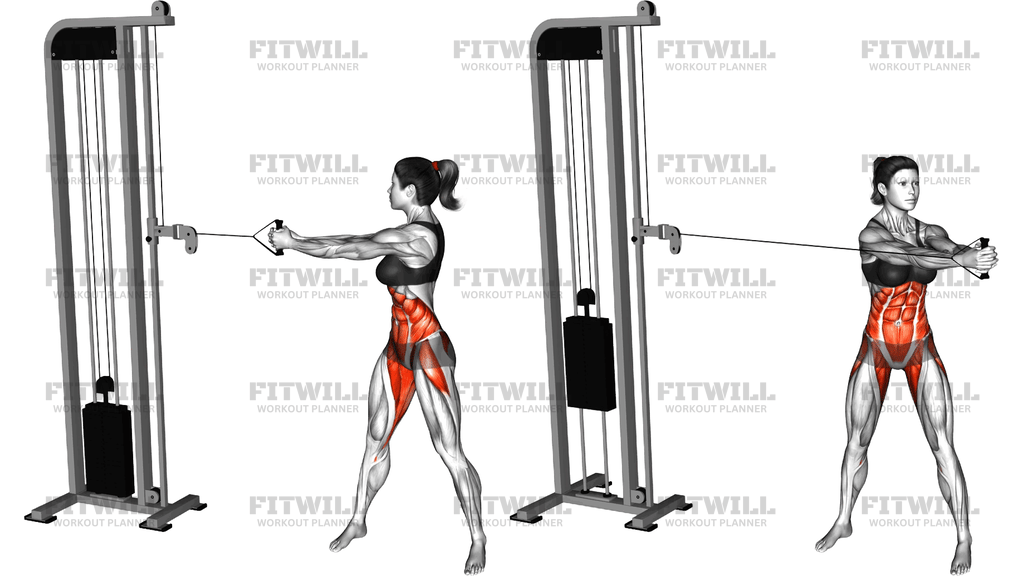
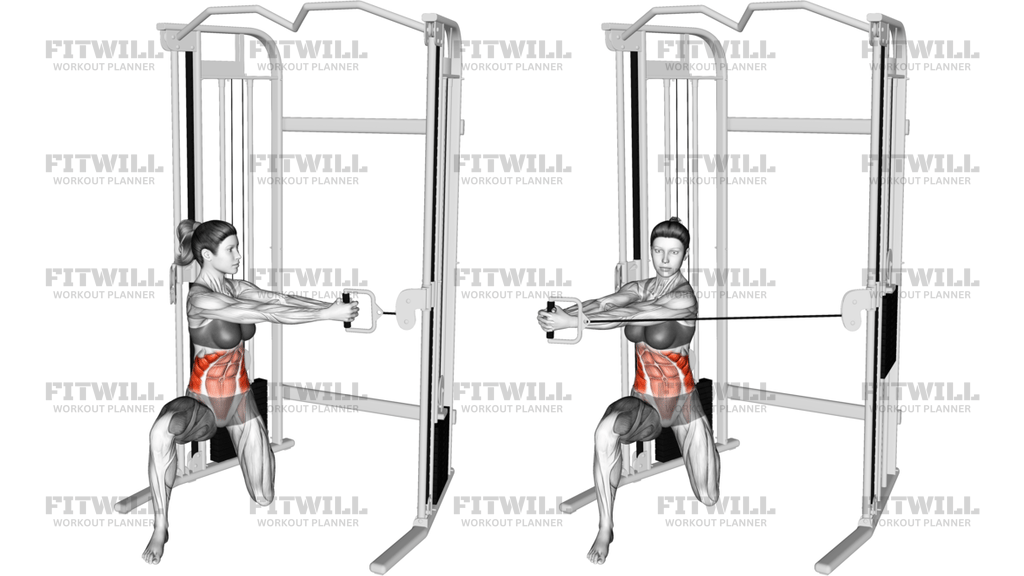
Cable Kneeling Twist is a half-kneeling cable rotation drill that trains the waist, core, and hips to control turning force instead of letting momentum take over. The cable machine and handle attachment give you a clear line of resistance, so every repetition asks your trunk to stay organized while your shoulders and ribs move together. It is useful for core training, rotational strength, and sports or daily tasks that involve twisting under control.
The half-kneeling stance changes the exercise from a simple arm pull into a trunk control drill. With one knee down, the opposite foot planted, and the pulley set at chest height, the obliques, deep core, glutes, and hip stabilizers all have to keep your pelvis from drifting as you rotate. If the setup is off, the movement turns into a lean or a yank instead of a true twist.
Start tall with your ribs stacked over your pelvis, both hands on the handle, and your arms extended in front of your chest. Exhale as you rotate your shoulders and rib cage away from the stack, letting the cable draw you only as far as you can stay square through the hips. Pause briefly where the tension is strongest, then return under control without letting the handle snap you back.
Cable Kneeling Twist works well as accessory core work after a main lift, in a warm-up that primes rotation, or in a conditioning circuit where you want the trunk to stay active under tension. Because the cable keeps resistance constant, it is especially useful for learning how to create force without losing posture. Light to moderate loads usually give better results than chasing a heavy stack.
The most common mistakes are using too much weight, letting the front knee cave, or spinning the whole body so fast that the hips and low back do the work. Keep the motion smooth, keep the down knee padded, and stop the set if you can no longer control the return. When performed well, Cable Kneeling Twist builds cleaner rotational strength and better trunk stability without needing a huge range.
[ Workout Log & Planner ]
Put your next workout in Fitwill
Keep your plan and training log ready when you are.


Instructions
- Set the pulley at chest height, clip on the handle attachment, and kneel sideways to the stack with the knee closest to the machine on the floor and the opposite foot planted in front.
- Hold the handle with both hands, step far enough away to create tension, and extend your arms straight in front of your chest.
- Stack your ribs over your pelvis, keep your front foot flat, and squeeze the glute on the down-knee side before you start the twist.
- Inhale to brace, then rotate your shoulders and rib cage away from the machine while keeping your hips mostly square to the front.
- Let the cable guide the turn without bending your elbows or turning it into a row.
- Pause for a beat at the end of the twist, then exhale and bring the handle back under control.
- Return to the start without leaning backward, collapsing through the waist, or letting the front knee cave inward.
- Reset your posture, re-brace, and repeat for the planned number of reps before lowering the handle and standing up carefully.
Tips & Tricks
- Keep the load light enough that the cable never yanks your shoulders out of position.
- If your front shin tips forward a lot, step the front foot a little farther away so the hip can stay stacked.
- Think about turning your sternum, not swinging your hands, so the twist comes from the waist instead of the arms.
- A soft elbow bend is fine, but do not let the handle drift back into a pulling motion.
- Squeeze the glute on the down-knee side to keep the pelvis from following the rotation.
- Shorten the range if your low back starts to arch or if your hips start sliding with every rep.
- Exhale through the twist and use the inhale on the return to keep the trunk organized.
- Pad the kneeling knee well; the position gets uncomfortable fast if the support point shifts during a set.
- Stop the set when the handle starts to snap you back instead of moving with steady tension.
Frequently Asked Questions
What muscles does Cable Kneeling Twist work?
It mainly trains the obliques and deep core, with the glutes and hip stabilizers helping keep the half-kneeling position steady.
Should I rotate my hips or just my torso in Cable Kneeling Twist?
Keep the hips mostly square and let the rib cage and shoulders do the turning. If the pelvis spins hard, the core is losing the job.
Why is Cable Kneeling Twist done in a half-kneeling position?
Half-kneeling reduces help from the legs and makes it easier to feel trunk rotation and anti-rotation control. It also exposes side-to-side sway more quickly.
How far should I twist on Cable Kneeling Twist?
Twist only as far as you can keep the cable smooth, the ribs stacked over the pelvis, and the front knee from drifting inward. Bigger is not better if the low back takes over.
Should my arms stay straight on Cable Kneeling Twist?
Yes, keep the arms mostly straight with a slight elbow softness. Bending hard at the elbows turns it into more of an arm pull than a trunk rotation drill.
Is Cable Kneeling Twist good for beginners?
Yes, if they start with a light stack and a short range. The kneeling setup makes it easier to learn control before adding load.
What weight should I use for Cable Kneeling Twist?
Choose a load that lets you rotate slowly without leaning back or jerking the handle. If the stack pulls you off balance, it is too heavy.
What should I do if I feel Cable Kneeling Twist in my lower back?
Reduce the range, lighten the load, and re-check that your ribs stay stacked over your pelvis. The twist should come from the waist, not from arching through the lumbar spine.
Is Cable Kneeling Twist the same as a woodchop?
It is similar in that both train cable-based trunk rotation, but this version is set at chest height and uses a more level, straightforward twist pattern.