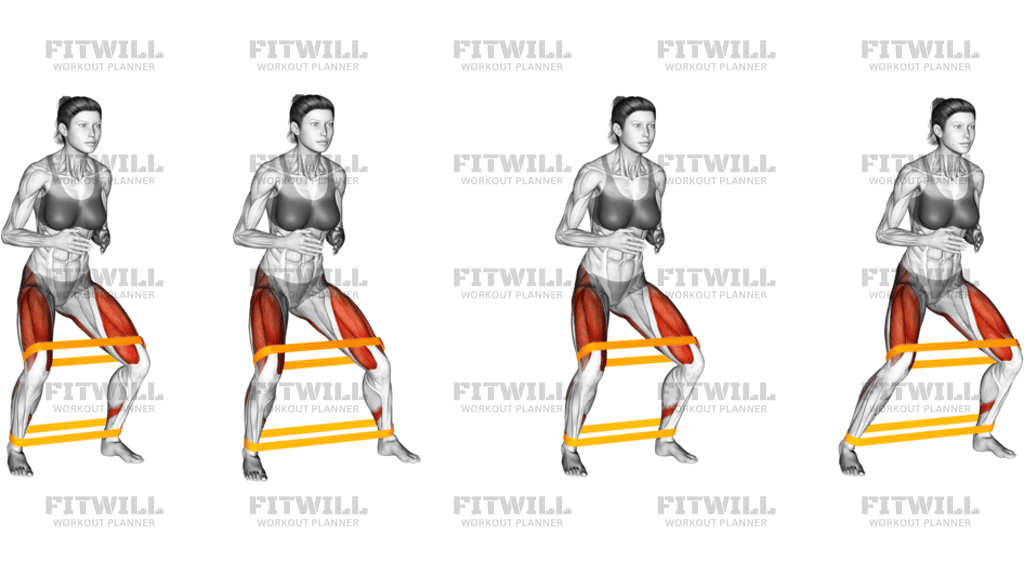
Resistance Band Shuttle
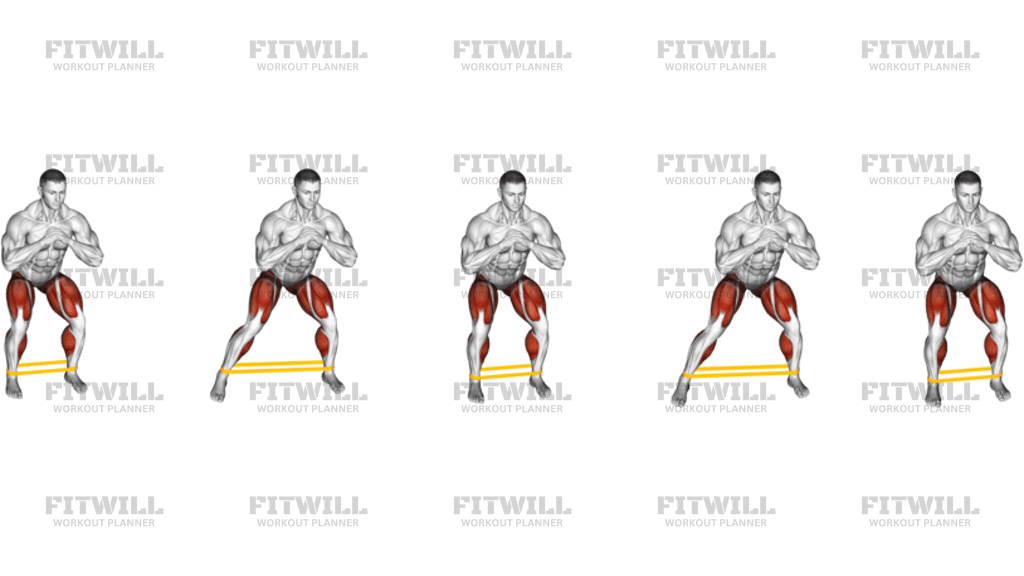
Resistance Band Shuttle is a lateral lower-body drill that uses band tension to train stepping control, hip stability, and coordinated footwork. The band adds resistance through the side-to-side travel, so every rep asks the legs and hips to produce force while the torso stays stacked and the feet stay organized. It is useful when you want a simple but demanding movement that blends strength, balance, and light conditioning in one pattern.
The setup matters because this exercise becomes messy fast if the band is too loose, the stance is too narrow, or the knees collapse inward. Stand on the center of the resistance band with both feet planted and hold the handles at your sides. Keep your chest tall, ribs down, and knees softly bent so you can move laterally without bouncing or leaning excessively.
Each shuttle should feel like a controlled side step rather than a wild shuffle. Step out against the band, plant the foot, then bring the other foot in without letting the band go slack. Keep the working knee tracking over the toes, keep the hips level, and let the feet skim the floor instead of crossing or twisting. Exhale as you step out and inhale as you gather back to center so the breathing rhythm stays tied to the direction change.
Resistance Band Shuttle works well as a warm-up for lower-body sessions, as an accessory drill before sport work, or as a low-impact conditioning option in small spaces. It can help reinforce cleaner knee and hip alignment for people who tend to collapse inward during side-to-side movement. Use lighter resistance if you want smooth, quick steps, and choose a stronger band only when you can keep the torso steady and the feet precise.
The goal is not to outrun the band. The goal is to keep tension on the band while moving with enough control that each step looks the same. If the handles start swinging, the steps get noisy, or the torso starts drifting side to side, shorten the range and slow the pace. Done well, Resistance Band Shuttle builds practical lateral control that carries over to warm-ups, athletic drills, and general lower-body training.
[ Workout Log & Planner ]
Put your next workout in Fitwill
Keep your plan and training log ready when you are.


Instructions
- Stand on the center of the resistance band with both feet hip-width apart and hold a handle in each hand at your sides.
- Set your toes forward, soften your knees, and bring the band just enough tension that the handles stay close to your thighs.
- Brace your midsection and sit into a shallow athletic stance without letting your chest tip forward.
- Step one foot out to the side, keeping pressure through the whole foot as the band stretches.
- Plant that foot, then bring the other foot in to re-establish your stance without relaxing the band.
- Repeat the side step to the opposite side, keeping both knees tracking over the toes.
- Move in a smooth shuttle rhythm instead of bouncing or crossing your feet.
- Keep your shoulders level and your hands quiet while the legs do the work.
- Finish the set by walking your feet back under you and lowering the handles under control.
Tips & Tricks
- A narrower stance makes the band feel heavier; widen your base slightly if the handles yank your shoulders upward.
- Keep the steps short enough that the planted foot stays flat instead of rolling to the outside edge.
- If your knees cave inward on the return step, slow down and press the knee gently toward the little-toe line.
- Do not let the handles swing across your body; keep them near the outer thighs so the resistance stays clean.
- Use a lighter band if you need to shuffle quickly without losing the side-to-side rhythm.
- Take a longer lateral step when you want more glute and hip work, but stop before the torso starts tilting.
- Keep the feet parallel or only slightly turned out so the movement stays lateral rather than becoming a squat.
- Pause for a beat in the planted position if you want more control and less momentum.
- If the band slides under your feet, anchor through the midfoot and reset the starting stance before continuing.
Frequently Asked Questions
What muscles does Resistance Band Shuttle work?
It mainly trains the hips, glutes, quads, and calves, with the core helping keep the torso steady during each side step.
How should the band be set up for Resistance Band Shuttle?
Stand on the center of the band with both feet and hold a handle in each hand. The handles should start close to your thighs so the band already has light tension.
Is Resistance Band Shuttle a strength exercise or a conditioning drill?
It can be both. Lighter band tension and quicker steps make it more of a conditioning drill, while slower, cleaner shuttles with more resistance make it a strength-focused accessory.
Can beginners do Resistance Band Shuttle?
Yes, but start with a light band and small side steps. The main goal early on is clean knee tracking and steady balance, not speed.
What is the most common mistake with the handles?
Letting the handles swing away from the thighs usually means the upper body is doing too much work. Keep your hands quiet and let the legs create the movement.
Should my feet stay parallel during Resistance Band Shuttle?
Mostly yes. A slight toe-out is fine, but if the feet turn out too much the drill stops feeling like a lateral shuttle and starts looking more like a squat.
Can I use Resistance Band Shuttle as a warm-up?
Yes. It works well before lower-body lifting or sport work because it warms up the hips and reinforces lateral control without heavy impact.
How do I make Resistance Band Shuttle harder?
Use a stronger band, take a wider side step, or slow the return step so the legs have to control more tension before resetting.