Barbell Seated High Front Raise
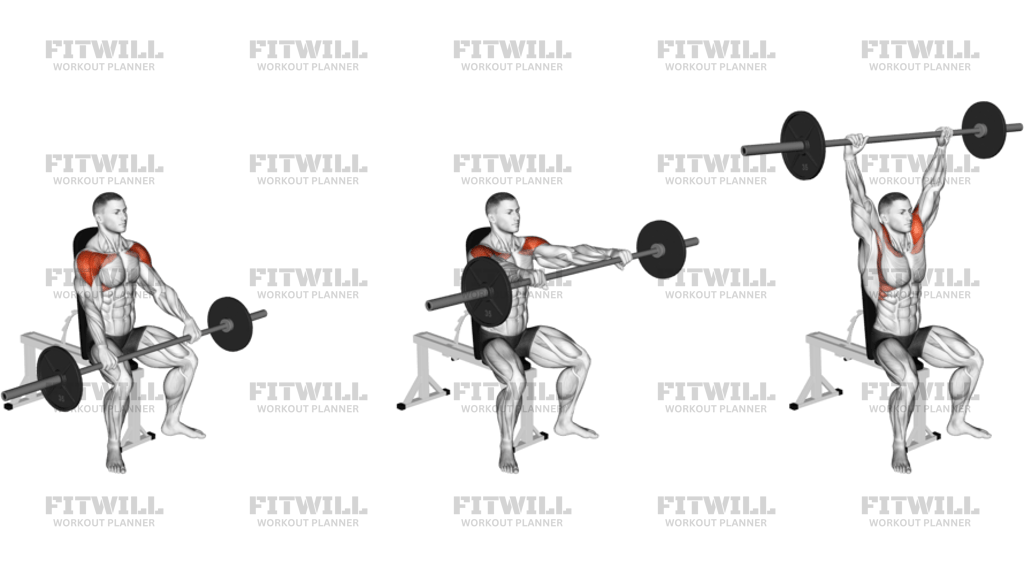
Barbell Seated High Front Raise is a seated shoulder raise that starts with the bar resting across the upper thighs and finishes with the bar traveling in a forward arc to an overhead lockout. The movement looks simple, but the seated position makes it much stricter than a standing version because the torso cannot help drive the bar upward. That makes this a useful accessory exercise for shoulder control, overhead coordination, and front-delt emphasis when you want precision more than heavy loading.
The image shows a flat bench setup with the lifter sitting tall, feet planted, and the bar held with an overhand grip in front of the thighs. From that start, the bar should move close to the face and continue upward until it stacks over the shoulders and midfoot. The key detail is not just getting the bar higher, but keeping the ribs from flaring and the lower back from taking over as the arms rise. If the torso has to lean back to finish, the load is too heavy or the range is too aggressive.
Because the bar ends overhead, shoulder comfort and scapular motion matter more than raw strength. Let the shoulders rotate upward as the bar rises instead of forcing the shoulder blades to stay pinned down. Keep the neck relaxed, wrists neutral, and elbows softly extended so the front of the shoulders can do the work without turning the rep into a press or a shrug. This exercise is best treated as a controlled raise to an overhead position, not a momentum lift.
Use it when you want a direct shoulder accessory that reinforces clean overhead positioning, usually in a lighter hypertrophy, warm-up, or technique-focused block. It can also help lifters who need more comfort and awareness in the top half of an overhead path. The exercise is not about max load, and the safest reps are the ones that look almost identical from the first rep to the last.
If the bar path feels cramped, the shoulders pinch, or the ribs pop up to finish the rep, shorten the range and reduce the load before adding volume. The goal is a smooth, repeatable arc from thighs to overhead with the torso quiet and the shoulders in control throughout the entire set.
[ Workout Log & Planner ]
Put your next workout in Fitwill
Keep your plan and training log ready when you are.


Instructions
- Sit on a flat bench with your feet flat, torso tall, and the barbell resting across the upper thighs in an overhand grip just outside shoulder width.
- Keep your chest open, ribs stacked over your pelvis, and your neck long before the bar leaves your legs.
- Start with straight but not locked elbows and neutral wrists so the bar can travel in a clean arc.
- Brace your midsection, then lift the bar forward and upward close to the body instead of swinging it away from you.
- Pass the bar in front of your face with a smooth path and continue pressing the arc until the bar reaches overhead.
- Finish with the bar stacked over the shoulders and midfoot, biceps near your ears, and the rib cage still under control.
- Pause briefly at the top without leaning back or shrugging the shoulders toward your ears.
- Lower the bar along the same forward path until it returns to the thighs with control.
- Reset your posture and breathing before the next repetition.
Tips & Tricks
- Use a light barbell or even an unloaded training bar first; this exercise exposes form flaws quickly.
- If your lower back arches to finish the rep, reduce the range or load instead of forcing the bar higher.
- Keep the bar path narrow and slightly in front of the face so the shoulders, not body swing, move the weight.
- Let the shoulders rotate upward naturally at the top rather than pinning the shoulder blades down hard.
- Keep the wrists stacked over the bar; bent-back wrists usually mean the load is too heavy.
- Exhale as the bar passes eye level or as you approach the overhead position to help control rib flare.
- Stop the set if the top position turns into a shrug or if the shoulders feel pinched.
- Hold the feet and hips still against the bench; any leg drive means the set has become a cheat rep.
- Use a smooth lowering phase and do not drop the bar back to the thighs between reps.
Frequently Asked Questions
What muscle does Barbell Seated High Front Raise target most?
It mainly targets the front of the shoulders, with the upper traps, serratus, and upper chest helping as the bar reaches overhead.
Why is the exercise done seated on a bench?
Sitting on a flat bench removes leg drive and makes the bar path much stricter, so the shoulders have to control the lift.
How should the bar move during the rep?
The bar should travel in a smooth forward arc from the thighs, past the face, and into an overhead position without swinging away from the body.
Should I lean back to get the bar overhead?
No. A small backward lean usually means the load is too heavy or the range is too long for the current set.
How wide should my grip be?
A grip just outside shoulder width is a practical starting point because it usually keeps the bar path clean and the wrists comfortable.
What should I do if the top position pinches my shoulders?
Shorten the range, reduce the load, and stop just below the painful position until the overhead path feels smoother.
Is this a press or a raise?
It is best treated as a high front raise to overhead. Keep the movement controlled instead of turning it into a heavy press.
Can beginners use this movement?
Yes, but only with a very light load and a strict overhead path. Beginners should earn the range before adding weight.