Assisted Bulgarian Split Squat
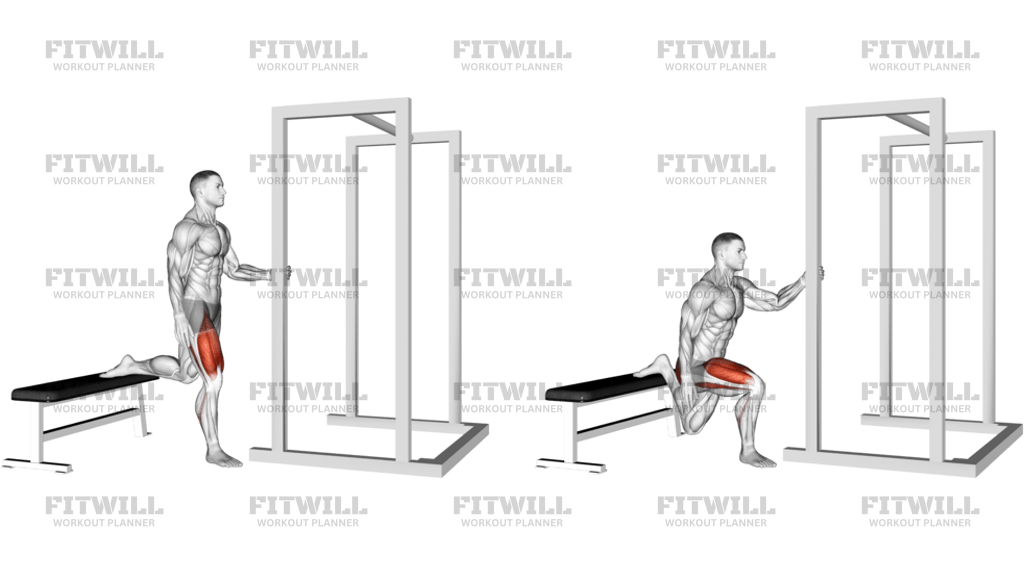
Assisted Bulgarian Split Squat is a rear-foot-elevated split squat performed with one hand lightly holding a rack, post, or other sturdy support. The support reduces balance demands so you can focus on the front leg, keep the pelvis level, and settle into a clean split stance. Because the exercise uses body weight, the difficulty comes from position, control, and range rather than external load.
The main training effect is on the front thigh and glute, with the adductors, calves, and trunk working to keep the knee tracking and the torso organized. The assistance is there to steady the body, not to pull you through the rep. If you lean, twist, or hang off the support, the movement turns into a balance drill and the target leg loses tension.
Set the front foot far enough forward that the heel stays down as you descend, and place the rear foot on a bench or pad behind you. Keep the front knee tracking in line with the toes, let the torso tilt slightly forward, and keep both hips facing ahead. A stance that is too short crowds the knee; a stance that is too long reduces depth and shifts the work away from the front leg.
Lower with control until the rear knee is close to the floor or until you reach a repeatable depth that keeps the front foot flat and the pelvis square. Drive up through the midfoot and heel of the front leg, stand tall without bouncing off the back foot, and reset each rep before starting the next one. This is a strong accessory choice for unilateral leg strength, knee control, and glute development when you want a stable split-squat pattern without heavy loading.
[ Workout Log & Planner ]
Put your next workout in Fitwill
Keep your plan and training log ready when you are.


Instructions
- Stand beside a rack, post, or upright and place the rear foot across a bench or pad behind you.
- Step the front foot forward far enough to keep the heel planted and the shin angled naturally.
- Hold the support lightly with the inside hand and square the hips toward the front.
- Tighten the ribs down, brace the torso, and let most of the load settle on the front leg.
- Lower straight down by bending the front knee and hip until the back knee approaches the floor.
- Keep the front knee tracking over the middle toes instead of collapsing inward.
- Press through the front heel and midfoot to stand up, keeping the support hand quiet.
- Exhale as you rise, reset your stance at the top, and repeat with the same depth on every rep.
Tips & Tricks
- Use the support only for balance; if you are hanging on it, the stance is probably too hard or too narrow.
- Keep the front foot flat. If the heel lifts, move the foot slightly farther away from the bench.
- Think down and up rather than driving forward, so the knee stays stacked over the foot.
- Let the torso lean a little, but keep the chest long and the pelvis facing forward.
- Choose a rear-foot height that lets you control the bottom position without cramping the hip flexor.
- Stop the descent when the pelvis starts to twist or the front knee caves inward.
- Keep the back leg relaxed; it is there to support the split position, not to push you out of the hole.
- Use a slow lowering phase so the front thigh stays loaded instead of bouncing off the bottom.
Frequently Asked Questions
What muscles does this work most?
The front thigh and glute do most of the work, with the adductors, calves, and core stabilizing the body.
Is the support hand supposed to help a lot?
No, it should only steady you. If you pull on the rack, reduce the load or shorten the range.
Where should my rear foot go?
Place it on a bench, pad, or other stable surface behind you, high enough to create a comfortable split stance without forcing your hips open.
How far in front should the front foot be?
Far enough that the heel stays down at the bottom and the knee can travel forward without pain.
Should I feel this in my back leg?
Only lightly. Most of the tension should stay in the front leg.
Can beginners do this exercise?
Yes, the assistance makes it easier to learn, but start with body weight and a small range you can repeat cleanly.
What is the most common mistake with the support?
Gripping or leaning hard into it, which unloads the front leg and turns the rep into a balance cheat.
How can I make it harder without adding weight?
Slow the lowering phase, pause at the bottom, or reduce how much help you take from the support.