Kettlebell Assisted Bulgarian Split Squat
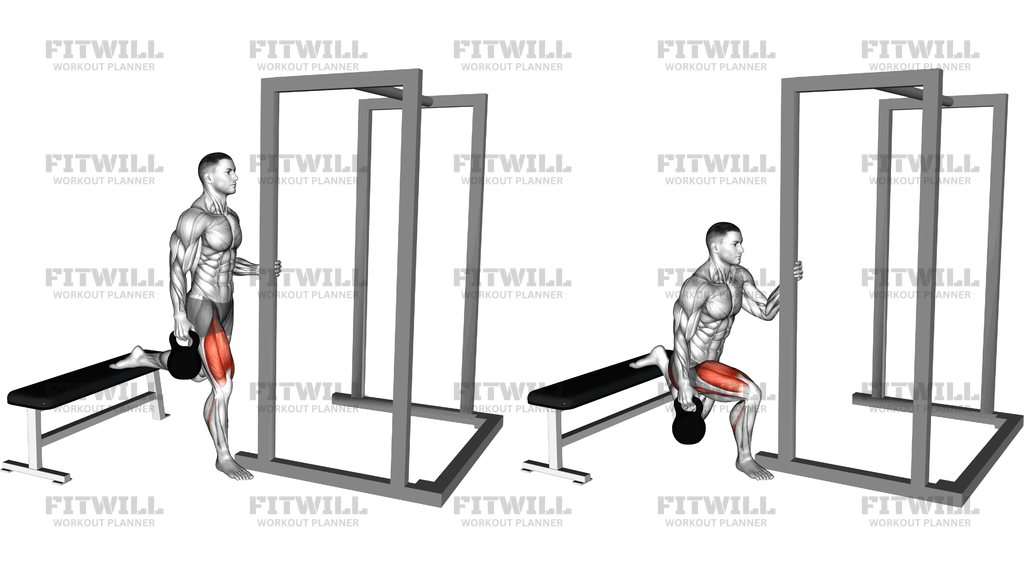
Kettlebell Assisted Bulgarian Split Squat is a rear-foot-elevated single-leg squat performed beside a support post or frame so you can keep balance without turning the set into a wobble. One foot stays planted on the floor in front, the back foot rests on a bench behind you, and a light hand on the support helps you stay tall while the front leg does the real work.
This variation is a strong choice for building front-leg quad and glute strength, plus hip stability, adductor control, and trunk discipline. The kettlebell adds loading on the working side, while the support lets you keep the torso organized enough to focus on depth, knee tracking, and clean force production instead of fighting for balance.
Setup matters here more than on many other split squats. If the front foot is too close to the bench, your knee will jam forward and the heel may pop up. If it is too far away, you will feel the load drift into the hip and lower back. The right stance lets you descend straight down, keep the front heel planted, and let the front knee travel naturally over the toes while the back leg stays relaxed on the bench.
On each rep, lower under control until the back knee approaches the floor or the front thigh reaches a depth you can own without the pelvis twisting. The support hand should be a guide, not a pull-up bar. Drive through the front foot to stand, finish with the hip and knee together, and keep the kettlebell quiet instead of swinging it around.
Use this exercise as accessory work for leg strength, unilateral balance, and knee-friendly quad training. It is also useful when you want a harder split squat variation without sacrificing form quality. Light to moderate loads usually work best at first, especially if your rear-foot position, stance length, and balance are still being dialed in.
[ Workout Log & Planner ]
Put your next workout in Fitwill
Keep your plan and training log ready when you are.


Instructions
- Stand in front of a bench with your rear foot ready to rest on it and a support post or frame beside your working side.
- Place the top of your back foot on the bench and plant your front foot far enough forward that your heel stays down when you bend both knees.
- Hold the support lightly with one hand and let the kettlebell hang at your side in the other hand.
- Square your hips and ribs, then brace your torso before you start the first descent.
- Lower straight down by bending the front knee and back knee together, keeping the front knee tracking over the toes.
- Keep most of your weight in the front foot and use the support only for balance, not for pulling yourself up or down.
- Descend until the back knee is close to the floor or the front thigh reaches a controlled depth you can repeat cleanly.
- Drive through the front midfoot and heel to stand back up, bringing the hip and knee to full extension with a smooth exhale.
- Reset your stance before the next rep so the bench contact, front foot position, and kettlebell stay consistent.
Tips & Tricks
- If your front heel lifts, step the front foot slightly farther from the bench before adding load.
- Keep the support hand light; if you are hanging on it, the working leg is not doing enough.
- Let the torso lean only a little as you descend, but do not fold forward at the waist.
- Think about dropping the back knee straight toward the floor instead of lunging forward.
- A slower lowering phase usually helps you feel the front quad and glute instead of bouncing out of the bottom.
- Keep the front knee in line with the second or third toe so it does not cave inward.
- Choose a kettlebell that lets you own the bottom position; if the pelvis twists, the load is too heavy.
- Use the bench only to support the rear foot, not to push yourself into the rep.
- Stop the set if the kettlebell starts swinging or if the support shoulder is taking over the movement.
Frequently Asked Questions
What muscles does the kettlebell assisted Bulgarian split squat work most?
It mainly trains the front-leg quadriceps and glute, with the adductors, hamstrings, calves, and core helping to stabilize the split stance.
Should I be pulling on the support post or frame?
No. The support is there for balance only. If you pull hard on it, the front leg loses tension and the exercise turns into a partial assisted rise.
Where should my rear foot sit on the bench?
The top of the back foot should rest comfortably on the bench behind you. You do not need to jam the toes hard into the surface.
How far forward should the front foot be?
Far enough forward that the front heel stays down and the knee can travel naturally over the toes as you lower.
Should the kettlebell stay on the same side as my front leg?
It can, but many lifters prefer the opposite hand because it challenges the hips and trunk more. Either way, keep the bell still and close to your side.
Can beginners do this version of the split squat?
Yes, if the kettlebell is light and the support hand is used only to steady the movement. Start with short sets and a stance you can repeat cleanly.
What if I feel the movement mostly in my back leg?
Shorten the rear-foot stretch slightly and shift more of your weight into the front foot. The back leg should help with balance, not drive the rep.
How deep should I go on each rep?
Go as low as you can while keeping the front heel planted, the pelvis level, and the support hand light. Depth should come from control, not from collapsing.